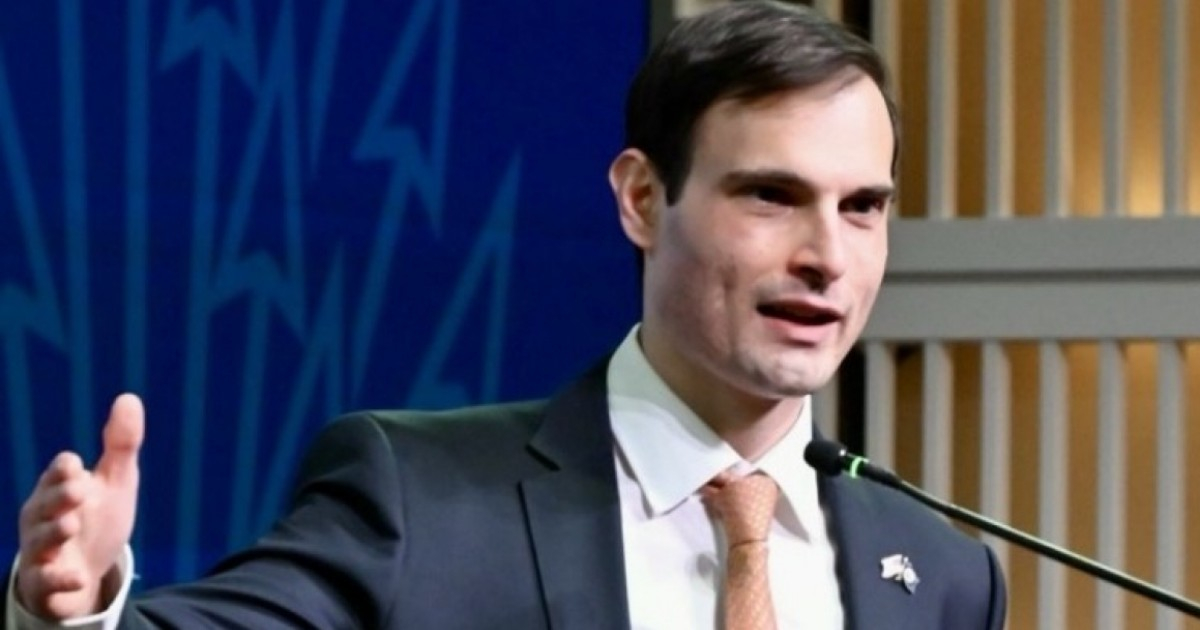
At just 29 years old, Jeremy Lewin, who has been at the forefront of the United States' policy towards Cuba and Venezuela over the past two years, has left the State Department as of Tuesday, just days before the midterm elections scheduled for November 3rd.
In a post on his X account, Lewin expressed gratitude to President Trump and Senator Marco Rubio, pledging to continue supporting the administration from the private sector. He stated, "It has been the privilege of a lifetime to work for President Trump and Secretary Rubio, and I am eternally grateful for their trust in me to execute their foreign policy vision."
"President Trump has broken away from decades of post-Cold War unease—permanently transforming U.S. foreign policy to prioritize Americans, keeping them safe, and promoting shared peace and prosperity in key regions," he added.
Lewin served as the Director of Policy Planning at the State Department—the highest strategic position after the Secretary himself—and was the youngest individual to hold this role in the department's history.
According to Axios, Lewin is set to marry soon and has secured a job in the private sector which he will join thereafter.
During his nearly two-year tenure, Lewin managed an extensive foreign policy portfolio for the region. In Cuba, he led bilateral talks in Havana with Raúl Guillermo Rodríguez Castro, known as "El Cangrejo" and grandson of Raúl Castro, and implemented Trump's administration sanctions against the Cuban regime, including those stemming from Executive Order 14404 signed on May 1, 2026.
In May, Lewin publicly demanded that the Cuban regime return to its people the resources that the military conglomerate GAESA allegedly accumulated in secret overseas accounts, estimated between $18 billion and $20 billion.
"The Cuban communist system is a cruel lie. While the people suffer from hunger, poverty, and repression, the regime's corrupt elites have funneled the country's resources into a secret network of foreign bank accounts for personal gain," he wrote on X.
In Venezuela, Lewin spearheaded diplomatic engagement with interim President Delcy Rodríguez following the capture of Nicolás Maduro. He played a crucial role in structuring a significant oil agreement between Washington and Caracas announced in August, involving a projected investment of over $100 billion.
Lewin joined the federal government in January 2025 as part of the cost-cutting initiative led by Elon Musk through the Department of Government Efficiency (DOGE). His first assignment was at the United States Agency for International Development (USAID), where he led the dismantling of the agency—approximately 83% of its contracts were eliminated by March 2025—and then helped restructure foreign aid programs under the State Department.
His departure comes at a sensitive time: talks between Washington and Havana have stalled since the Cuban regime rejected the U.S. demand for Miguel Díaz-Canel to step down, a condition Havana dismissed days ago.
The open question remains: who will take over Lewin's role as the key interlocutor with Havana at a time when Trump has hinted that he might send Rubio himself to negotiate directly with the Cuban regime?
Impact of Jeremy Lewin's Departure on U.S. Policy
What role did Jeremy Lewin play in U.S. policy towards Cuba and Venezuela?
Jeremy Lewin led U.S. policy initiatives towards Cuba and Venezuela, including implementing sanctions against the Cuban regime and facilitating a major oil agreement with Venezuela.
What are the potential implications of Lewin's departure from the State Department?
Lewin's departure could affect ongoing diplomatic efforts and negotiations with Cuba and Venezuela, especially as talks have recently stalled with Havana.
How did Jeremy Lewin contribute to changes at USAID?
Lewin led the dismantling of USAID, reducing its contracts significantly, and assisted in restructuring foreign aid programs under the State Department.