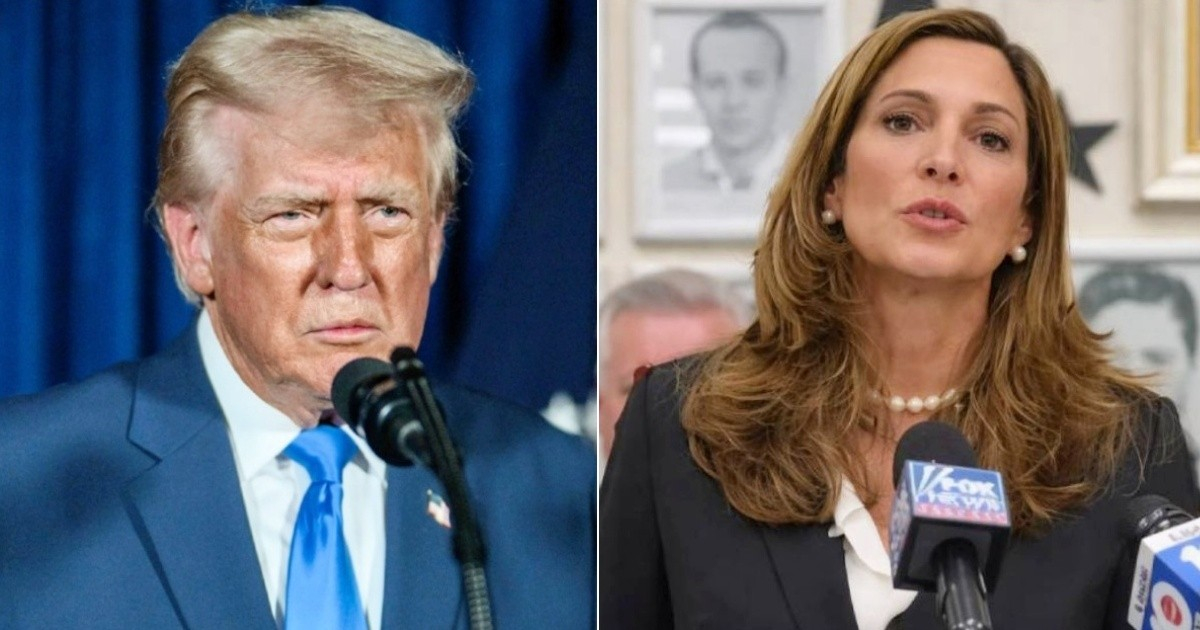
An automated call financed by Battleground Alliance, a Democratic super PAC funding election ads, claims that Cuban-American congresswoman María Elvira Salazar "supported everything Trump wanted" regarding immigration policies.
PolitiFact, an American organization specializing in evaluating the truthfulness of public statements, scrutinized the call's content. Their analysis found the claims to be "largely accurate" concerning the congresswoman's voting record, though they noted it left out key details about her stance on body cameras and masks for immigration officers.
Targeting voters in Florida's 27th District, which includes parts of Miami, the call is part of the political campaign leading up to the November 3 legislative elections. Salazar is running against Democratic journalist Eliott Rodríguez.
Claims Against Salazar's Immigration Votes
The audio accuses the Republican congresswoman of endorsing "$83 billion for ICE, 10,000 new agents, new detention centers, and arresting grandmothers, children, and people just trying to work." It also alleges she visited Alligator Alcatraz and described the cages as clean, and voted against ICE officers removing masks and using body cameras.
PolitiFact's investigation, conducted by journalist María Briceño, clarifies which claims are factually supported and which require further context.
Where Does The $83 Billion Figure Originate?
PolitiFact verified that Salazar supported two bills allocating billions to the Immigration and Customs Enforcement (ICE), although the $83 billion figure cited by Battleground Alliance stems from the specific budget allocations in both laws.
Salazar voted in favor of H.R. 1, dubbed the One Big Beautiful Bill, signed by Donald Trump in July 2025. This legislation allocated approximately $75 billion to ICE, including $45 billion for immigrant detention centers and nearly $30 billion for hiring new agents.
The Department of Homeland Security (DHS) stated that these funds would enable the hiring of 10,000 new ICE agents and increase detention capacity.
In June 2026, Salazar also backed the Secure America Act, which allocated another $38.5 billion to the agency.
Battleground Alliance explained to PolitiFact that their $83 billion figure combined the $45 billion for detention centers from the first law and the $38.5 billion from the second.
Thus, the $83 billion does not represent the total funding approved for ICE through both laws, but rather a specific combination of budget allocations. PolitiFact considers the calculation accurate, though understanding its origin helps clarify the claim.
Do Funds Support Arrests of the Elderly, Children, and Workers?
The call links the funding approved by Salazar to the Trump administration's detention and deportation policy, including arrests of seniors, minors, and working individuals.
PolitiFact reminds readers that the Trump administration maintained that any person residing illegally in the United States could be subject to deportation.
They also note that media outlets have documented arrests of seniors, children, and workers at their workplaces during immigration operations.
In this context, the automated call's claim is based on documented detention practices. However, there is a distinction between voting to fund and expand ICE operations and making decisions about individual detentions.
Salazar's vote contributed to providing resources for expanding ICE's operational and detention capacity, but it did not authorize each arrest mentioned in the political message.
Alligator Alcatraz: Did Salazar Call the Cages Clean?
Yes. PolitiFact confirmed that Salazar described the Alligator Alcatraz detention center facilities as clean after visiting the South Florida immigrant detention center in July 2025.
In an interview with CBS News, the congresswoman stated, "It's a jail; people are in cages, I sat on the beds; they are clean, they are soft... It was clean and very well presented."
She did, however, add an important clarification: "I'm talking about the areas I visited."
During that interview, Salazar also claimed the facilities met the highest applicable standards for federal detention centers of that type.
In another appearance on Fox & Friends, she explicitly stated that "the cages were clean," a statement Battleground Alliance used to support their accusation.
Nonetheless, conditions at the center were challenged by journalistic investigations and oversight agencies.
A Miami Herald and Tampa Bay Times investigation revealed that, of the approximately 750 people detained in July 2025, more than 250 had no criminal convictions or pending charges in the United States.
Additionally, a report by the Department of Homeland Security's Office of Inspector General published in September 2026 determined that the facilities failed to meet federal standards related to health and environmental safety, medical care, nutrition, and personal hygiene.
The document also described the confinement of some detainees in small metal enclosures.
These findings contrast with Salazar's favorable assessment following her visit, though they reflect a later official evaluation.
The controversy saw another episode in September when a South Florida woman, whose father had been detained in Alligator Alcatraz, confronted the congresswoman publicly over her support of the facilities.
Salazar responded to NBC, stating the woman had previously rejected the help offered for her father's case and labeled the confrontation as a "political effort coordinated with a clear agenda."
Body Cameras and Masks: What Did Salazar Really Vote For?
This is where PolitiFact identifies the main omission of context in Battleground Alliance's message.
The call claims Salazar "voted against ICE agents removing masks and using body cameras." However, the legislative sequence is more complex.
According to the verification, the congresswoman did not directly vote against a standalone bill to ban masks or require body cameras.
What she opposed was a Democratic motion to recommit a legislative proposal containing various conditions related to ICE operations.
Those proposals included requiring agents to use body cameras, remove masks, show identification, and have a warrant for arresting immigrants.
A recommit motion is a parliamentary procedure to send a bill back to committee, sometimes with instructions for modifications before final approval.
Therefore, Salazar's negative vote meant she did not support that motion containing those requirements, but it does not equate to voting against a specific law banning masks or requiring body cameras.
There is also another fact the automated call does not mention.
In April 2026, Salazar voted in favor of the final version of a law that allocated $20 million for body cameras for immigration agents.
However, that law did not include a ban on using masks during operations.
The distinction is significant: Salazar opposed a legislative proposal combining various ICE restrictions and obligations, but later supported funding for one of those oversight mechanisms.
Thus, the call is based on an actual vote, though its wording may lead listeners to believe the congresswoman generally opposed using body cameras, something her legislative record does not support.
Salazar's Legislative Votes and Public Statements on Immigration
The controversy arises as Salazar faces Democratic journalist Eliott Rodríguez in Florida's 27th District during the final stretch of the campaign.
Battleground Alliance's message contrasts Salazar's legislative support for measures strengthening ICE's detention and deportation capabilities with her public statements advocating immigration reform providing alternatives for certain undocumented immigrants.
In July 2025, the congresswoman introduced the Dignity Act, a proposal offering regularization mechanisms for immigrants without criminal records who meet certain requirements.
More recently, in September 2026, she recorded a video outside the White House accusing Trump of going "too far" with deportations.
The two positions are not necessarily incompatible from a legislative standpoint: a congressman can support resources for enforcing immigration laws and simultaneously promote regularization mechanisms.
The differences between her legislative votes and public statements are part of the electoral debate on her immigration stance.
Cuban-American Vote: Opposition to Deportations and Republican Support
Differences in positions on immigration and party preferences are also reflected in Miami-Dade's Cuban-American electorate.
The FIU Cuba Poll 2026, published this Wednesday and based on interviews conducted in September with 1,004 people, shows 76% of Cuban-Americans oppose deporting Cuban citizens without criminal records, including 63% of those identifying as Republicans.
Despite this, 68% of respondents say they will vote for Republican candidates in the November elections.
The results illustrate that opposition to certain deportation policies does not necessarily translate into abandoning the Republican Party. The survey pertains to Cuban-Americans in Miami-Dade and should not be interpreted as a specific measure of voting intentions in the 27th District.
Battleground Alliance's call occurs in a context where, according to the FIU survey, a majority of surveyed Cuban-Americans oppose certain deportations while maintaining their preference for Republican candidates.
Ultimately, PolitiFact's verification supports much of the automated call's claims but also highlights that Salazar's immigration history warrants more context than the campaign message provides.
The congresswoman voted for significant increases in ICE funding, and her statements about the cleanliness of Alligator Alcatraz are documented. However, her stance on body cameras cannot be summarized solely as a vote against them, as she also supported legislation allocating resources to these devices.
Understanding María Elvira Salazar's Immigration Record
How accurate is the claim that Salazar supported $83 billion for ICE?
The figure originates from specific budget allocations in two laws Salazar supported, totaling $83 billion when combined. PolitiFact considers the calculation accurate, though it's essential to understand the context of these allocations.
Did Salazar vote against body cameras for ICE agents?
While Salazar voted against a motion containing various ICE restrictions, including body cameras, she later supported legislation funding $20 million for body cameras for immigration agents.
What did Salazar say about Alligator Alcatraz?
Salazar described the detention center facilities as clean, stating she sat on the beds and found them soft and well-presented, though later reports contradicted her assessment.