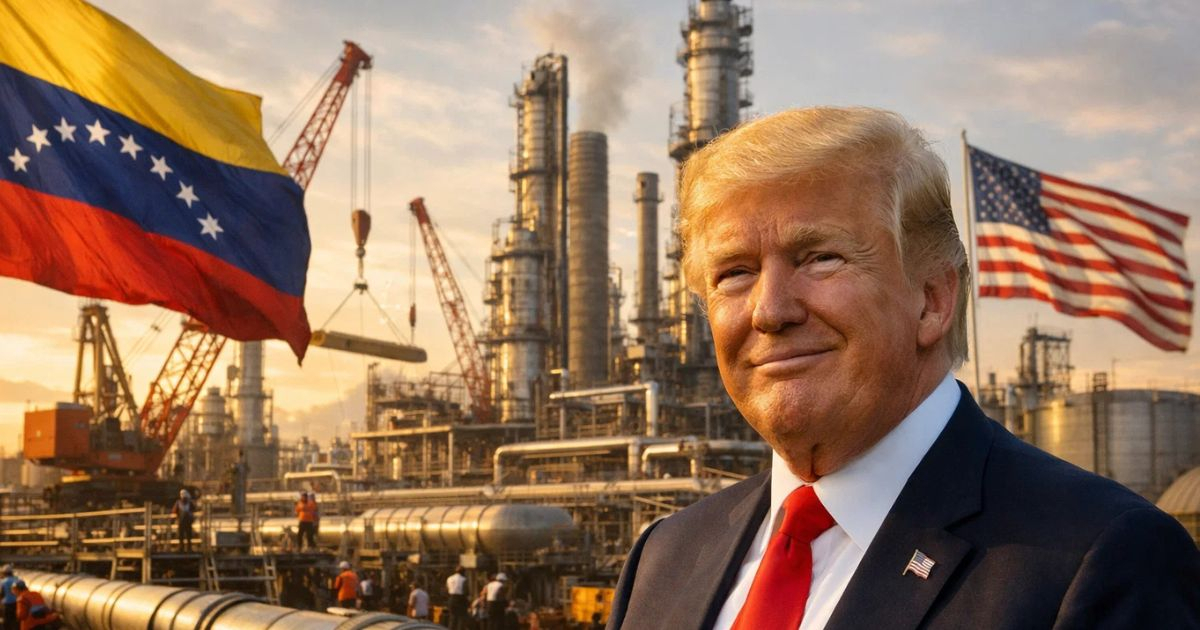
During a campaign rally for the upcoming midterm elections, Donald Trump celebrated the arrival of a Venezuelan oil tanker carrying a million barrels of crude at the port of Corpus Christi, Texas. The former president described the U.S. military intervention in Venezuela as the "greatest oil victory in history."
Pointing to the tanker docked at the port, Trump emphasized that Venezuelan oil is coming to the U.S. "at zero cost to the American taxpayer," justifying the acquisition with a phrase reminiscent of imperial conquest: "To the victor belong the spoils."
Addressing his supporters, Trump said, "Thanks to our significant victory in the recent conflict with Venezuela, the oil... Look at that ship. Isn't it magnificent?" This statement referenced the operation that led to the capture of Nicolás Maduro on January 3, 2026.
Trump also took the opportunity to paint a picture of a prosperous future for Venezuela, stating that "billions and billions of dollars are now being invested by major oil companies, many from Texas," resulting in job creation in the South American country that "no one would have believed possible just a year ago."
Speculation About Statehood
The most striking moment came when Trump made a jest about possible annexation: "Who knows, maybe one day soon it will become a thriving 51st state. It's possible. Let's make it the 51st state and instead of a president, we'll elect a governor."
This joke is not new. Trump first floated the idea of a "51st state" in March 2026, following Venezuela's victory in the World Baseball Classic. He reiterated the notion in May, citing the country's oil reserves valued at $40 trillion, and in August, he shared a map of Venezuela covered with the American flag labeled "State 51."
Venezuela's interim president, Delcy Rodríguez, publicly rejected the possibility of annexation in May 2026.
The Oil Agreement
The oil shipment highlighted by Trump is part of an agreement announced on August 29, 2026, between Washington and North American Blue Energy Partners (NABEP), led by Venezuelan entrepreneur Alejandro Betancourt.
Under this deal, the United States secured a 35% stake in the parent company and purchase rights to 20% of its production at cost, without profit margins, in exchange for diplomatic and military support. The agreement entails the development of 17 oil fields over 25 years, with projected investments exceeding $100 billion and access to more than 65 billion barrels of proven reserves.
Secretary of State Marco Rubio joined Trump at the Corpus Christi event to showcase the Venezuelan oil tanker, which also served a clear electoral purpose: to support Republican candidate Ken Paxton against Democrat James Talarico in a closely contested Texas Senate race.
Trump had previously highlighted the Venezuelan deal as his greatest achievement at the United Nations General Assembly in September, and he once again made it the centerpiece of his political narrative heading into the midterms. "Who knows, maybe one day soon it will become a thriving 51st state," he reiterated, leaving open a possibility that the Venezuelan government has thus far categorically dismissed.
Frequently Asked Questions about the U.S.-Venezuela Oil Deal
What was Trump's justification for the oil acquisition from Venezuela?
Trump justified the acquisition by stating that Venezuelan oil arrives at zero cost to the American taxpayer, using the phrase "To the victor belong the spoils" to emphasize the benefits of the U.S. military operation in Venezuela.
What does the U.S. gain from the agreement with NABEP?
The United States gains a 35% stake in the parent company and rights to purchase 20% of its production at cost, along with diplomatic and military support commitments.