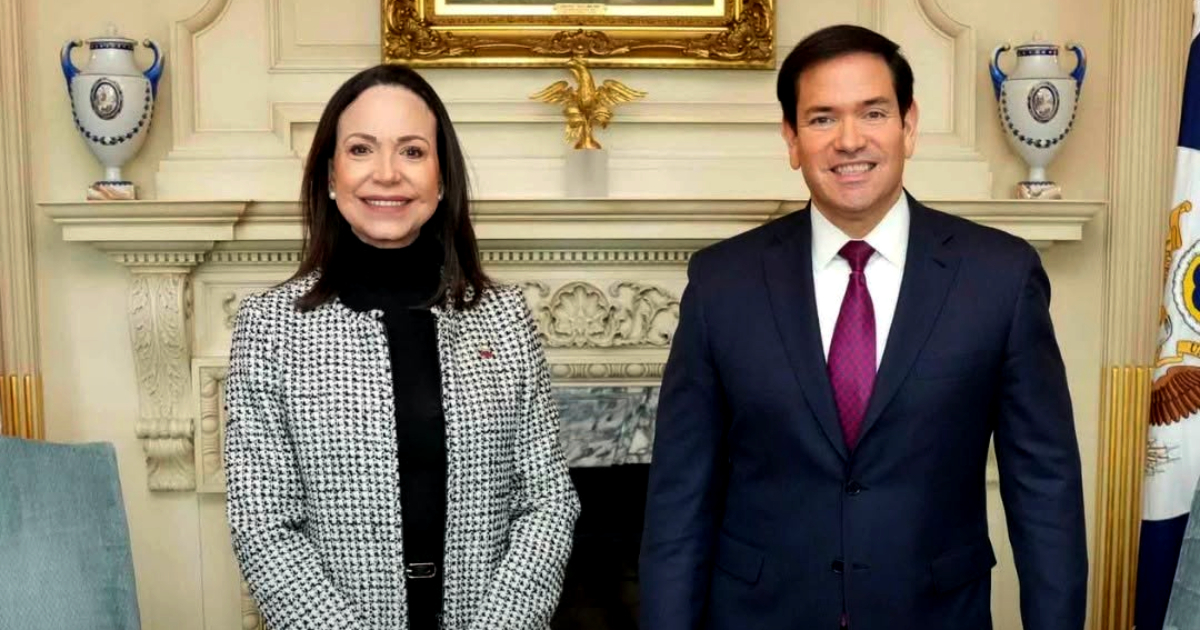
U.S. Secretary of State Marco Rubio issued a subtle warning on Monday to Venezuelan opposition leader María Corina Machado, just one day following her return to Venezuela after nearly ten months in exile.
According to a report by Axios, Rubio, without directly naming Machado, told reporters bluntly, "You can’t protest your way to democracy."
These comments were made during a teleconference with the media, the transcript of which was released by the State Department on Tuesday. This reflects the changing dynamics for the Trump administration with Machado's return and her stance on the transition process.
Machado made her way back to Venezuela on Sunday, traveling by private jet from Panama to Colombia and crossing into Venezuela by land, as reported by sources close to Reuters. She made a public appearance at the Santa Rosa Church in Barquisimeto, Lara state, and then traveled over 400 kilometers to Caracas, where she was greeted by thousands of supporters. "I am here, with you," she posted on X.
The Political Tension Between Washington and Machado
The friction between Washington and Machado centers around two main issues: the electoral timeline and the oil agreement between the U.S. and Delcy Rodríguez's government. Machado demands elections be held in 2027, whereas the Trump administration has not set a date, instead conditioning them on three prior reforms.
The first reform is to overhaul the Supreme Court, which is currently filled with loyalists from the previous government, by the end of 2026. The second involves reforming the National Electoral Council at the start of 2027. The third addresses Venezuela's sovereign debt, estimated at $300 billion, which exceeds the country's GDP.
An additional condition suggested by a senior State Department official, as noted in the call transcript, is the reform of security services. "For a democratically elected government to succeed, it cannot inherit an economic apocalypse that could bring it down," the official emphasized.
Concerns Over Oil Deal Transparency
Machado has also criticized the oil deal between Washington and Rodríguez's government, citing a lack of transparency and democratic legitimacy. This criticism has raised concerns among Trump administration officials.
A White House source quoted by Axios clearly stated, "Venezuela is this administration's main foreign policy achievement, and if the progress we've made unravels and Machado becomes a destabilizing factor, no one wins."
Rubio stressed that the process must not be delayed or diverted. "That’s not going to happen. We have agreed deadlines, and so far, all have been met," he said, referring to Rodríguez's government.
The Secretary of State also praised the actions of the Venezuelan government, highlighting the removal of Iranian and Cuban influences and the extradition of Alex Saab. Saab, a former ally of Maduro and a cooperative witness against him, pleaded guilty to money laundering in a Miami federal court in September 2026. Rubio emphasized that he focuses on Rodríguez's actions, not her words.
In response, Rodríguez dismissed Machado's return as a "show," suggesting she should feel "remorse" for supporting "external military aggression" against Venezuela, referencing Maduro's capture by U.S. forces on January 3, 2026.
Election Timeline: What's Next?
The State Department specified that for new elections to be called, Rodríguez would have to declare the presidency vacant, triggering a constitutional six-month period. In the most optimistic scenario, elections could be held by June 2027, although the Trump administration doesn't rule out the possibility of them occurring in 2028.
"If, at the end of the day, we have a new Supreme Court, a new Electoral Council, new elections, and a new system of government, that's what we want. And no matter what people say along the way, as long as that happens, this is a results-based process," Rubio concluded. "But if anyone tries to derail this process, they are doing great harm to Venezuela."
Key Questions on Venezuela's Political Future
What are the conditions set by the Trump administration for Venezuela's elections?
The conditions include reforming the Supreme Court by the end of 2026, changing the National Electoral Council at the beginning of 2027, and addressing the $300 billion sovereign debt.
Why has María Corina Machado criticized the oil deal with Delcy Rodríguez's government?
Machado has criticized the oil deal due to concerns over its lack of transparency and democratic legitimacy.
What actions has the Venezuelan government taken that Marco Rubio praised?
Rubio praised the Venezuelan government's removal of Iranian and Cuban influences and the extradition of Alex Saab, a former ally of Maduro.