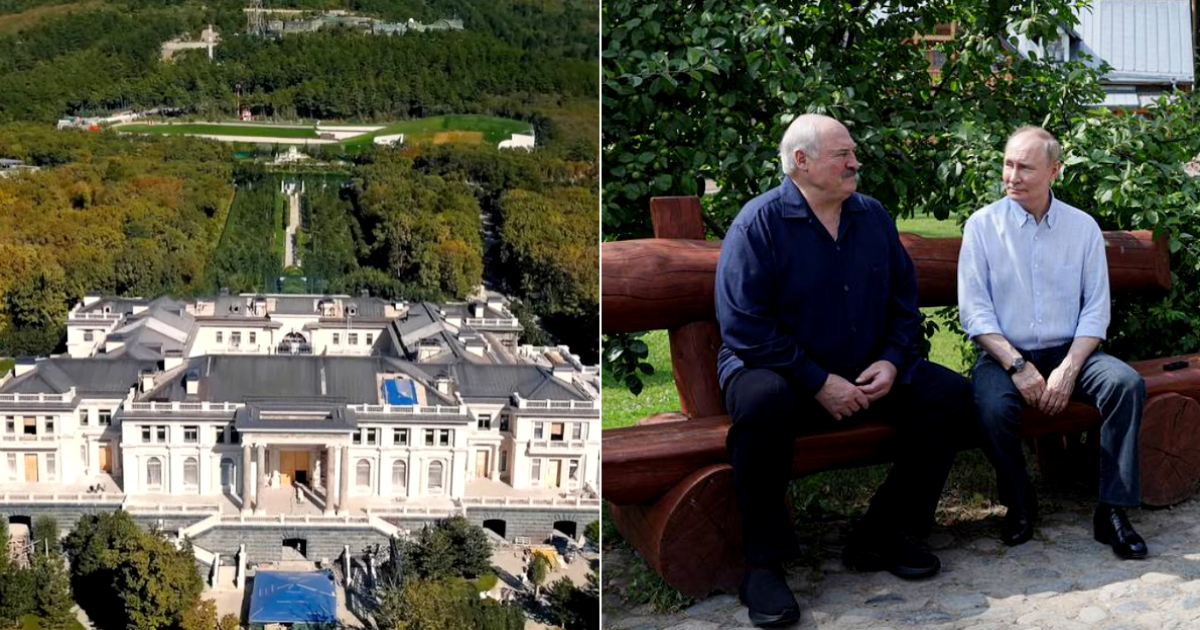
In a move showcasing his rising apprehension, Vladimir Putin has transformed his favored residence in Valdai, situated in northwestern Russia, into one of the nation's most heavily fortified locations. Satellite images reviewed by Radio Free Europe/Radio Liberty indicate that at least 15 new air defense towers have been erected around the estate, bringing the total number of anti-aircraft positions to approximately 50.
This significant enhancement in security is strikingly disproportionate: the sparsely populated town in the Novgorod region now boasts nearly half the air defense capacity of Moscow, a city teeming with over 19 million residents, as reported by the British newspaper The Telegraph.
The newly installed defenses are positioned within a 50-kilometer radius of the residence and are believed to be equipped with short-range Pantsir and Tor systems, considered Russia's premier assets for countering aerial threats like low-flying drones.
Each defense unit carries a hefty price tag, exceeding $21 million, raising questions about the allocation of resources that could potentially be used to safeguard Russian civilians instead of the personal mansion of the Kremlin's leader.
This augmented perimeter also encompasses the Khotilovo military airfield—linked to the estate by a private rail line—and Lisiy Island, which hosts a complex of laboratories reportedly connected to Russia's biological weapons program, based on the same satellite image analysis.
Nestled on a forested peninsula between two lakes, the Valdai complex allegedly includes a multi-story palace, a wooden dacha spanning about 1,200 square meters, an underground bunker, and a replica of the Kremlin's presidential office to obscure Putin's exact location. It is believed that his partner, former rhythmic gymnast Alina Kabaeva, lives there with their two children.
The heightened security measures mirror the Russian leader's growing paranoia over the threat posed by Ukrainian long-range drones, which have proven capable of striking deep within Russian territory.
In December 2025, the Kremlin accused Ukraine of launching over 90 drones against the Valdai residence, a claim denied by both Kyiv and the CIA. Nonetheless, protective measures have continued to escalate.
In June of this year, Yandex Maps—Russia's version of Google—obscured approximately 2.1 square kilometers of satellite images of the area, while Putin's residences in Sochi and Gelendzhik remain visible.
Anti-drone nets were also detected over truck parking areas along the M10 highway, about 10 kilometers from the estate, in response to tactics like Ukraine's Operation Spiderweb, where drones concealed in trucks targeted Russian military airfields.
Putin's fixation on his personal security starkly contrasts with the opaque fortune attributed to him. Officially, he declares an annual salary of around $140,000 and modest assets, but unofficial estimates peg his real wealth between $40 billion and $200 billion, controlled through a network of proxies and oligarchs.
A January 2021 investigation by Alexei Navalny exposed a palace in Gelendzhik valued at approximately $1.37 billion.
While Putin reinforced his estate, on Monday night, a barrage of Ukrainian drones breached Russian defenses in Voronezh, resulting in at least two fatalities and 17 injuries. The attack also targeted a petrochemical plant producing synthetic rubber and polymers used in armored vehicles and solid fuel for Iskander missiles. According to The Telegraph, this was the third Ukrainian strike in three days against a Russian synthetic rubber factory.
The war, which the Kremlin initially anticipated as a "three-day operation" when it launched the full-scale invasion of Ukraine in February 2022, has dragged on for more than four years without resolution. In response, Putin has chosen to encircle his personal refuge with an air defense shield rivaling that of his country's capital.
Frequently Asked Questions about Putin's Valdai Estate Security
Why has Putin increased security around his Valdai residence?
Putin has fortified his Valdai residence due to mounting concerns over potential drone attacks, particularly from Ukrainian forces, which have demonstrated the capability to strike deep within Russian territory.
What types of defense systems are installed around the Valdai estate?
The newly installed defense systems around the Valdai estate are believed to include short-range Pantsir and Tor systems, which are among Russia's most effective air defense resources.
How does the security at Valdai compare to that of Moscow?
The air defense capacity at the Valdai residence is nearly half of what is present in Moscow, despite Moscow being a major city with a population exceeding 19 million.