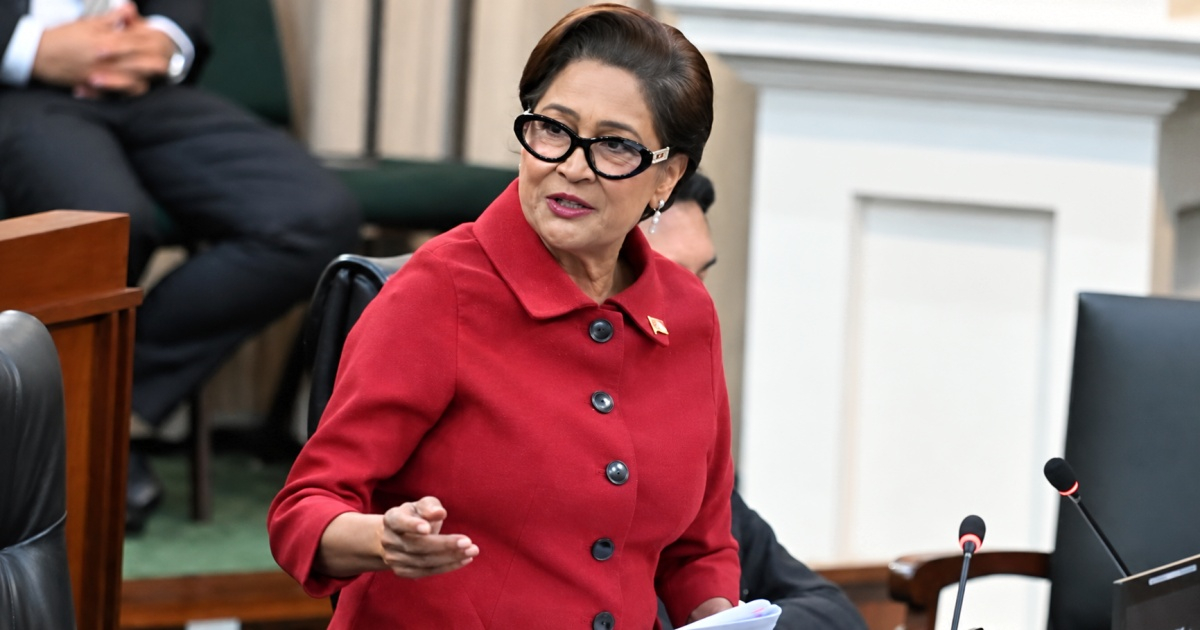
Trinidad and Tobago's Prime Minister, Kamla Persad-Bissessar, delivered a sharp rebuke on Monday to a group of former Caribbean leaders who had signed an open letter urging international support for the United Nations' annual resolution against the U.S. embargo on Cuba. The vote on this resolution is set for Wednesday, October 28.
In an interview with Guardian Media, Persad-Bissessar accused the signatories of hypocrisy, arguing that they promote for Cuba a political system they would never endorse in their own countries.
"I encourage these former Caricom leaders to push for their own countries to become dictatorships run by the political parties they do not belong to," she stated.
The prime minister was even more direct in her follow-up comments: "I believe they should stop embarrassing themselves with this hypocrisy. My advice is not to support an oppressive political system imposed elsewhere that they would not want at home; it only makes them look ignorant and confused."
Growing Divisions in Caribbean Politics
Persad-Bissessar's statements highlight the growing rift between the Trinidad and Tobago government and former leaders of the Caribbean Community (Caricom), who continue to advocate for regional support of the resolution against U.S. sanctions.
The controversy was ignited by an open letter published by the Jamaica Observer on October 24, addressed to nations worldwide. The letter lists ten former Caricom leaders among its signatories, including Freundel Stuart (Barbados), Dean Barrow and Said Musa (Belize), Keith Mitchell and Tillman Thomas (Grenada), Donald Ramotar (Guyana), Bruce Golding and P.J. Patterson (Jamaica), Kenny Anthony (Saint Lucia), and Ralph Gonsalves (Saint Vincent and the Grenadines).
However, Guardian Media also identified former Trinidadian Prime Minister Keith Rowley as a signatory, though his name was not included in the Jamaica Observer's list of ten leaders.
The letter describes the U.S. measures against Cuba as "unilateral coercive actions" that contradict the UN Charter and international law, urging all nations to support the resolution.
Internal and External Pressures
Within Trinidad and Tobago, there is pressure on the government from different quarters. Former Foreign Minister Amery Browne publicly demanded on Monday that the country vote in favor of the resolution, emphasizing the importance of Caricom solidarity and the right to political and economic expression free from unjust sanctions.
Adding to this, 23 Trinidadian social movements, representing workers, farmers, women, religious groups, and others, sent an open letter to Persad-Bissessar, urging a favorable vote. They argue that U.S. restrictions aim to create economic hardship for Cubans to force political change.
The regional context is also influenced by strong U.S. diplomatic pressure ahead of the vote. Karin Sullivan, the U.S. Chargé d'Affaires in Barbados and the Eastern Caribbean, published an opinion piece on October 23, claiming that Cuba's power outages are the fault of the regime, not the embargo. Additionally, U.S. Ambassador to the UN, Mike Waltz, hosted a forum on Cuba at the United Nations headquarters on October 19 and 20.
A Resolution Facing Waning Support
The resolution, officially titled "Necessity of Ending the Economic, Commercial, and Financial Embargo Imposed by the United States of America against Cuba," has been voted on annually in the General Assembly since 1992. Although it is not legally binding and cannot force Washington to lift its sanctions, it carries significant political and diplomatic weight.
However, its international support has dwindled in recent years. In 2024, it received 187 votes in favor; in 2025, this dropped to 165 in favor, with seven against and 12 abstentions, marking the worst outcome for the Cuban government in over a decade.
The United States maintains that its sanctions are intended to pressure Havana over human rights violations and political repression, while opponents argue that restrictions worsen economic hardships for the Cuban population.
Wednesday's vote will again test international support for the resolution and reveal whether Trinidad and Tobago will uphold its historical backing of the measure or adopt a different stance amid its prime minister's criticisms of Cuba's political system.
Understanding the U.N. Vote on Cuba
What is the U.N. resolution on Cuba about?
The U.N. resolution calls for the end of the U.S. economic, commercial, and financial embargo against Cuba, which has been in place since the early 1960s. It is a non-binding resolution that carries political and diplomatic significance.
Why does the U.S. impose sanctions on Cuba?
The United States maintains sanctions against Cuba to pressure the Cuban government over human rights violations and political repression, arguing that these measures are necessary to promote democratic change on the island.
How has international support for the resolution changed?
International support for the resolution has decreased over the years. In 2024, it received 187 votes in favor, but this number fell to 165 in 2025, with an increase in votes against and abstentions.