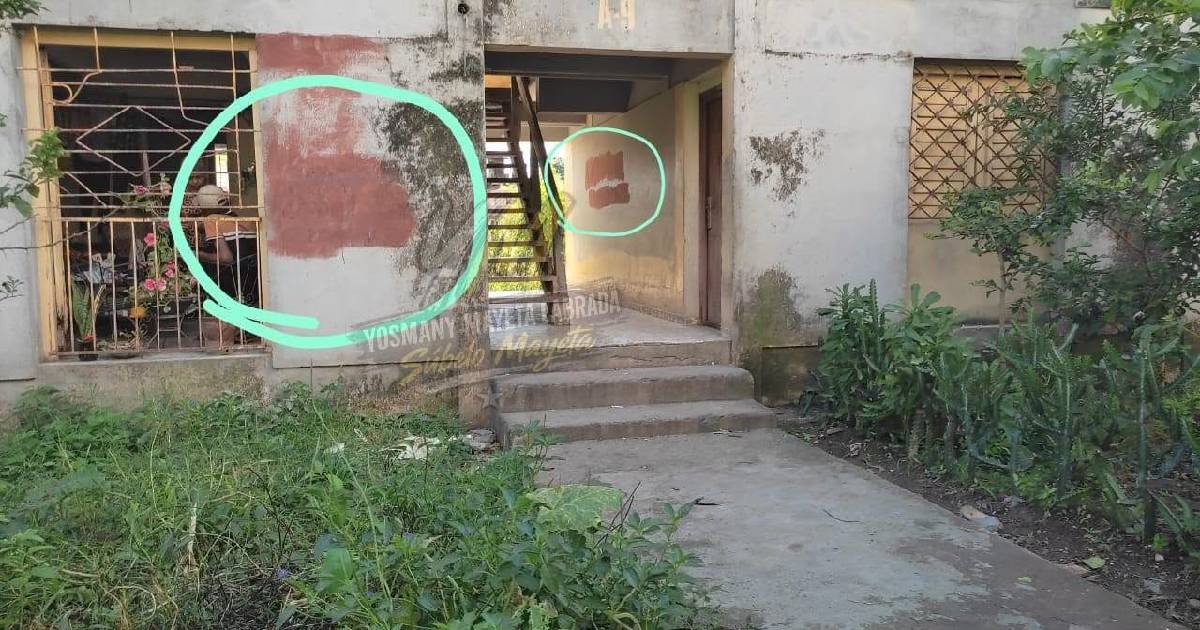
Residents of the La Cuba neighborhood in Palma Soriano, Santiago de Cuba, reported a heavy police presence on Monday after anti-government slogans appeared on the walls of multi-family buildings near the park, close to Calle 1 Final.
Phrases such as "Down with the dictatorship," "Down with Raúl and Fidel," and "Down with communism" were seen on the facades of several residential blocks in the area, as reported by journalist Yosmany Mayeta Labrada.
A local resident who reached out to Mayeta Labrada stated that "police officers arrived with a MININT vehicle, along with the sector chief and the delegate, and several individuals were taken for questioning."
A contingent of uniformed officers remained stationed in a park near the site of the graffiti.
The authorities acted swiftly to erase the slogans: "The graffiti was quickly covered with paint," according to the journalist, and photos distributed show sections of walls freshly painted and a vehicle—apparently a dark green military jeep—surrounded by people on a street with deteriorated cobblestones.
As of now, it remains unconfirmed how many individuals were questioned, if any arrests have been made, or who was responsible for the graffiti.
The source also mentioned possible graffiti at a commercial establishment and rumors of a supposed theft of flour and other goods, although Mayeta Labrada clarified that these incidents have not been verified.
This episode is part of a trend that has intensified throughout 2026 across Cuba, amid an energy crisis with power outages lasting between 50 and 80 hours and a severe shortage of food and basic goods.
The Cuban Observatory of Conflicts recorded 41 anti-government graffiti incidents in June 2026 alone, the highest monthly count since records began in September 2020.
Palma Soriano has a documented history of protest. On July 11, 2021, it was one of the most active municipalities, with hundreds taking to the streets as MININT riot officers suppressed demonstrators with batons.
In September 2023, following a 15-hour blackout, a wall in the municipality bore a message reading "Surrender the country" against Díaz-Canel; the National Revolutionary Police responded with experts and dogs to erase the graffiti and investigate the author.
Those who paint anti-government slogans in Cuba risk prosecution under Article 124 of the Penal Code, which classifies "propaganda against the constitutional order" with sentences ranging from three to eight years in prison, and from four to 10 years when physical or digital means are used.
The most recent case involves painter Ariel Limias Leyva, formally charged with this offense after protesting with a sign on the steps of the Havana Capitol in early October; as of Monday, he remained incommunicado in Villa Marista.
Mayeta Labrada encapsulated the paradox with a phrase that highlights the accumulated discontent: "In Cuba, they can cover a wall with paint in minutes, but that doesn't mean they can erase the dissatisfaction that led someone to write on it."
Insights into Recent Anti-Government Graffiti in Cuba
What triggered the police operation in Palma Soriano?
The police operation was triggered by the appearance of anti-government slogans on the walls of residential buildings in the neighborhood.
What are the consequences of painting anti-government slogans in Cuba?
Those responsible for painting anti-government slogans in Cuba face prosecution under Article 124 of the Penal Code, which can lead to imprisonment ranging from three to eight years, and up to ten years if physical or digital means are employed.