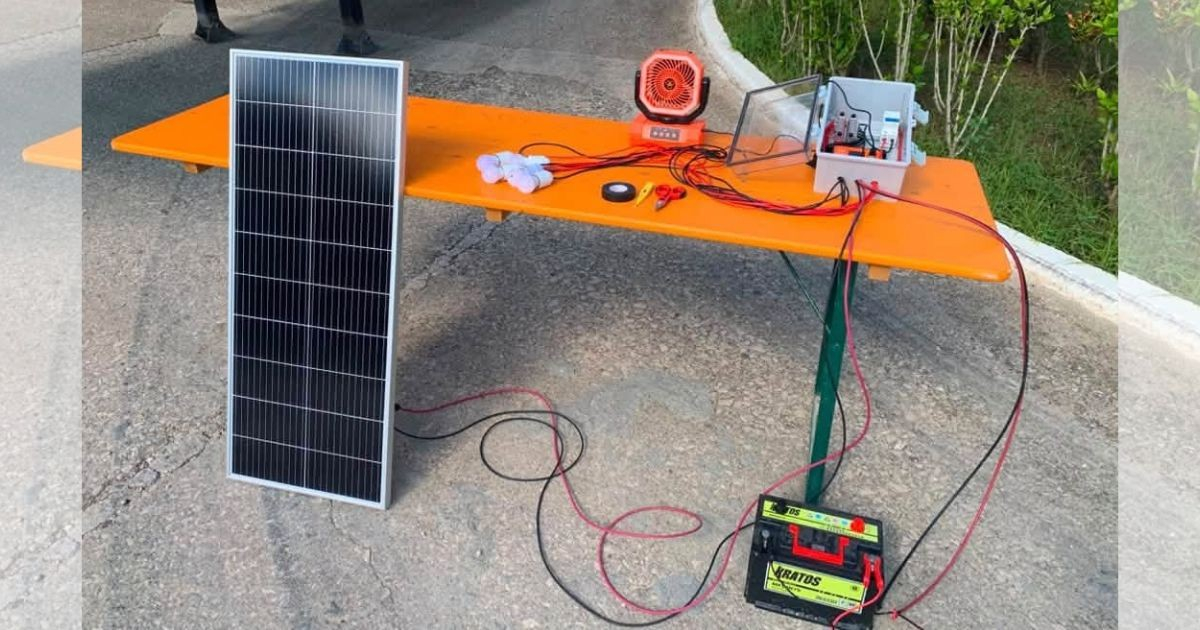
The initial shipment of 1,000 solar kits aimed at coffee-growing families in eastern Cuba has arrived, part of a BioCubaCafé program that plans to distribute 2,000 units with partial funding from the Food and Agriculture Organization (FAO).
Recipients are expected to cover half of the cost through income from coffee sales.
On Monday, BioCubaCafé announced it had received the first batch of solar systems intended to provide lighting, ventilation, and power for small electronic devices in rural homes affected by frequent power outages.
Innovative Solution for Energy Challenges
The initiative is presented as a solution for coffee-producing mountainous areas, where the national electrical grid's deficiencies hinder both household and agricultural activities.
The kits operate with a 12-volt direct current photovoltaic panel, eliminating the need for an inverter. This feature is said to lower costs and make installation simpler.
Each kit includes a distribution box capable of powering five light bulbs and features two USB ports for charging cell phones and other small devices.
A fan with an integrated lamp and battery, rechargeable via USB, is also part of the kit, along with a battery to store energy for nighttime use.
Additional components include 20 meters of cable, a clamp, a screwdriver with a voltage tester, and a roll of electrical tape.
Financial Aspects of the Solar Kit Program
A key aspect of the program is its funding mechanism. Each kit is priced at $360, but thanks to FAO's financial contribution, producers will only pay $180.
BioCubaCafé notes that a similar system sells for roughly $1,300 in the Cuban market.
Farmers won't need to pay the $180 upfront. Instead, the cost will be deducted from a portion of the earnings from their coffee production.
For the 2026-2027 harvest, BioCubaCafé offers $0.60 per can of premium Arabica coffee and $0.30 for robusta, with monthly payments made to the producer's personal card.
These rates mean a kit costs the equivalent of 300 cans of Arabica or 600 cans of robusta, provided they meet quality standards.
Details on the percentage of each monthly payment allocated to the kit, the repayment period, or contingencies for smaller harvests were not specified.
The company also didn't clarify how many families are assigned a kit or provide a complete delivery schedule. The confirmed information is the arrival of the first 1,000 kits in eastern Cuba.
Priority for High-Performing Coffee Growers
In selecting beneficiaries, BioCubaCafé stated that priority will be given to farmers who exceeded their production commitments in the previous harvest.
This selection criterion aims to reward high-performing producers and encourage better results in the current campaign.
Thus, access to the systems will not only depend on the family's electricity needs but also on their production history, at least in the initial phase.
Broader Context of Energy Initiatives in Cuba
The program is part of broader efforts to support the 2026-2027 coffee harvest in eastern Cuba, a region also impacted by Hurricane Melissa in October 2025.
Other measures include payments in foreign currency, tripartite contracts between producers, the Agroforestry Group, and BioCubaCafé, as well as the supply of food, technological packages, and resources like fuel and sacks for collection.
Concurrent with this initiative, other coffee-related entities have also announced changes in their payment methods.
Recently, the Eladio Machín Coffee Processing Company in Cienfuegos stated it would pay harvest workers in foreign currency, without specifying the currency, amounts, or start date.
These initiatives highlight a growing trend of linking remuneration to foreign currencies in certain production activities, albeit with varying conditions and methods among companies.
The initiative for coffee growers is not the first solar energy program announced in Cuba in 2026.
In February, Camagüey authorities reported the distribution of solar panels to 180 educational sector workers.
This program provided equipment for teachers' homes, with payment facilitated through bank credits, though it drew criticism for the number of recipients and selection criteria.
That same month, it was revealed that solar modules for select Heroes of Labor were priced at 75,200 Cuban pesos, despite being part of a state labor incentive program.
Additionally, in March, Prime Minister Manuel Marrero announced the government would complete the installation of over 10,250 photovoltaic systems for teachers, doctors, and Heroes of Labor, along with 5,000 modules for isolated communities and priority centers.
Understanding the Solar Kit Initiative for Cuban Coffee Growers
What is the main goal of the solar kit program in eastern Cuba?
The primary aim is to provide coffee-growing families with reliable energy sources to mitigate the impacts of frequent power outages, supporting both domestic and agricultural activities.
How are the solar kits funded?
Each kit costs $360, with farmers paying $180 thanks to funding support from the FAO. Payments are deducted from the coffee sales income.
Who has priority access to the solar kits?
Priority is given to coffee growers who exceeded their production commitments in the previous harvest as a reward and incentive for better performance.