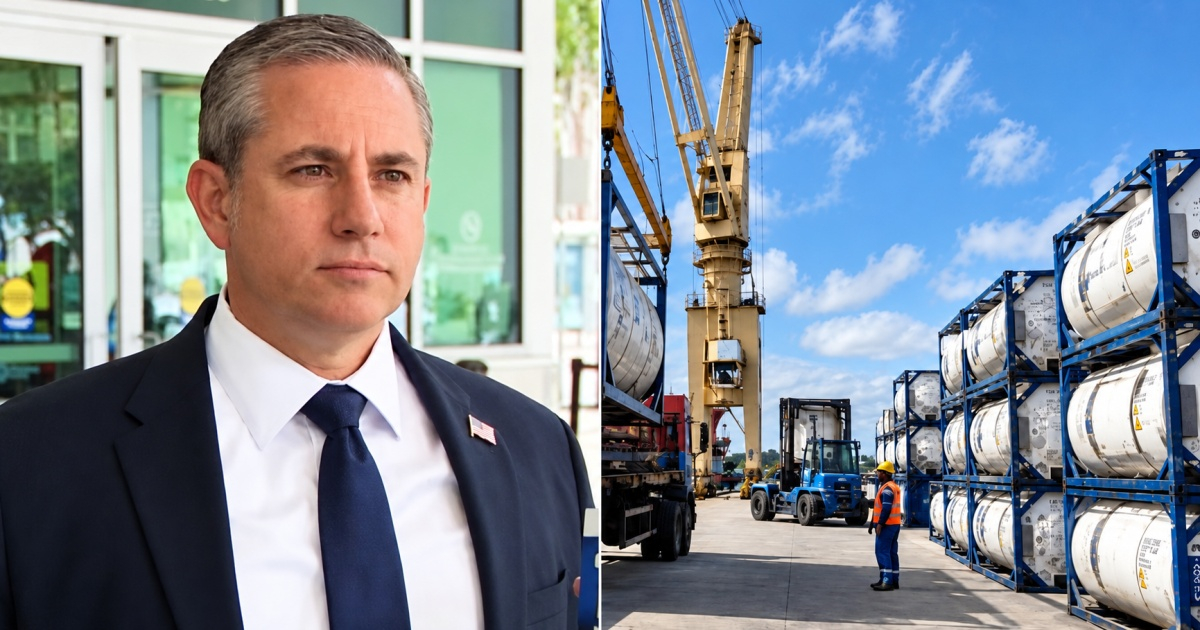
Miami-Dade's tax collector, Dariel Fernández, announced on Sunday that his office has launched an official investigation into fuel shipments arriving at CIMEX—a corporation sanctioned by the U.S. Department of the Treasury. Fernández warned that local businesses involved in illegal transactions with Cuba risk losing their operating permits.
Possible Administrative Actions and Their Implications
Dated October 25, the statement outlines the potential administrative repercussions. "Should we find that a business violates federal law by engaging in transactions with Cuba, we will revoke its local business tax receipt, following the necessary legal procedures," the statement declares.
Fernández emphasized that the investigation is being conducted in collaboration with the Department of State, the Department of Commerce, and other federal agencies. However, the statement did not provide independent confirmation from these entities, nor did it specify the businesses involved, volumes of fuel, or any findings.
Fernández described the issue as a matter of national security. "Our message is clear: if you break U.S. laws, you must face the consequences. Operating a business in Miami-Dade does not place anyone above the law," he asserted.
Understanding the Revocation of Local Business Tax Receipts
The local business tax receipt is the document that legally authorizes a company to operate in Miami-Dade. According to section 205.0532 of the Florida Statutes, applicants or renewers must swear they are not conducting business with Cuba in violation of federal law; a false declaration constitutes perjury.
Revocation is an administrative action, not a criminal one, and does not lead to the automatic shutdown of the business nor affect federal or state licenses. It also does not imply a halt to remittances or a ban on all trade with Cuba.
The Broader Context: CIMEX, Fuel, and Sanctions
CIMEX is listed as a Specially Designated National (SDN) by the Office of Foreign Assets Control (OFAC) under the Cuba program, with its status updated in October 2026. It is part of the military conglomerate GAESA, declared a blocked entity since June of this year.
The immediate backdrop is the seizure, announced in early October, of over 620,000 gallons of biodiesel in 90 shipments bound for ENETEC S.A., a state-owned Cuban company sanctioned by OFAC in July 2026.
Investigations by ADN Cuba revealed that CIMEX sources fuel from at least 16 SMEs and distributes it through its network of service stations, as well as supplying the Ministry of the Revolutionary Armed Forces (FAR).
On October 24, the Department of State acknowledged it couldn't rule out the diversion of fuel exported to the Cuban private sector towards regime entities. From January to August 2026, petroleum derivative imports from the U.S. to Cuba amounted to $231.74 million, a historically unprecedented figure.
A Long-Running Campaign
Sunday's warning is the latest in a systematic campaign launched in late 2025. In September, the office revoked the tax receipt of Lux Sky Cargo LLC for alleged ties to ENETEC S.A. In June, it revoked Vanguard Energy's license for an agreement to send over 250,000 barrels of fuel to Cuba via CUPET. In February, the office notified nearly 4,000 county businesses of potential commercial links with the island.
The HB 905 (FIRE) law, effective July 1, 2026, expanded the authority of Florida's local governments to suspend or revoke permits for companies operating with Cuba in violation of federal legislation.
"Our office will use every legal tool within its authority and work with our federal partners to hold offenders accountable. We will not look the other way," Fernández concluded.
Key Questions About the Investigation Into CIMEX Fuel Shipments
What is the significance of CIMEX in the Cuba sanctions?
CIMEX is a corporation sanctioned by the U.S. Department of the Treasury and is part of the military conglomerate GAESA. It plays a crucial role in fuel distribution and is involved in transactions that have caught the attention of U.S. authorities due to potential violations of federal law.
What are the potential consequences for businesses in Miami-Dade?
Businesses in Miami-Dade found to be illegally engaging with Cuba could have their local business tax receipts revoked, which is an administrative measure impacting their legal authority to operate within the county.
How does the investigation affect U.S.-Cuba relations?
The investigation underscores the U.S. government's vigilance in enforcing sanctions against Cuba and aims to prevent illegal transactions that could undermine the embargo, thereby affecting diplomatic and trade relations.