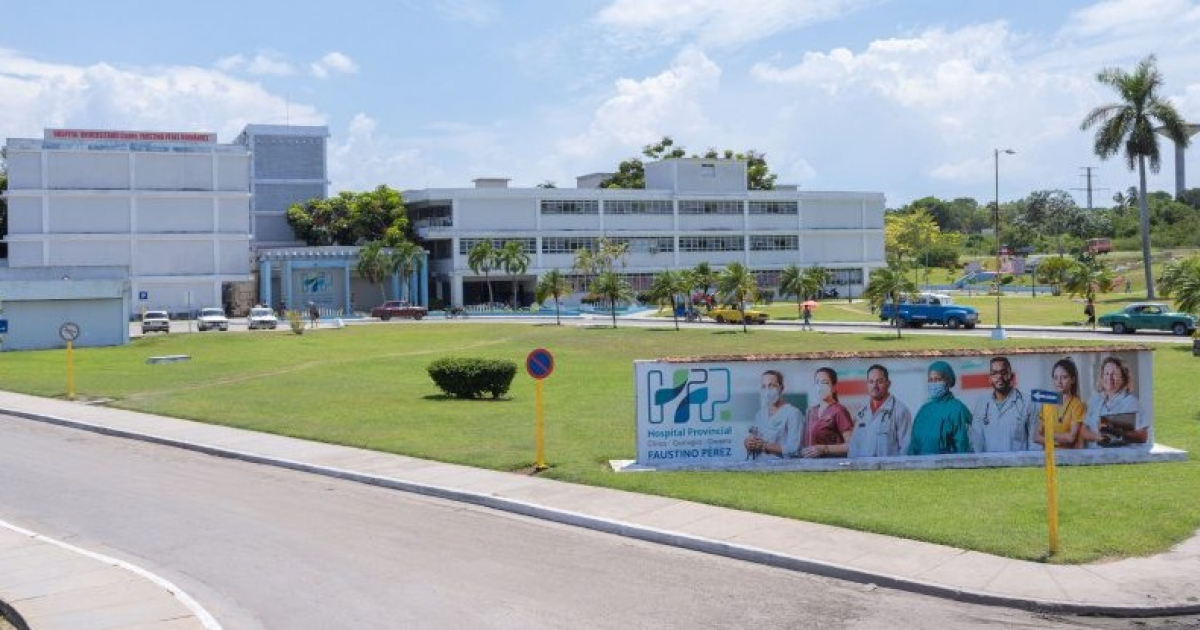
After dedicating over 20 years to patient care at Matanzas Provincial Hospital, Madelyn Fonseca Brito found that her nursing salary was inadequate to support her family.
According to a report in Diario de Cuba, she left the nursing profession in 2025 and now works in a restaurant, where her weekly income provides financial relief that the hospital never could.
Fonseca, who graduated in 2002, worked continuously in Surgery, Intensive Care, the Burn Unit—where she spent over 15 years—and Oncology. Long before making a definitive decision, she juggled 24-hour hospital shifts with side jobs on her days off, such as caring for the elderly and working as a sales clerk in a private business.
"I would arrive at the hospital eager to do many good things, but as the day went on, conditions got tougher without the necessary resources," she recalls.
The breaking point came when her situation became unsustainable on two fronts. "First, due to economic problems, because my salary no longer supported my household, and second, because I felt bad for not being able to provide the right care to my patients," she explained.
She took a job as a cashier and later also worked as an accountant, balancing the books until the early hours. "I started to discover another world, saw an economic improvement, and felt relieved, in the sense of not facing so many end-of-month difficulties to cover household expenses. It was tough, but I had to make the decision," she recounted.
Despite the financial improvement, she admits the transition was emotionally challenging. "People recognized me at the restaurant and asked why I was there, knowing I was a good nurse," she added.
Fonseca's story is not unique. This week, a nurse from Guantánamo sarcastically commented on the impossibility of surviving on 4,000 pesos—she could only withdraw 40% of her salary from her magnetic card—and questioned what could be purchased with that money.
"What can you buy to live, as a mother of two teenagers, when a five-pound chicken package costs 4,500? When a pound of rice is 380, a bottle of oil is 2,700, and a pound of sugar is 550 pesos?" she detailed.
Low wages, poor working conditions, and a lack of resources to care for patients have led to a massive exodus of healthcare professionals to other sectors or abroad.
Data from the National Office of Statistics and Information released at the end of 2025 show that between 2021 and 2024, Cuba lost about 77,522 healthcare personnel, including doctors, nurses, technicians, and dentists.
In August of this year, new government-approved salaries for the sector came into effect. According to Resolution 17/2026 from the Ministry of Labor and Social Security, specialist nurses earn 7,045 CUP, while basic nurses receive 4,755 CUP.
However, the nominal increase doesn't withstand the realities of the informal market, where the monthly basic food basket costs more than 100,000 pesos per person, according to Javier Pérez Capdevila, Ph.D. in Economic Sciences.
The irony circulating on Cuban social media following the announcement of the salary increase summed up the popular sentiment with brutal honesty: with the new salary, workers "could now buy eggs and oil in the same month."
Understanding the Healthcare Exodus in Cuba
What prompted Madelyn Fonseca Brito to leave her nursing job?
Economic struggles and the inability to adequately care for her patients led Madelyn Fonseca Brito to leave her nursing position for a job in a restaurant.
How widespread is the issue of healthcare professionals leaving their jobs in Cuba?
The problem is significant, with Cuba losing approximately 77,522 healthcare personnel between 2021 and 2024 due to low wages and poor working conditions.
How do the new government-approved salaries compare to the cost of living in Cuba?
Despite the increase, the new salaries fall short compared to the cost of living, with the basic food basket costing over 100,000 pesos monthly, far above what healthcare workers earn.