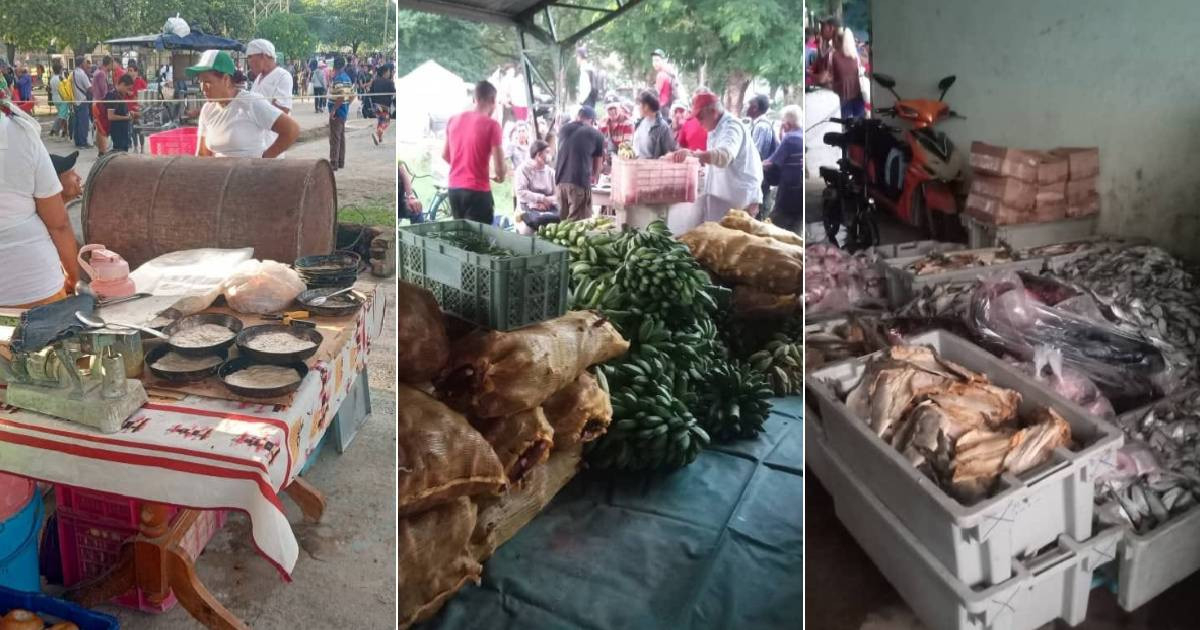
The agro-commercial fair in the city of Las Tunas returned to the 26 de Julio park this Saturday, greeted with both praise from the state-run digital portal Tiempo 21 and criticism from locals. Residents voiced concerns about the high prices, the quality of the goods, and the swift depletion of available products.
"There's supposedly everything, but by the time you get there, nothing's left," remarked one resident on Facebook, contrasting sharply with the state media's positive spin on the "quality, variety, and costs" of products from the Provincial Food Industry Enterprise.
Price Controversies and Product Quality
The cost of bananas became a focal point for many complaints. At the fair, they were priced at 60 pesos each, which was higher than the rates found at informal local markets, according to some residents.
"Prices here are higher than on the street; you can find bananas for 35, 40, 45, and 50 pesos elsewhere, but at the fair, they're 60 pesos and they're just skins," a user commented. Others echoed dissatisfaction with the quality, describing the bananas as "nothing but peels."
Electronic Payment Issues and Accessibility
Beyond pricing, several residents reported that vendors often do not accept electronic payments, posing a significant hurdle for those without cash on hand.
"The fish vendor told me: we accept it, but I forgot the QR code," a local recounted about trying to purchase fish. Another resident expressed frustration over the situation, noting, "I've lost the motivation to go because they never accept electronic payments... it's a long trip there only to return empty-handed and exhausted."
Unequal Access and Economic Strain
The fair's product scarcity further fueled frustration. According to one comment, the lack of purchasing limits allows those with cash to buy up the products early, leaving others with nothing.
"Given the high demand and frequency of these events, those with cash take advantage because there are no limits," a resident pointed out.
Some criticisms also questioned the fair's effectiveness in addressing supply shortages. A local noted that some officials attend merely to pose for cameras, branding the event as "mere publicity" since many state workers can't afford the products on display.
Another comment highlighted the disparity between prices and the income of much of the population. "Unattainable for state workers earning starvation wages and retirees with meager pensions," a user lamented.
Lingering Discontent and Broader Concerns
These grievances have persisted for months. In May, the provincial government canceled the fair, citing a lack of fuel to transport products from municipalities, while in Havana, dozens of buses were mobilized for a political event organized by the Communist Youth Union in support of Raúl Castro.
During June's Father's Day edition, yogurt was priced at 490 pesos and ice cream at 1,460 pesos. In July, a carton of eggs reached 2,600 pesos, which at the time equated to about 85% of the minimum monthly pension.
The July edition was described by Tiempo 21 as "a challenge to resilience," but some citizens labeled it "the fair of misery" and "a charade." The complaints from this Saturday once again question the ability of these events to ease the daily struggles of Las Tunas residents.
The economic backdrop exacerbates the challenge of benefiting from these offerings. The average state salary hovers around 7,074 pesos per month, while independent estimates place the cost of basic needs for one person between 50,000 and 96,000 pesos monthly.
FAQs About Las Tunas Agro-Commercial Fair
What are the main complaints about the Las Tunas fair?
Residents mainly complain about the high prices, poor quality of products, and lack of electronic payment options.
Why is product availability an issue at the fair?
The absence of purchasing limits allows those with cash to buy products early, depleting stock quickly and leaving others without access.
How do prices at the fair compare to local informal markets?
Prices at the fair are reportedly higher than those at informal markets, with bananas priced at 60 pesos compared to 35-50 pesos elsewhere.
How does the economic situation affect the fair's accessibility?
The average state salary is much lower than the estimated cost of living, making it difficult for many to afford fair prices.