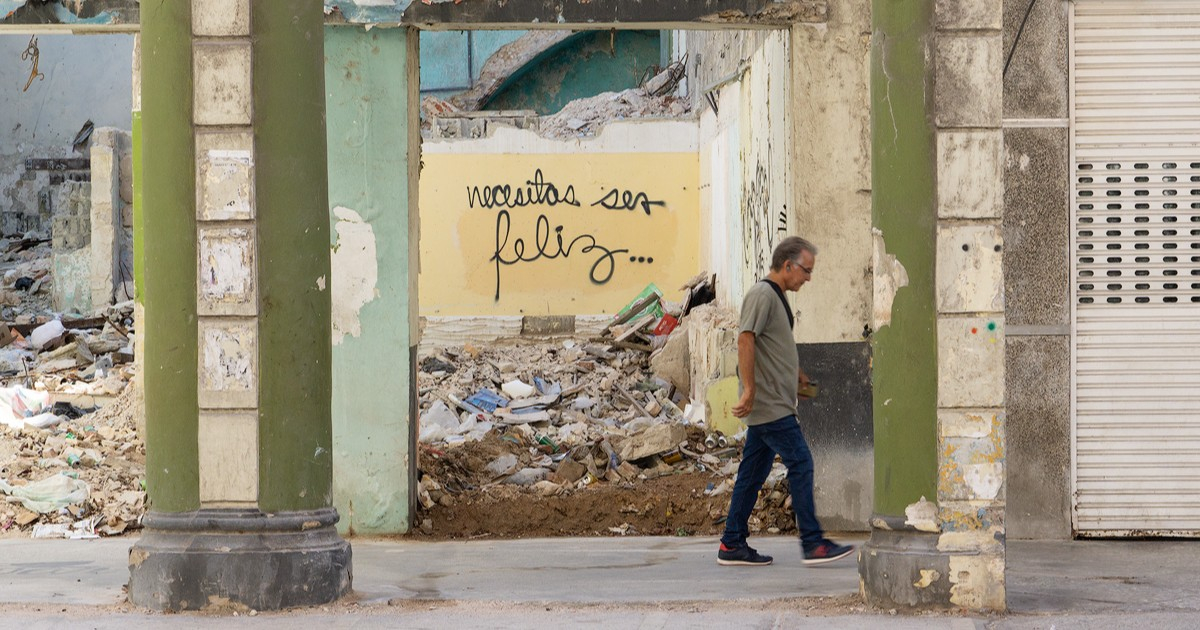
On Friday, Cuban scholar and essayist Hilda Landrove presented a thought-provoking piece titled "Cuba: The Grim Face of Resistance" in Rialta Magazine. Her essay critically examines how Cuba's ruling elite and supportive intellectuals have manipulated the term "resistance" for propaganda purposes.
Holding a Ph.D. in Mesoamerican Studies from the National Autonomous University of Mexico and serving as a professor at Monterrey Institute of Technology in Querétaro, Landrove begins her essay with a stark assertion: "Resistance is one of those terms I've consigned to the recycling bin."
The analysis is anchored in a personal anecdote involving a deceased loved one who endured a long fasting period before a medical test. The poignant words of her relative—"These bastards have taught us to endure the unendurable"—serve as a metaphor for how the regime has twisted resistance into a harmful condition: "you resist because you have no choice," writes Landrove, with no future plans or goals in sight.
Resistance Versus Reexistence and Resilience
Landrove contrasts Cuba's use of "resistance" with two alternative concepts: "reexistence"—a term from studies on indigenous and Afro-descendant communities that suggests creating a life worth living—and "resilience," defined as individual adaptive creativity. However, she argues that neither concept accurately represents the Cuban situation, where resistance is exploited by the elite to dodge accountability for the people's suffering, attributing it solely to imperialism and the embargo.
She criticizes Cuba's leadership as a "parasitic elite that has consumed and destroyed everything," dismissing the notion of "creative resistance"—a phrase coined by Miguel Díaz-Canel—as the only linguistic contribution (not necessarily conceptual) he has made to his self-proclaimed continuity agenda.
The Paradox of Resistance
This stark contrast is highlighted by Díaz-Canel's conflicting statements: during a June Communist Party Plenary, he acknowledged that "resistance alone is no longer sufficient," yet later claimed in an interview with Brazil's Folha de Sao Paulo that Cuba's lack of collapse was due to this very "creative resistance."
The essay also targets international supporters of the regime, accusing them of basing their enthusiasm on an abstraction "that lacks real people." She cites a statement from someone in Mexico: "Cuba must resist, because to me, Cuba is a symbol we cannot abandon." Landrove concludes, "Those who resist do not truly exist for those who demand them as part of the narrative of the invincible revolution."
A Consistent Critical Voice
This essay continues Landrove's ongoing critical analysis throughout 2026. In July, she described Cuba as a "concentration camp"; in September, she condemned those defending the dictatorship as "accomplices of our oppressors"; and in June, she criticized Díaz-Canel's economic reforms as "too little, too late," asserting that "the system is beyond reform."
The publication comes amid an unprecedented humanitarian crisis: Cuba is projected to suffer the worst economic decline in Latin America in 2026 with a 10.3% contraction, according to CEPAL. The country frequently experiences power generation deficits exceeding 2,000 MW and has endured eight national collapses of the National Electric System this year. On the repressive front, Prisoners Defenders has documented 1,372 political prisoners as of October 1, including minors.
Landrove concludes with a collective expression of exhaustion: "The resistant are weary; pleading, whether out of mercy or justice, for the end of this long night of totalitarianism, so that life can finally be lived without paying the price of an abstraction that has already caused too much sorrow."
Frequently Asked Questions About Cuba's Resistance
What is the main critique of the Cuban government's use of "resistance"?
Hilda Landrove criticizes the Cuban government for using "resistance" as a propaganda tool to evade responsibility for the hardships faced by the Cuban people, attributing these difficulties solely to external forces like imperialism and the embargo.
How does Landrove contrast "resistance" with other concepts?
Landrove contrasts "resistance" with "reexistence" and "resilience," arguing that these concepts suggest creating a dignified life and adaptive creativity, respectively, which do not align with the Cuban reality where resistance is used to perpetuate the regime's narrative.
What economic challenges is Cuba facing in 2026?
Cuba is experiencing a severe economic downturn with an estimated 10.3% contraction in 2026, frequent power generation deficits, and multiple national electrical system collapses.