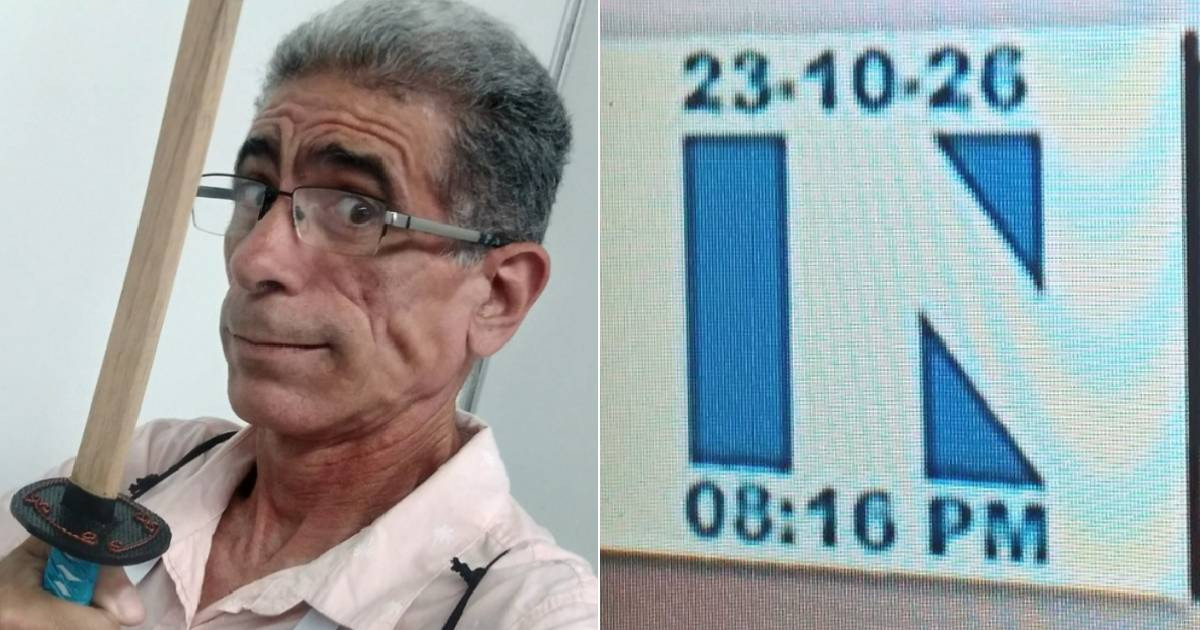
Francisco Rodríguez Cruz, who serves as the vice president of the Union of Cuban Journalists (UPEC), has openly admitted that the National Television News (NTV) fails to resonate with the Cuban populace. This candid observation has resonated with many, as numerous viewers have questioned both the credibility and the perspective of state-run journalism.
Rodríguez, also known as "Paquito el de Cuba", shared his thoughts on Facebook last Friday while watching the NTV. He confessed it had been a while since he tuned in, partly due to the "oil blockade and lack of electricity."
"I'm 16 minutes into the broadcast... Meetings and long faces. Nothing that connects with ordinary people. It's tough to win the cognitive war for the Revolution this way," he noted.
His comments drew attention, especially as they came from a vice president of the association that represents official Cuban journalists. Although his remarks remain within the official narrative of the so-called "cognitive war," they highlight a significant issue for institutional discourse: engaging with a populace whose daily challenges are seldom addressed on state television.
Responses to his post indicated that the issue extends beyond power outages. One commenter criticized the NTV's credibility and the repetitive nature of meetings discussing unresolved issues.
"The disconnect isn't just about electricity shortages; it's about trust. How many meetings discussing 'key issues' have we witnessed? Yet these 'cardinal problems' persist, stubbornly reappearing on the agenda, stuck in an endless loop," the commenter stated.
Several users shared how power outages dictate their routines. One mentioned that the few hours of electricity are spent cooking, doing laundry, or catching up on Turkish series stored on USB drives.
Another user noted they hadn't watched NTV in over a year, not due to lack of interest, but because electricity was never available during its broadcast time.
Some comments came from individuals who haven't tuned in for years. One user, who claimed 23 years without watching, recalled the news mixing international stories that caused "stress, anxiety, anger, and even shame" with national reports on exceeding production targets. They questioned if the format remained unchanged.
A particularly striking comment encapsulated this discontent: "Cuba is in pieces, but NTV doesn't realize it."
Other comments directly criticized Rodríguez's post. One labeled it as "distasteful sarcasm" and "mockery of the people," while another contrasted TV content with the reality observed on the streets.
"It's all achievements and meetings. Step outside, and you'll see how far NTV is from reality. Official journalism is the most outdated thing in this country," one person asserted.
This discourse highlights a contradiction between the goal of winning the "cognitive war" and the audience's criticism of NTV's content and credibility.
In late August, an electrical failure at the studios forced a presenter to apologize live. Days later, another outage interrupted the broadcast for several minutes.
In mid-October, NTV mistakenly aired a subtitle reading, "The U.S. embargo on Cuba doesn't prevent the island's people from surrendering," leading to widespread mockery before the segment was pulled.
Rodríguez's social media behavior often appears satirical and contradictory. In May, he mocked then-President Donald Trump's threat to deploy an aircraft carrier to Cuban waters, and in early October, he donned a wig to ridicule opposition activist Anna Bensi shortly after her sentencing.
Meanwhile, UPEC, which in April called for a "global propaganda front" against "lies" about Cuba, is dealing with its own crisis.
On July 22, during the Plenary of the National Committee of the official organization, Ariel Terrero, dean of the Faculty of Communication at the University of Havana, expressed concern over the journalism program's enrollment, with only 17 students registered for the 2026-2027 academic year, the lowest number on record.
In response to this predicament, the Faculty of Communication has issued an extraordinary call for journalism students, targeting those already enrolled in other university disciplines.
Understanding NTV's Disconnect with Cuban Citizens
Why is NTV criticized by Cuban citizens?
NTV has been criticized for failing to address the everyday concerns of Cubans, focusing instead on meetings and official narratives that don't resonate with the general populace.
What issues do viewers have with the credibility of NTV?
Viewers have raised concerns about the repetition of unresolved issues and the lack of transparency in how these issues are addressed, leading to doubts about NTV's credibility.
How do power outages affect NTV viewership in Cuba?
Frequent power outages limit the time available to watch television, leading Cubans to prioritize other activities during the few hours of electricity they have.
What steps is UPEC taking to address its current challenges?
UPEC is facing challenges such as declining journalism enrollment and has issued an urgent call for new students from other disciplines to join the journalism program.