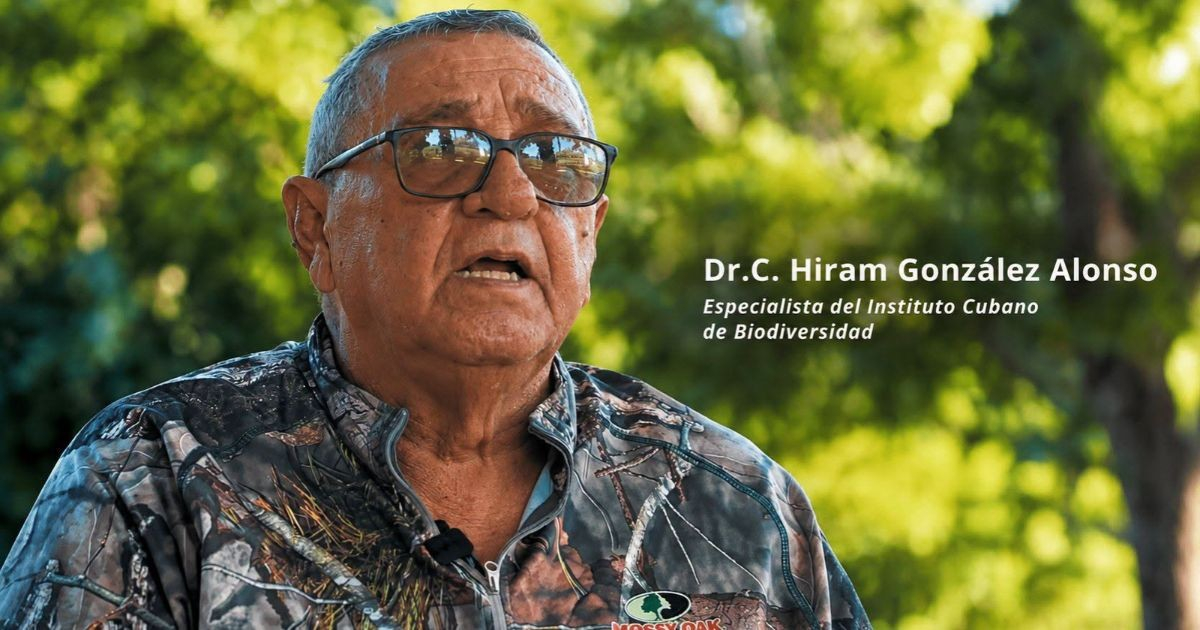
The National Museum of Natural History of Cuba announced on Saturday through its social media channels the passing of Dr. Hiram González Alonso, a prominent Cuban ornithologist whose work over the past four decades has been a significant "pillar of science in our country."
Born on April 14, 1951, in Caraballo, Jaruco, now part of Mayabeque province, Hiram José González Alonso devoted much of his scientific career to the study and preservation of Cuban bird species. Holding a PhD in Biological Sciences with a focus on ornithology and wildlife conservation, he authored over 80 publications in both national and international scientific journals, wrote several books, and participated in numerous scientific conferences across various countries.
For many years, González Alonso was associated with the Institute of Ecology and Systematics (IES), where he led the Cuban Migratory Bird Laboratory and served as President of the Cuban Zoological Society. At the time of his death, he chaired the Scientific Council of the Cuban Institute of Biodiversity, according to the National Museum of Natural History.
One of his notable literary contributions includes "Aves de Cuba" (2002), for which he served as general editor. He also took part in significant studies on the conservation of endangered species.
His name stands among the primary authors of the work "State of Conservation of Threatened Fauna: Red Books of Cuba," which received the Special Award from the Ministry of Science, Technology, and Environment for its environmental importance. Just days before his death on October 12, 2026, he was cited as an ICB specialist in a CITMA alert regarding the illegal capture of birds in Cuba.
The scientific community's respect for Dr. González Alonso was evident in the condolences that poured in following the announcement of his passing. A colleague reminisced about working closely with him on several projects, beginning in the mid-1980s as part of an international collaboration between the IES, Birds Canada/Long Point Bird Observatory, and the Canadian Wildlife Service. This work, the colleague noted, "enriched the careers of many Cuban biologists, as well as international biologists who visited the country."
Friends and colleagues unanimously described the loss as irreplaceable. A fellow from the Faculty of Biology recalled his early passion for birds and ecosystem conservation, stating, "Cuban science loses a great scientist, and birds lose their best friend."
One researcher highlighted González Alonso's dedication to promoting scientific knowledge by recalling how he facilitated the distribution of Cuba's threatened bird catalog. From the Sierra del Rosario Biosphere Reserve, a specialist remarked, "Honoring his legacy is the best way to keep him alive."
His death comes at a critical time for nature conservation in Cuba. The archipelago is home to 410 bird species, according to the 2026 Annotated List of Cuban Birds, with around 28 endemic species, including the tocororo, the national bird, and the bee hummingbird, known as the smallest bird in the world.
Cuba's rich birdlife faces significant conservation challenges, with numerous species under threat and others experiencing environmental pressures that jeopardize their habitats.
The country's ongoing structural crisis, marked by decades of institutional decay and resource shortages, increasingly hinders scientific research and ecosystem protection, making the contributions of individuals like González Alonso even more invaluable.
The National Museum of Natural History of Cuba summed up his legacy: "His knowledge, dedication to science, and passion for nature leave a profound impact on those fortunate enough to work with and learn from him. His legacy will live on in his research, the scientific community he helped build, and everyone inspired by his work."
Key Insights on Cuban Ornithology and Conservation
Who was Dr. Hiram González Alonso?
Dr. Hiram González Alonso was a renowned Cuban ornithologist and conservationist, known for his extensive research on Cuban birds and his contributions to wildlife preservation.
What are some challenges facing bird conservation in Cuba?
Bird conservation in Cuba faces challenges such as habitat loss, environmental pressures, and the illegal capture of birds, compounded by the country's ongoing structural and resource crises.
Why is the legacy of Dr. González Alonso important?
Dr. González Alonso's legacy is crucial because of his impactful research, his role in forming the scientific community in Cuba, and his dedication to promoting conservation efforts for endangered species.