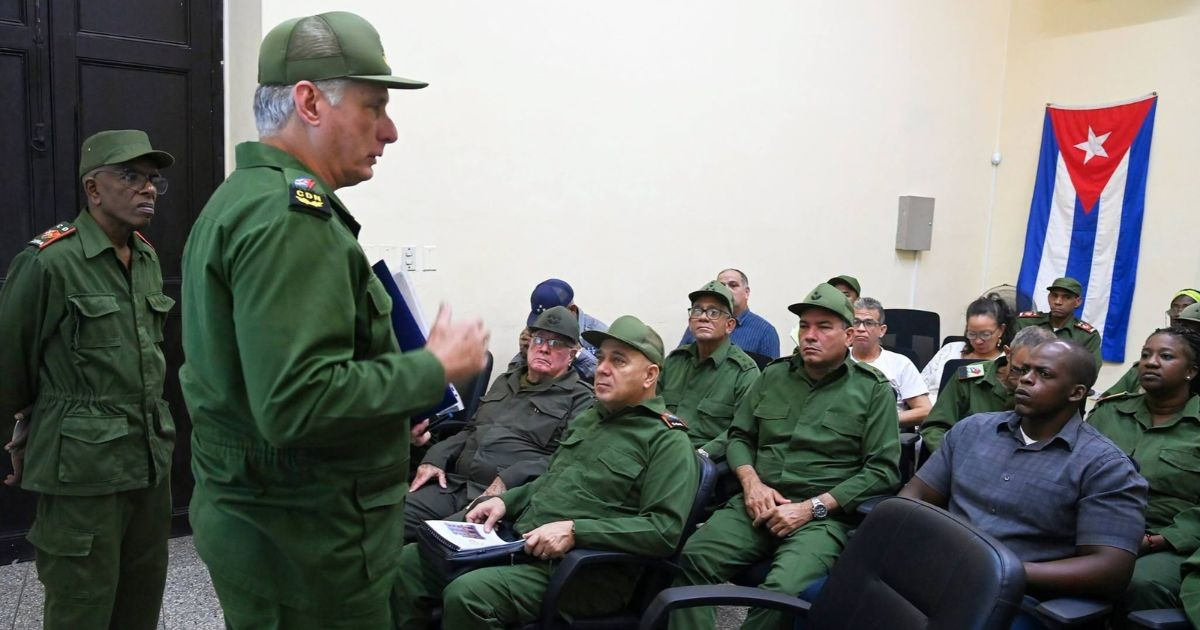
On Friday, Miguel Díaz-Canel made an appearance at the Defense Zone Council in Los Sitios, located in Central Havana, during the fourth National Defense Day in October. His visit was marked by a statement that has become a staple of the regime but is increasingly met with disdain by the Cuban people: "We must not tire."
As expected, the response on social media was swift and unequivocal. Many citizens, who have been enduring weeks without electricity, water, or any meaningful assistance from local defense councils, expressed their frustration by writing, "Enough with the oppressors."
The official Cuban Presidency Facebook page portrayed Díaz-Canel's visit as an inspection of "the consolidation of defense tasks and social issues in peaceful times with wartime structures." During the event, emphasis was placed on the Production and Defense Brigades, the movement My Neighborhood for the Homeland, and community initiatives like Cabildo Quisicuaba and La Cobija.
However, despite official claims of "progress and challenges" in areas such as electricity, water, waste management, and support for vulnerable populations, the realities are stark. The challenges are numerous, while the so-called progress is often fabricated by the regime.
In Los Sitios, home to over 33,000 residents, there are plans for 22 Production and Defense Brigades. Díaz-Canel, who seems to believe military rhetoric can replace fuel and turbines, stated, "I am convinced that under current circumstances, we will overcome them with our effort and talent," as reported by Radio Rebelde.
Yet, this "effort and talent" are being tested in literal darkness. On Friday, Cuba's electricity availability was a mere 1,030 MW against a projected demand of 2,850 MW, resulting in an estimated maximum deficit of 1,850 MW. Matanzas has experienced recent power outages lasting nearly 70 consecutive hours, and in Pinar del Río, some areas have endured over 90 hours without electricity.
The energy crisis is compounded by severe issues with water supply. Approximately 2.7 million people lack access to potable water or receive it sporadically due to power outages, as the regime itself acknowledged earlier this month.
While Díaz-Canel called for resilience in Los Sitios, geopolitical tensions were simultaneously unfolding. In Fort Myers, Florida, Trump humorously suggested positioning a warship 50 yards off the Cuban coast, quipping, "They'll raise their hands," before announcing plans to send Marco Rubio to "close the deal." Rubio himself issued an unprecedented call for Cubans to "cooperate discreetly with the CIA."
In response, Díaz-Canel accused the U.S. of harboring "domination ambitions over Cuba" on Facebook. However, with over 1,300 political prisoners under the regime's control, it is clear that they are the ones dominating the beleaguered Cuban populace with an iron fist.
Meanwhile, in a neighborhood in Camagüey, residents reported that authorities hastily cleared accumulated trash in anticipation of the leader's visit: "They cleaned up because the appointed leader is coming," they said. This situation serves as a perfect metaphor for 67 years of revolution: tidying up the misery just before the cameras roll, while asking the people to endure it without complaint.
Key Questions Surrounding Cuba's Current Crisis
What challenges are Cubans facing with electricity and water supply?
Cubans are enduring severe power shortages, with availability significantly below demand, leading to prolonged blackouts. Additionally, around 2.7 million people lack reliable access to potable water, exacerbated by the power outages.
How have Cuban citizens reacted to Díaz-Canel's call for endurance?
Citizens have expressed their frustration on social media, calling for an end to repression and criticizing the regime's failure to address basic needs like electricity and water.