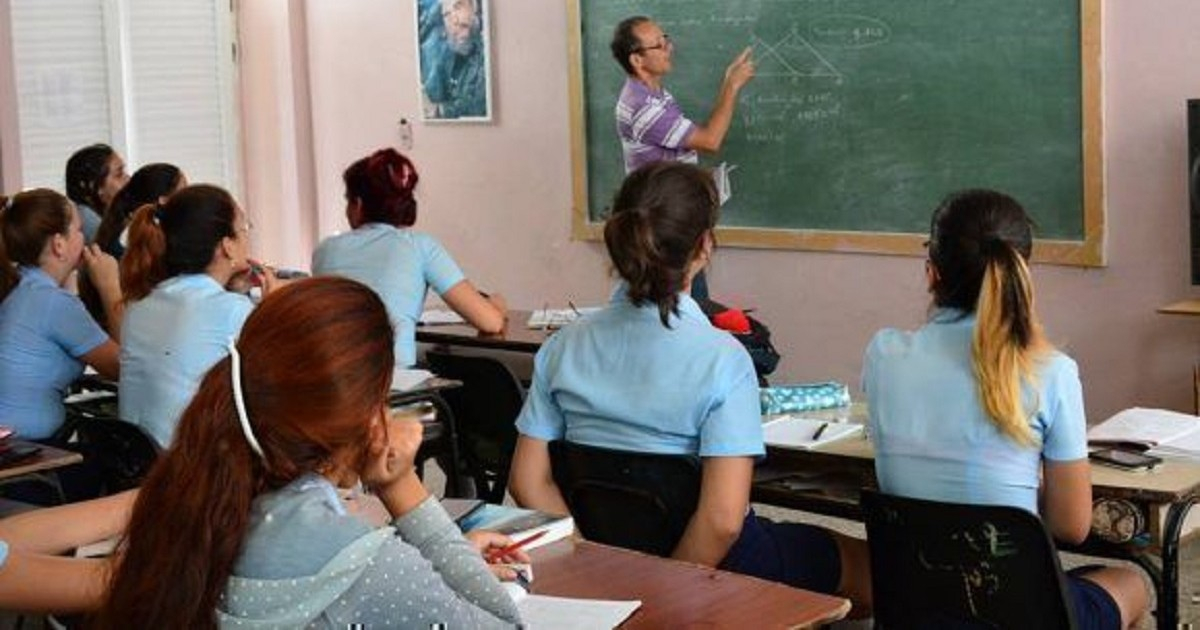
In the midst of an unprecedented educational crisis, the Cuban regime is drafting a new Education Law, consisting of 243 articles, to replace the existing Law 680 from 1959. Despite this ambitious legislative effort, the country faces a staggering shortage of nearly 24,000 teachers, leaving over 380,000 students without assigned teachers, while educators earn less than $12 per month.
The proposed law, which opened to public consultation on October 21 and is scheduled for presentation to the National Assembly in December, was developed with input from more than 25 organizations, coordinated by the Ministries of Education and Higher Education.
The Ideological Tug-of-War
One of the most striking contradictions is found early in the draft. Article 11 acknowledges students' right to "freely express their opinions" and participate in decisions affecting them. However, Article 12 mandates students to "defend the principles of the Revolution, preserving national independence and security." The draft fails to address how conflicts between these provisions would be resolved or the consequences for students expressing anti-socialist views.
This ideological burden extends to educators as well. Article 14 requires both teaching and non-teaching staff to "defend the Socialist Homeland, the principles of the Revolution, and Cuban societal values," demanding continuous political-ideological training and ethical behavior on social media, without clarifying what this entails in practice.
Reality Check: The Dire State of Cuban Education
While the regime focuses on classroom ideology, the reality for the 2026-2027 school year tells a different story. As of September 1, national teaching coverage barely reached 73%, with approximately 24,000 positions unfilled and over 380,000 students lacking full-time teachers, as reported by state-run newspaper Granma.
Regions such as Camagüey, Holguín, Matanzas, and Sancti Spíritus experienced the most severe shortages. To fill the gaps, the Ministry of Education turned to student teachers, retired educators returning to work, and professionals from other fields.
The Root Cause: Insufficient Salaries
The primary reason for the teacher exodus is inadequate pay. Resolution 18/2026, effective since July 1, set salaries between 6,130 and 7,735 Cuban pesos monthly, equivalent to less than $12 at the informal exchange rate, compared to a basic basket valued between 25,000 and 50,000 CUP.
Education Minister Naima Trujillo Barreto admitted to EFE that "income is a significant issue because it's true that we experience mobility due to salaries that do not meet our professionals' needs."
Private Sector Steps In Amidst Blackouts
The situation is worsened by frequent power outages. At the start of the school year, the Electric Union predicted a deficit of up to 2,310 MW during peak hours, with blackouts affecting 70% of the nation. A primary school in Matanzas was without electricity for over 23 days in the first weeks of the term.
Given this collapse, the private sector has been forced to step in where the state has fallen short. On October 18, Minister Trujillo acknowledged that small and medium-sized enterprises (SMEs) and non-state companies provided food, footwear, clothing, and transport routes for students, which she described as a significant response.
The draft law addresses this reality obliquely: Article 239 allows educational entities to generate additional income through foundations, interface companies, and SMEs, yet still prohibits independent private schools.
Vice Minister Marlen Triana Mederos explained to Granma, "We remain budgeted, but we will be able to use complementary funding to continue enhancing educational processes."
By mid-October, teacher coverage had improved to 86%, but 11,000 students still did not attend classes regularly, and only 49% of the priority group had school uniforms.
In May 2026, UNESCO warned that Cuban education is "at risk," with over 2,000 schools urgently needing support and more than 400,000 students facing reduced school hours.
Frequently Asked Questions about Cuba's Education Crisis
What are the major challenges facing Cuban education today?
Cuban education is grappling with a severe teacher shortage, inadequate salaries for educators, frequent power outages, and significant dependence on private sector support.
How is the Cuban government addressing the education crisis?
The government is drafting a new Education Law and relying on student teachers, retirees, and professionals from other fields to fill teaching vacancies, while also permitting educational entities to generate additional income.
What role does the private sector play in Cuban education?
The private sector has been crucial in providing resources such as food, clothing, and transportation for students, helping to fill the gaps left by the struggling state system.