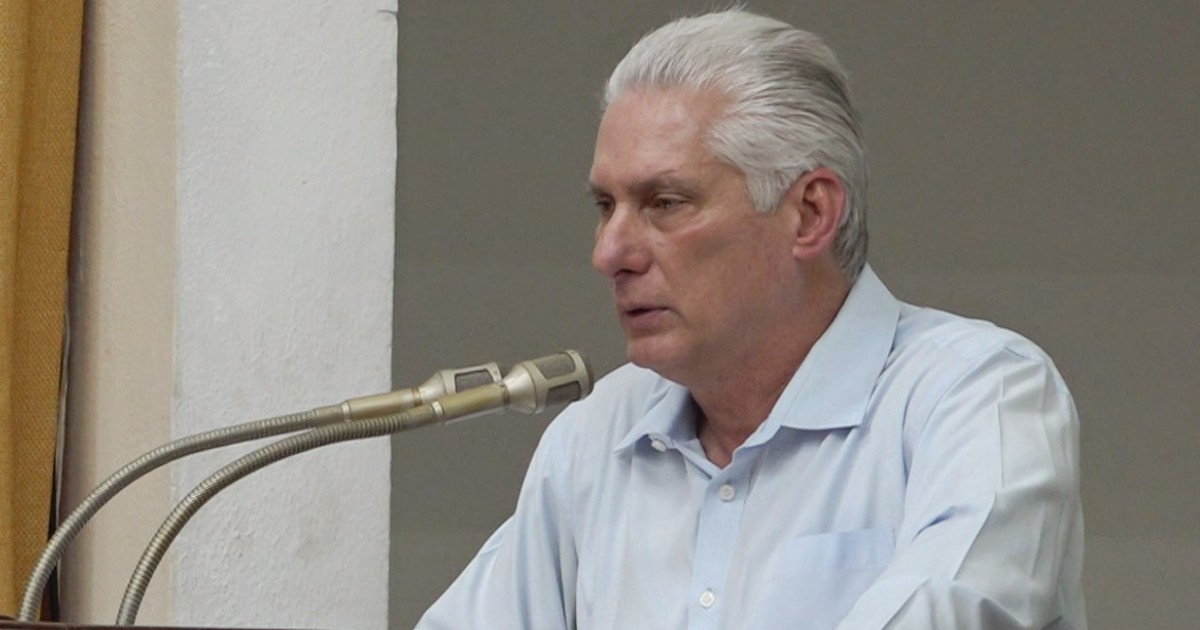
On Thursday, Miguel Díaz-Canel acknowledged that food production is crucial for the political survival of Cuba's regime. This statement came as he concluded a visit from the Communist Party's Central Committee to the Ministry of Agriculture, which aimed to assess the progress of 176 approved economic and social transformations initiated in June.
"Without food, there is no social stability; without food, the socialist construction process cannot achieve the well-being it strives for in our country," Díaz-Canel declared. He identified food sovereignty and the stability of the National Electric System as the top priorities at present.
He also recognized the substantial material challenges facing agriculture: "Producing food today, with virtually no fuel, is exceedingly difficult," he admitted, highlighting issues such as "rural migration and the decline in the workforce."
Despite this grim assessment, Díaz-Canel maintained a stance of resilience: "We will not surrender because we must produce the food that our nation requires."
The Political and Ideological Battle of Agriculture
The leader framed agricultural work as a political defense mission: "Every hectare planted, every ton harvested, and every liter of milk collected is an act of defending the Revolution and, under the current circumstances, an act of resistance as well."
"Agriculture is also an ideological and social battleground," he added. He emphasized that improving rural community conditions, reducing migration, and creating opportunities for the youth are essential components of these transformations. Díaz-Canel also revisited a slogan from Raúl Castro: "We must turn to the land and make it productive."
Dire Food Scarcity and Unmet Promises
This warning comes amid alarming statistics: 96.91% of the Cuban population lacks adequate access to food, 33.9% of households reported at least one member went to bed hungry in the past month, and 25% of Cubans go to sleep without dinner, according to the Food Monitor Program.
Prime Minister Manuel Marrero Cruz, who was also present, stated that policies for 170 of the 176 transformations are already developed, supported by 214 legal norms. However, just three weeks prior, he admitted that "improvements in the quality of life are yet to be perceived by the population."
The gap between official announcements and reality is stark. Rice production plummeted from 304,000 tons in 2018 to just 79,000 in 2025. Between 2018 and 2023, pork production fell by 95%, beans by 70%, and milk by 58%. Overall agricultural output declined by 53% in 2024, while Cuba spends over $2 billion annually importing 70% to 80% of its consumption needs.
Economic Challenges Compound the Crisis
Unfulfilled promises are a recurring theme. In May, Díaz-Canel claimed that Cuba would "eat what it is capable of producing." By June, he stated, "there is no sovereignty with an empty plate" when presenting the 176 measures. In October, the regime postponed results to 2027.
On October 16, Deputy Minister of Agriculture Telce González admitted that providing a concrete date for food improvement would be "irresponsible," further revealing that "regulations alone will not work. The issue lies within our mindset."
The macroeconomic environment worsens the situation. The Economic Commission for Latin America and the Caribbean (ECLAC) forecasts a 10.3% contraction of Cuba's GDP by 2026, the worst in Latin America, with food inflation reaching 36.01% year-on-year in August and the informal dollar surpassing 700 pesos in September.
Economist Elías Amor described the reform package as "a complete hoax," noting that from January to May 2026, net sales in the state sector dropped by 29.2%, and the number of loss-making companies rose from 252 to 363.
On social media, Cubans express their accumulated frustration: "We have lost hope because it's been too long with too many unfulfilled promises. What counts and is expected are results. You can't eat efforts and good intentions."
Understanding the Food Crisis in Cuba
What are the main challenges facing Cuba's food production?
Cuba's food production faces significant challenges including shortages of fuel, rural migration, and a declining workforce.
How has Cuba's agricultural output changed in recent years?
Cuba's agricultural output has significantly declined, with rice, pork, beans, and milk production all experiencing drastic drops from 2018 to 2025.
What is the Cuban government's stance on the current food crisis?
The Cuban government acknowledges the severity of the food crisis and emphasizes resilience, asserting the need to produce the nation's food requirements despite challenges.