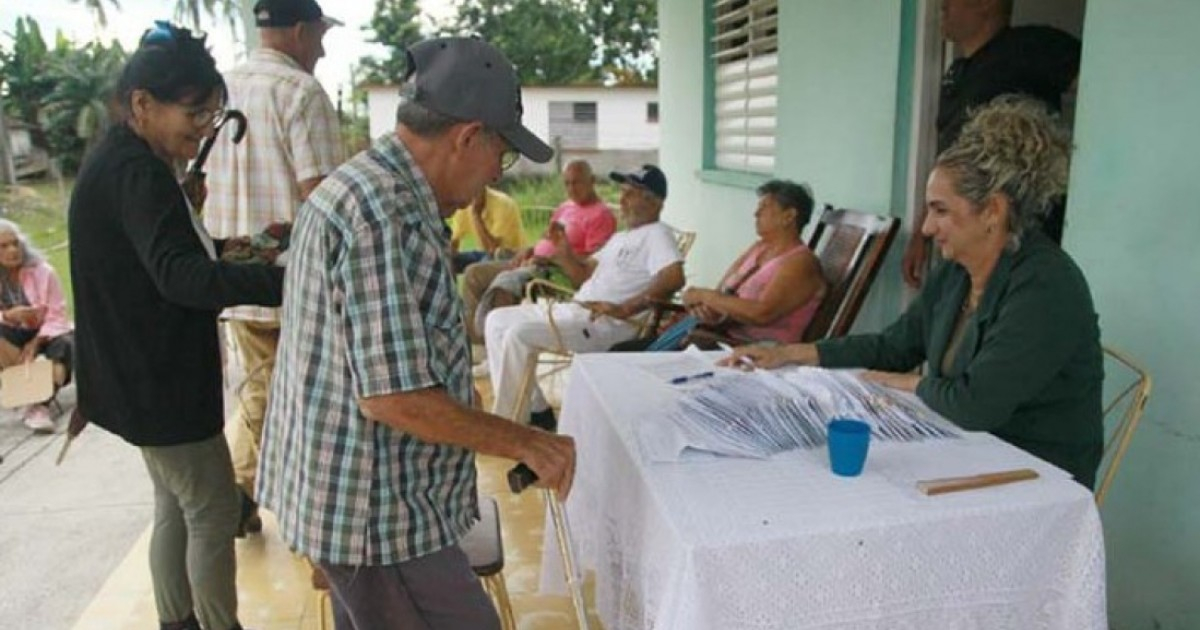
The Popular Savings Bank (BPA) is directly delivering pension payments to rural and suburban areas in Sancti Spíritus by collaborating with 11 non-state economic entities in the province, as reported by the Cuban News Agency.
Leading this local initiative is Branch 5102, situated in the Colón neighborhood of Sancti Spíritus city. Yamilsi Arteaga Calcines, the branch director, stated to the state-run media that they reached out to self-employed workers and representatives from small and medium-sized enterprises (SMEs) in the area, presenting them the opportunity to join the program, which was met with a positive response.
Currently, nine self-employed individuals and several SMEs are actively participating within their scope of influence.
What sets the experience in Sancti Spíritus apart from the general model is that a bank employee personally travels to the community to handle payments, rather than assigning this responsibility entirely to the private sector.
Yunaisy Plasencia Cárdenas, a specialist from the Provincial Directorate of BPA, recounted traveling approximately five kilometers from the city to disburse pensions to 51 individuals in a single day, using a local resident's home as a makeshift payment site.
"We prioritize pensioners from groups 1 and 2, those born up to 1949, considering their age, health issues, and transportation difficulties," Plasencia Cárdenas explained.
For those unable to reach even the community payment point, arrangements are made for home delivery of payments.
Beneficiaries have highlighted the necessity of such alternatives. "Given the current situation and high prices, the pension isn't enough, but having it paid nearly at your doorstep, without the hassle of traveling to Guayos or Cabaiguán, spending a lot on transport, and avoiding queues, is a blessing," expressed Julio Quintana, a physically impaired retiree from La Aurora.
Quintana's testimony underscores a broader reality: the minimum pension in Cuba stands at 4,000 pesos monthly, roughly seven to eight dollars at the informal exchange rate, a sum insufficient for basic needs amidst soaring prices.
The initiative to distribute pension payments outside bank branches began in April as a pilot in four Havana municipalities, where the Central Bank authorized payments in shopping centers to ease pressure on overwhelmed bank branches.
This approach has gradually spread to other provinces. In Holguín, the government launched a plan to distribute pensions in cash through around 20 SMEs and private economic actors. In Guantánamo, the model expanded to over a thousand contracts with economic actors, reaching 18,344 retirees, accounting for 37% of the provincial total.
Nevertheless, the expansion hasn't eradicated scenes of hardship: in September, elderly individuals were documented sleeping on the ground overnight outside bank branches in Santiago de Cuba, hoping to secure a payment turn, highlighting ongoing issues in cash access beyond those served by the program.
Economist Elías Amor has cautioned that involving the private sector in pension payments poses liquidity risks if bank reimbursements are delayed, along with additional bureaucratic burdens for participating businesses.
"Pension payment is a state function and responsibility, and any involvement of private agents in this process entails significant risks," Amor commented to CiberCuba.
Understanding the Pension Payment System in Cuba
How is the BPA facilitating pension payments in Sancti Spíritus?
The BPA is bringing pension payments directly to rural and suburban communities by working with non-state economic actors, allowing pensioners to receive payments closer to their homes.
What challenges do pensioners face in receiving their payments?
Pensioners often confront mobility issues, high transportation costs, and long queues, making it difficult to access bank branches for payments.
What are the potential risks of involving private businesses in pension payments?
Involving private businesses can lead to liquidity issues if bank reimbursements are delayed and can introduce additional bureaucratic challenges for these businesses.