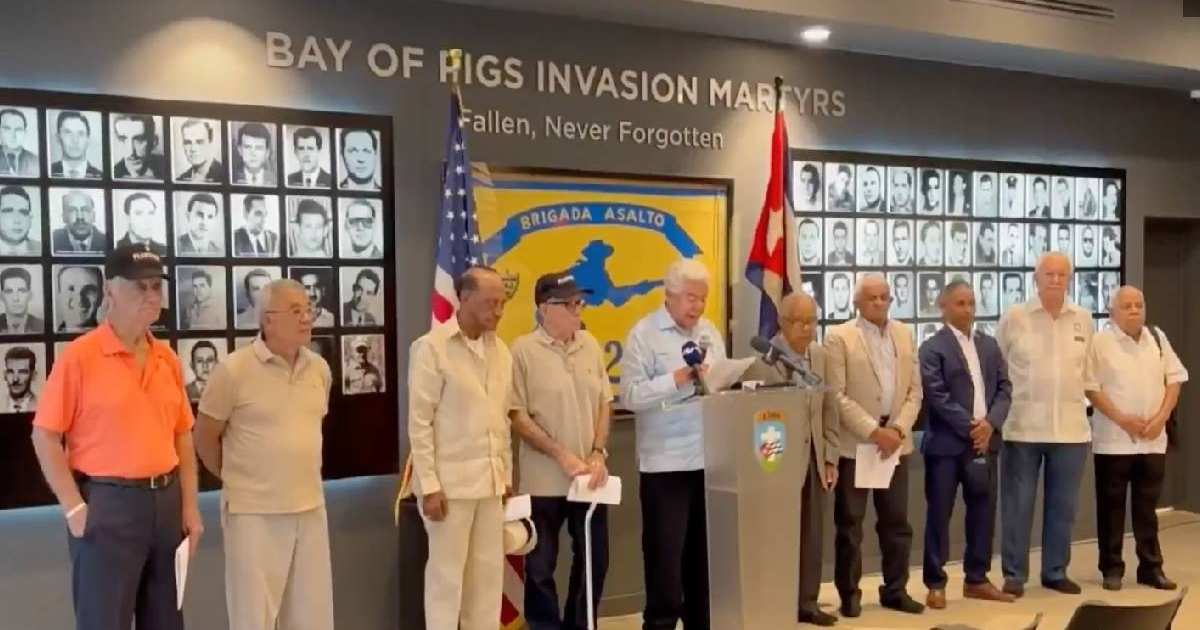
In Miami, a group of more than 130 former Cuban political prisoners from various generations issued a powerful statement on Thursday. They outlined non-negotiable conditions for any potential transition process in Cuba, demanding that all political prisoners be freed and dissent be decriminalized before any negotiations with the regime begin.
Ángel de Fana, a prominent figure from the "plantados" movement, read the declaration to a group of signatories and media representatives at the headquarters of Brigade 2506 in Miami, as reported by Telemundo 51.
The statement, titled "To the People of Cuba and the United States" and dated October 10, brings together former inmates whose imprisonment spans from the early years of the regime to recent times.
In an introductory note, the authors clarify they don't represent any specific organization but speak as Cubans who were imprisoned for opposing the system.
"We are not seeking vengeance but justice for the people's demands," the signatories assert, honoring the paths of those who took up arms and those who chose non-violent resistance.
The document explicitly opposes any approach that grants economic autonomy without political freedom or that maintains the dominance of the ruling elite.
For these signatories, Cuba's crisis cannot be resolved through economic reforms managed by the same structures that created it.
The call for the release of political prisoners is central to their proposal. The authors recall that during their incarceration, they refused to be used as bargaining chips and insist that this principle should remain intact.
"Negotiations can only commence after political prisoners are liberated. Their suffering should not become a tradeable commodity," the declaration emphasizes.
Simultaneously, the signatories do not rule out a negotiated solution, contemplating a provisional transitional government that could temporarily include military and regime officials with acceptable records, alongside Cubans from the island and the diaspora.
The condition is that such involvement shouldn't serve as a means to perpetuate the current political system.
The document also supports an active role for the United States and welcomes any country ready to prevent repression against unarmed citizens, considering it legitimate for Washington to directly support the Cuban people's struggle to reclaim their sovereignty.
Following the presentation, De Fana confirmed in an interview that the declaration had been sent to the State Department and congress members, though no response had been received by that time.
The choice of venue carries deliberate symbolic weight: Brigade 2506 comprises veterans of the Bay of Pigs invasion, thus linking historical armed resistance with the civil resistance of former political prisoners.
De Fana has a direct precedent for this declaration: in 1976, while serving time at Combinado del Este, he, along with 137 other inmates, signed a letter rejecting any negotiations that did not include the unconditional release of all political prisoners.
Fifty years later, he reiterates the same principle from exile, leading the organization Plantados Until Freedom and Democracy in Cuba.
This presentation occurs during a period of heightened political tension. Secret talks between Marco Rubio and Raúl Castro's grandson stalled when Washington demanded the removal of Díaz-Canel as a non-negotiable condition. Meanwhile, the Cuban exile community in Miami grows increasingly disillusioned with the Trump administration for its inaction against the dictatorship.
According to Prisoners Defenders, as of October 1, 2026, there were 1,372 political prisoners in Cuba, including 40 minors. This figure serves as the central argument for the signatories' unwavering stance in any negotiations.
Key Questions about Cuban Political Prisoners and Negotiations
Why is the release of political prisoners a non-negotiable condition?
The release of political prisoners is seen as essential because it addresses fundamental human rights and justice issues, ensuring that those unjustly imprisoned for their political beliefs are freed before any talks that could legitimize the regime.
What role does the United States play in this situation?
The United States is encouraged to take an active role in supporting the Cuban people's efforts to reclaim their sovereignty and prevent repression against unarmed citizens. The involvement of international actors is seen as crucial to ensuring a fair transition process.
How many political prisoners are currently in Cuba?
As of October 1, 2026, there are reported to be 1,372 political prisoners in Cuba, including 40 minors, highlighting the extensive human rights issues within the country.