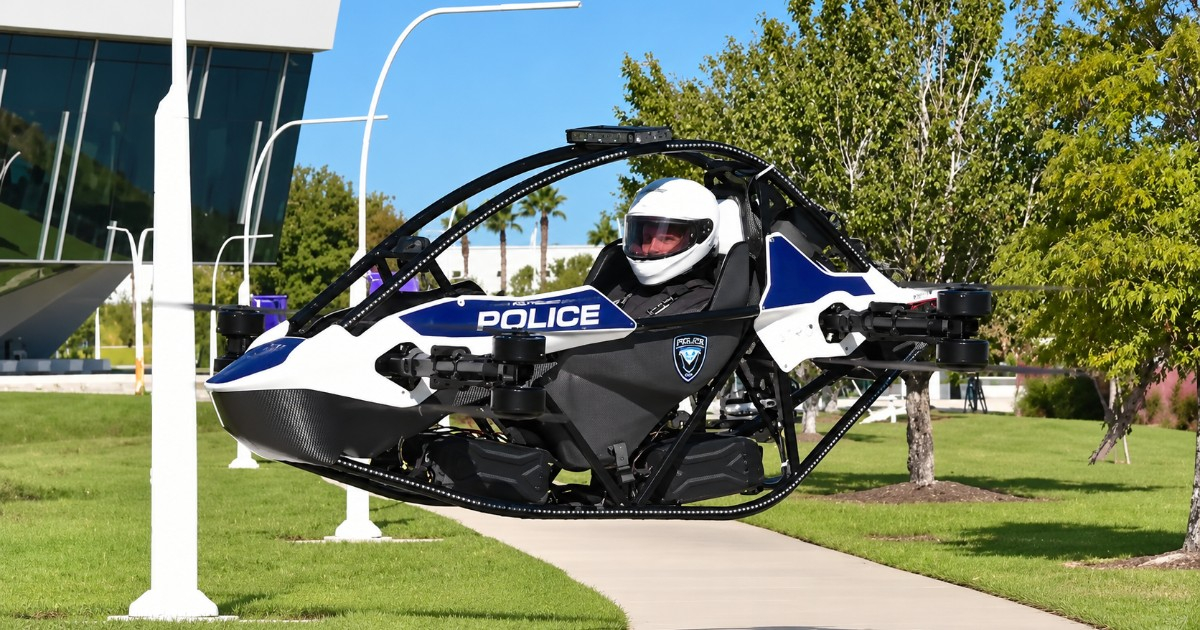
In a pioneering move, a Florida university has introduced what it hails as the nation's first electric flying police vehicle. This manned aircraft, costing nearly $150,000, is designed to bolster patrols, aid in search operations, and enhance emergency response capabilities.
Unveiled on Tuesday, the vehicle, named "Astro," was presented by the Florida Polytechnic University Police Department located in Lakeland, at the heart of the state.
The university proudly claims to be the first law enforcement agency in the United States to integrate a manned electric aircraft capable of vertical takeoff and landing, also known as an eVTOL, into its operations.
While Astro resembles something out of a sci-fi film, it has yet to engage in regular police patrols. The institution is currently in the last stages of securing the necessary approval from the Federal Aviation Administration (FAA).
The Unique Capabilities of Astro
Powered by electric motors, Astro is capable of vertical ascension without the need for a runway. Unlike typical drones used by law enforcement, this vehicle includes a seat for a pilot, allowing direct control by an officer.
According to a report by FOX 13 Tampa Bay, the university invested nearly $150,000 in the aircraft, which weighs around 154 pounds without its battery and can remain airborne for approximately 20 minutes.
Developed by the company Jetson, the Jetson ONE model is crafted for a single occupant. As reported by Spectrum News, it can carry up to 210 pounds and reach altitudes of 400 feet. However, its limited range means it won't replace police cars or helicopters for extended missions.
Potential Applications and Future Prospects
The university aims to assess Astro's effectiveness in scenarios demanding swift access to hard-to-reach areas. Potential applications include searching for missing persons, monitoring the campus and its surroundings, and responding to emergencies in locations inaccessible to ground vehicles.
Astro could also play a role in post-hurricane recovery efforts, particularly when flooding, debris, or road damage obstruct access. Additionally, it might be used to deliver emergency supplies to isolated areas, within the device's technical and operational limits.
Aaron Murray, the university police chief, stated that this technological advancement aims to stay ahead of changes in public safety as new forms of aerial mobility develop. "Advanced air mobility is a burgeoning technology, and we can choose to be proactive or reactive as it evolves," Murray emphasized in the university's announcement.
The Florida Poly Police Department also plans to collaborate with other regional security agencies to explore Astro's use during emergencies and joint operations. However, an official date for commencing police flights has not been set.
FOX 13 reported that project leaders hope to receive FAA approval between November and the end of December, though this timeline is not guaranteed.
The Inspiration Behind Astro's Name
The aircraft's name, "Astro," pays homage to the dog from the animated series The Jetsons, which envisioned a futuristic society with flying vehicles as a part of daily life since the 1960s.
Despite a three-year waiting list for the Jetson ONE model, manufacturer Jetson prioritized Florida Polytechnic University's order. CEO Stéphan D'haene explained that the decision was driven by the desire to explore this technology beyond entertainment and recreational flights.
Jetson views the university project as an opportunity to investigate new uses for lightweight electric aircraft in public safety activities.
Educational Opportunities and Research Advancements
Beyond its police functions, Astro will serve as a research and educational tool for engineering and computer science students. This fall, the university launched a new Aerospace Engineering program, believing the aircraft will provide hands-on experience for studying emerging technologies.
A team of students is already working with the equipment, analyzing its features and developing academic projects based on operational data.
According to FOX 13, university researchers are also considering creating a digital twin—a virtual representation of the vehicle and its operational environment—to design training scenarios through virtual reality.
Professor Matt Bohm, head of the Mechanical, Industrial, and Aerospace Engineering department, told the network that these tools would prepare operators for various situations before encountering them in real-life conditions.
The unveiling of Astro coincides with Florida's push for advanced air mobility development, a technology encompassing electric aircraft capable of vertical takeoff and landing.
Last April, Florida enacted legislation to facilitate the future operation of electric flying taxis by establishing a legal framework for developing vertiports and charging infrastructure. The HB 1093 law, signed by Governor Ron DeSantis, laid out provisions for integrating these facilities into the state’s transportation system and funding their construction.
FAQs on Florida's Flying Police Vehicle Initiative
What is the purpose of the flying police vehicle "Astro"?
Astro is designed to enhance patrols, assist in search operations, and improve emergency response by providing swift access to difficult-to-reach areas.
How does the flying police vehicle operate?
Astro operates with electric motors, allowing it to take off and land vertically without a runway, and includes a seat for a pilot to control the vehicle directly.
What are the potential applications of Astro beyond policing?
Astro could be used for emergency supply delivery, post-disaster recovery, and as a tool for education and research in engineering and aerospace fields.
When will Astro begin its official police flights?
There is no confirmed date for the start of official police flights, but FAA approval is anticipated between November and December.