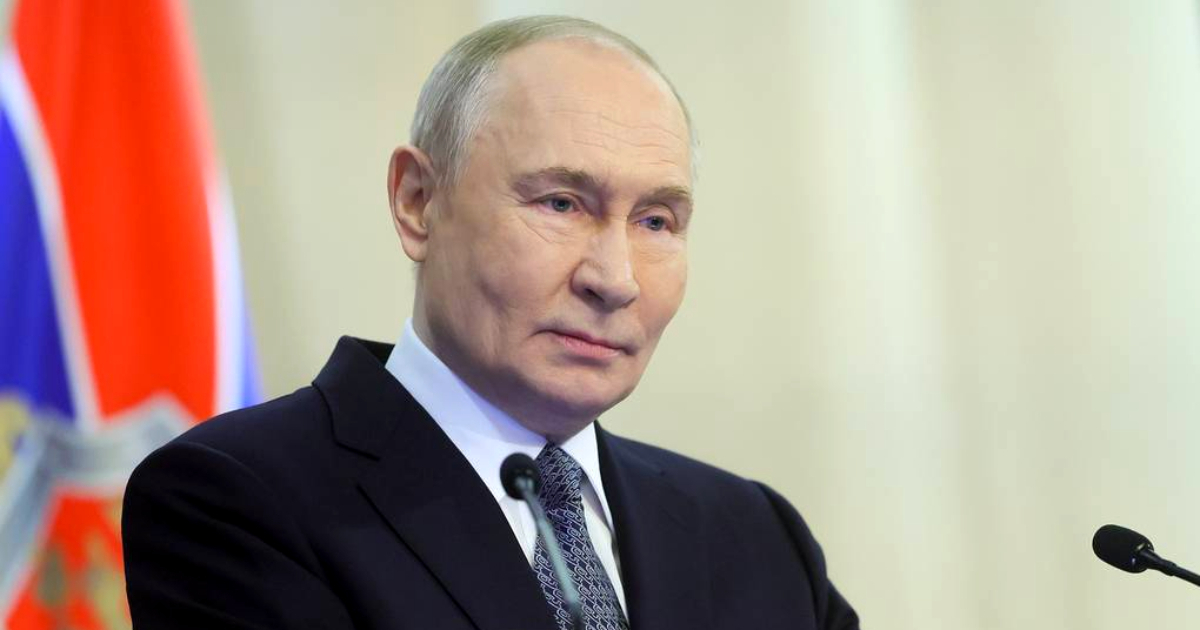
On Wednesday, Vladimir Putin expressed his readiness to restart trilateral discussions concerning Ukraine around November 10, facilitated by the United States.
According to an EFE report, the Russian leader engaged in a nearly three-hour meeting at the Constantine Palace in Saint Petersburg with Steve Witkoff, the White House's special envoy.
During a phone press briefing, Yuri Ushakov, the Kremlin's International Policy Advisor, confirmed Russia's stance: "The president informed Witkoff that, in principle, we are prepared to recommence trilateral negotiations around November 10 on the crucial issue of establishing a security system for Russia and Ukraine post-conflict."
Ushakov mentioned that Witkoff responded positively to the announcement, suggesting that the resumption of talks "will undoubtedly be received with great satisfaction by the U.S. president, Donald Trump."
These trilateral discussions among Russia, Ukraine, and the United States had been on hold since mid-February, following the Trump administration's shift in focus towards military operations against Iran, which diverted diplomatic efforts from the European conflict.
On the eve of the Saint Petersburg meeting, Ukrainian President Volodymyr Zelensky met in Oslo with Witkoff, Norwegian Prime Minister Jonas Gahr Støre, and Finnish President Alexander Stubb to present Ukrainian proposals on security guarantees and potential ceasefire formats.
However, Putin approached the ideas formed in the Norwegian capital with skepticism. Ushakov noted that while the Russian leader heard the "new positions and ideas" from Kiev and European leaders, he found "little of practical value" for the settlement process.
Putin also used the meeting with Witkoff to emphasize what he described as the "strategic initiative" of his forces across all front sectors, recalling the massive Ukrainian drone attack involving over 1,600 drones against Moscow in September during the final day of the Russian legislative elections.
The meeting also covered other bilateral issues, including the war in Iran and a deal for Russian diesel supply to the United States, a deal Zelensky labeled as "weak," creating tension between Washington and Kiev.
The relationship between Trump and Zelensky is currently strained; the U.S. president remarked in October that Ukraine needed "a new president" to close a deal, while Zelensky warned that siding with Putin would be a "historic mistake" for Washington.
Back in September, envoys Witkoff and Kushner traveled to Moscow and then Kiev, managing a 72-hour air truce that failed to yield significant political progress. The U.S. peace proposal was scaled down from 28 to 19 points following consultations with Ukraine and European allies who deemed it overly favorable to Russia.
Putin also proposed a potential trilateral summit with Trump and Chinese President Xi Jinping on the sidelines of the Asia-Pacific Economic Cooperation (APEC) meeting scheduled in Shenzhen for November 18 and 19, although this meeting remains unconfirmed and without a defined agenda.
Key Questions About the Resumption of Ukraine Peace Talks
Why are the trilateral talks between Russia, Ukraine, and the United States significant?
These talks are crucial as they aim to establish a security framework for Russia and Ukraine following the conflict, potentially bringing stability to the region.
What caused the previous suspension of these talks?
The talks were suspended as the Trump administration redirected its focus towards military actions against Iran, which drew attention away from the European conflict.
What was the outcome of Zelensky's meeting in Oslo?
During the Oslo meeting, Ukrainian proposals on security guarantees and potential ceasefire formats were presented, though Putin expressed skepticism about their practicality.
What are some of the tensions between Trump and Zelensky?
Tensions arise from Trump's comments about Ukraine needing a new president to secure a deal and Zelensky's warning against the U.S. siding with Putin, calling it a "historic mistake."