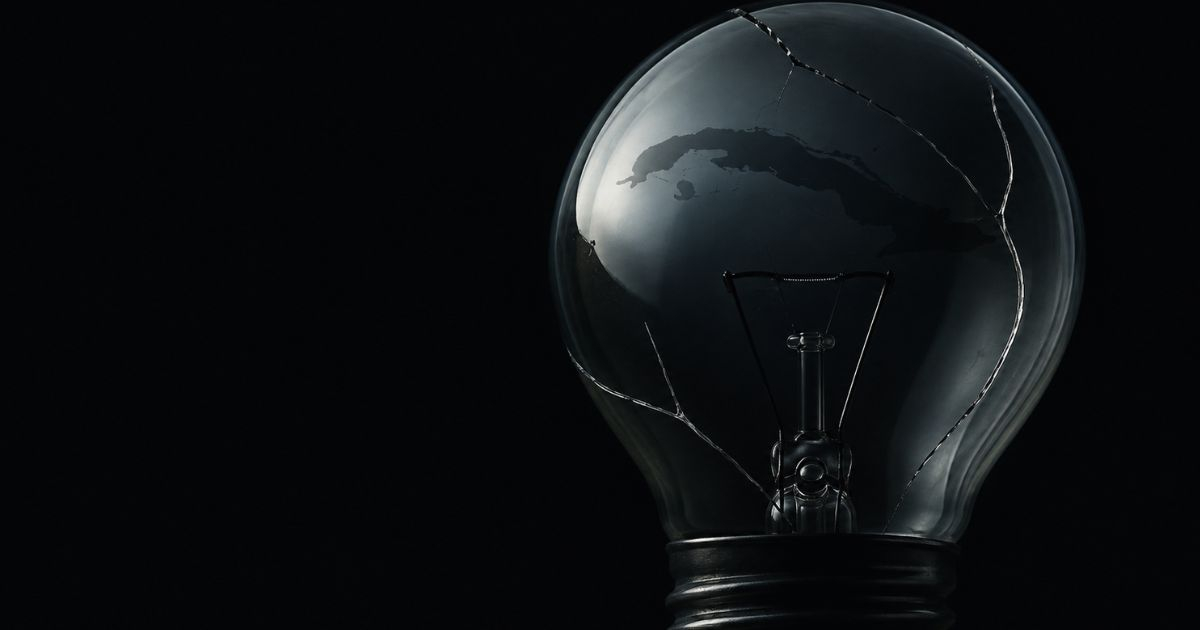
This Wednesday, Cuba is bracing for another day of severe power outages. The Electric Union (UNE) forecasts an impact of 1,963 MW during peak demand hours, approaching a staggering 2,000 MW shortfall, as outlined in the official report released this morning.
On Tuesday, the system was already operating at its limits, with service interruptions due to capacity shortages persisting throughout the day and night. The highest impact was recorded at 1,942 MW at 7:50 PM.
As of 6 AM Wednesday, the National Electric System's (SEN) availability stood at a mere 1,017 MW against a demand of 2,300 MW, leaving 1,292 MW without power.
By midday, an impact of 1,450 MW was anticipated, and during the evening peak, the expected demand rises to 2,950 MW with only 1,017 MW available, resulting in a 1,933 MW deficit.
Major Power Plants Face Simultaneous Failures
The simultaneous breakdown of several units is largely responsible for this crisis. Out of service are Mariel's unit 8, Santa Cruz's units 1 and 2, Felton's unit 2, and Renté's units 3 and 6.
Additionally, maintenance is ongoing for three units: Santa Cruz's unit 3, Nuevitas's unit 5, and Renté's unit 5. These thermal generation constraints total 518 MW.
The largest thermoelectric plant in the country, the CTE Antonio Guiteras in Matanzas, is also unavailable. It synchronized on Monday night at 10:06 PM but went offline again just 24 hours later, with causes "yet to be identified." Guiteras has had at least 17 unexpected outages throughout 2026.
Insufficient Solar Energy Contributions
On Tuesday, solar photovoltaic energy contributed 3,752 MWh, with a peak output of 591 MW at midday. However, this was insufficient to offset the collapse of the thermal network during nighttime hours.
This week's crisis is part of a worsening situation that intensified mid-month. On October 16, a fire in Santa Cruz's unit 1, caused by an oil leak in the rotor, pushed the maximum impact to 2,026 MW, leaving 75.5% of the national demand unmet with only 740 MW available against a 2,900 MW demand.
Structural Issues and Oil Shortages
The most severe impact in October occurred on October 2, with a maximum shortfall of 2,130 MW. September was even gloomier, with at least 23 out of 28 days ending with over 2,000 MW of unmet demand. A Communist Party leader in Pinar del Río admitted that some circuits had been without electricity for more than 90 consecutive hours.
The underlying causes of this collapse are structural issues that the regime has failed to address for decades. Cuba requires about 110,000 barrels of oil daily but produces only around 40,000 barrels internally. This leaves a deficit of approximately 60,000 barrels daily, which is no longer covered by Venezuela, Mexico, or Russia, whose supplies ceased in 2026.
The forecast of 1,963 MW of impact for tonight indicates that Cubans will once again endure prolonged blackouts without any real capacity for the system to reverse the situation.
Understanding Cuba's Power Outage Crisis
What is causing the power outages in Cuba?
The outages are primarily due to simultaneous failures in multiple power plants and ongoing maintenance, combined with structural issues like insufficient oil production and supply shortages.
How are renewable energy sources contributing to Cuba's power grid?
Solar photovoltaic energy is contributing, but its output is insufficient to compensate for the collapse of the thermal network, especially during nighttime hours.
What structural issues are affecting Cuba's energy sector?
Cuba faces longstanding structural issues, including inadequate oil production and a reliance on external oil supplies, which have ceased from countries like Venezuela, Mexico, and Russia.