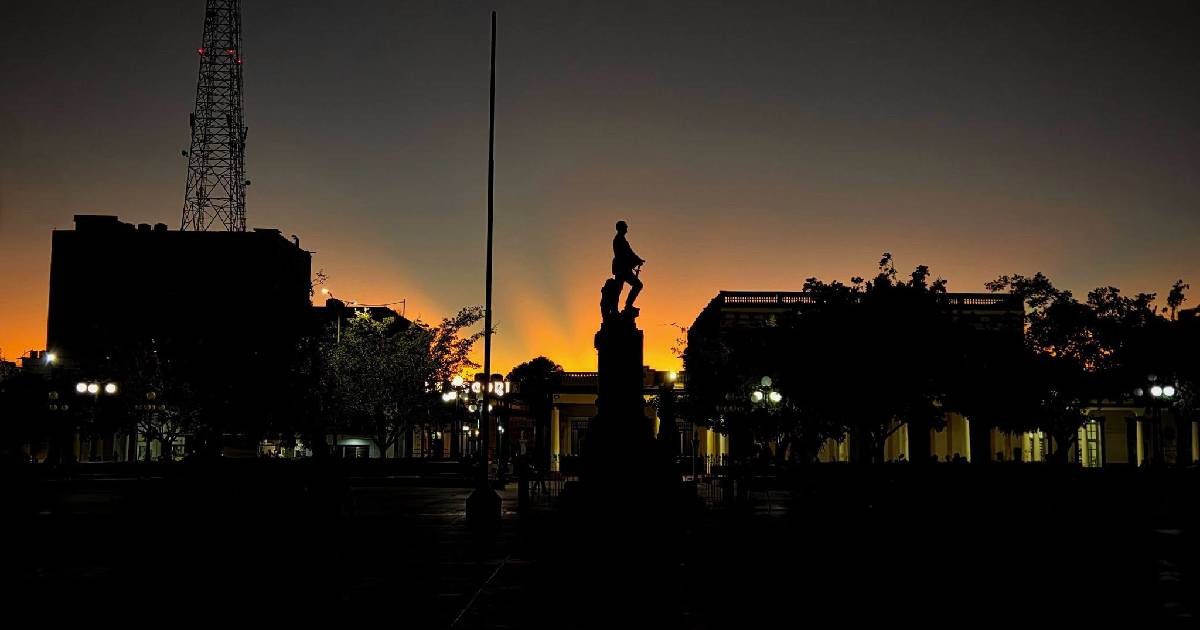
Holguín-based writer José Poveda Cruz took to Facebook on Saturday to share a satirical piece titled "Farewell to the Circuit Rotation," humorously bidding adieu to the recently terminated power rotation system by the Holguín Electric Company. This comes as the city endures a relentless 25-hour power outage.
The announcement from the provincial electric company coincided with Poveda Cruz's post, as they formally ceased the circuit rotation in the city due to the "complex circumstances affecting the National Electric System." Only the circuits powering the Lenin Hospital, the province's largest medical facility, were exempted from this measure.
Using wit, Poveda Cruz detailed the absurdity of the canceled system: "The arrangement involved enduring 12 or 13 hours without electricity, to then relish three glorious hours of power. Just enough time to charge your phone, cook a meal, do some laundry, and reassure yourself of your place in civilization."
He further dissected the regime's euphemistic language, pointing out: "Circuit rotation—a term that sounds almost musical, crafted in the national factory of euphemisms where blackouts become 'interruptions,' scarcity translates to 'challenges,' and disaster is a chance to enhance administrative vocabulary. If water were cut off for five years, they'd likely call it an intermittent hydration program."
The irony in Poveda Cruz's writing paints a vivid picture of the exhausting daily crisis faced by Cubans: "We've now been without power for 25 hours and no one knows when it will return or how long the miracle will last. Food spoils, the heat takes over, and one wonders how long a person can endure such an experiment without the word 'life' becoming an exaggeration."
Human Toll of the Energy Crisis
His portrayal of the human condition is equally bleak: "People speak in hushed tones, walk with hunched shoulders, and wear the look of someone who just received bad news—even if it's the same news as yesterday. We are a laboratory of human resilience, where decision-makers test their theories and the population provides the experimental material for free. Except the researchers usually have electricity."
Social media reactions to the electric company's announcement were also filled with irony. "What rotation?" one user questioned, encapsulating the sentiment of those who never experienced regular power schedules. Another user cynically predicted, "When the National Electric System completely collapses, which isn't far off, state TV will boast we are lucky to have the moon at night and the sun by day."
Statistics back this skepticism. On Saturday morning, the National Electric System's availability was a mere 758 MW against a demand of 2,250 MW. In Holguín, the served demand was just 50 MW, with some circuits experiencing over 39 hours without service, and one exceeding 43 hours. That same day, residents of Santa Rita in Jiguaní (Granma) took to the streets, yelling "We want power!" at a police patrol that failed to disperse them.
Wider Implications and Systemic Issues
The electric collapse is exacerbating the water crisis, as over 80% of Cuba's water supply system relies on electricity. The regime itself acknowledged that 2.7 million Cubans are affected by water disruptions. Poveda Cruz is no stranger to these hardships; earlier in October, he recounted 28 days without water in his home, highlighting the disparity between neighbors with and without water pumps.
This crisis stems from longstanding structural issues. The Antonio Guiteras thermoelectric plant, the largest in the country, has faced at least 17 unscheduled outages this year alone. On October 16, a fire took the Ernesto Guevara de la Serna thermoelectric plant's unit 1 offline in Mayabeque, while the Felton thermoelectric plant in Mayarí also went out of service that day. Cuba has experienced eight total disconnections from the National Electric System this year.
Poveda Cruz concludes his piece with a blend of humor and hopelessness: "Fortunately, planetary rotation still exists, and no official has announced a reorganization of Earth's movement. Although, given how long we've been living in darkness, the sun almost feels like a private service."
Understanding Cuba's Energy Crisis
Why did the Holguín Electric Company stop the power rotation?
The Holguín Electric Company ceased the power rotation due to the complex circumstances impacting the National Electric System, which made continuing the rotation untenable.
What has been the public's reaction to the end of power rotation?
The public's reaction, primarily on social media, has been one of irony and skepticism, with many questioning the effectiveness of the rotation and expressing doubt about future power reliability.
How does the power crisis affect other services in Cuba?
The power crisis significantly impacts other services, particularly water supply, as over 80% of Cuba's water system depends on electricity, affecting millions of Cubans.