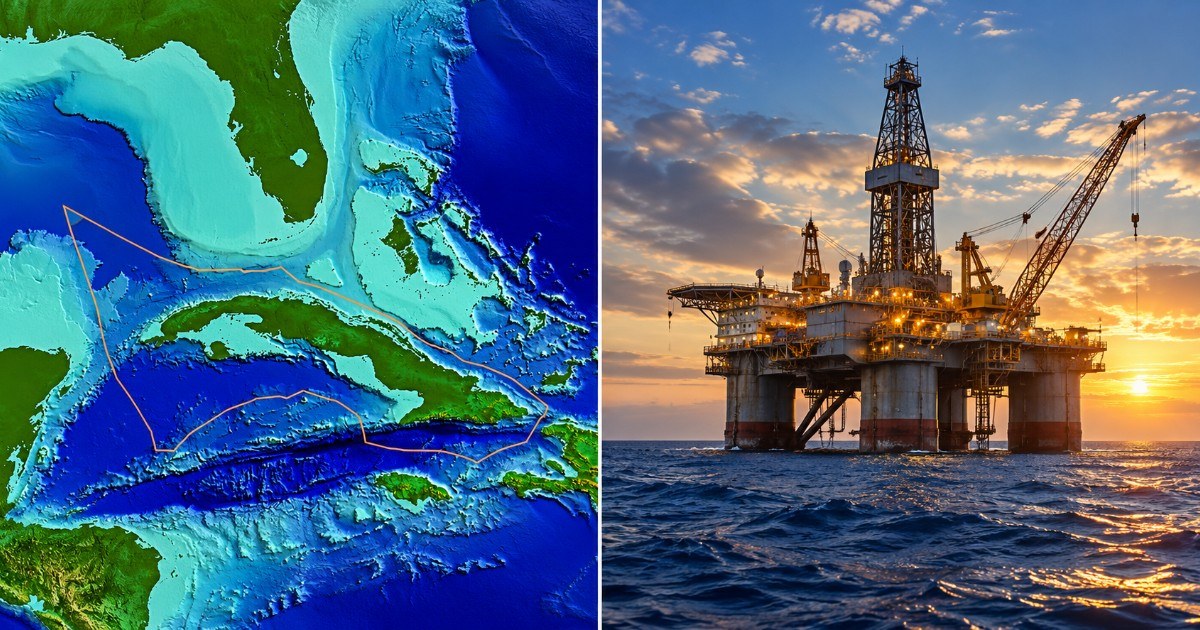
In an effort to broaden its oil exploration horizons, Cuba is setting its sights on an expansive area of the Gulf of Mexico, tapping into its continental shelf that stretches beyond the 200 nautical mile limit.
Cuban authorities estimate this additional zone encompasses about 1,700 square kilometers of seabed and subsoil, a prime target for future studies on potential natural resources, including oil and gas.
Scientific Foundation for Expansion
On Saturday, Armando Rodríguez Batista, the Minister of Science, Technology, and Environment, took to Facebook to share insights about the scientific research underpinning Cuba's appeal to the United Nations Commission on the Limits of the Continental Shelf. The focus was on a region known as the Eastern Polygon of the Gulf of Mexico.
This initiative earned accolades in 2025, securing one of the National Awards from the Academy of Sciences of Cuba (ACC), which honored 104 scientific achievements across various fields. The research was distinguished in the Technical Sciences category.
Demonstrating the Extended Continental Shelf
The project aimed to demonstrate, through geological, geophysical, hydrographic, and geodetic studies, that Cuba's continental shelf naturally extends beyond the 200 nautical mile boundary, in accordance with the United Nations Convention on the Law of the Sea.
The roots of this initiative trace back to 2009, when Cuba initially submitted its request to the Commission. On February 15, 2024, Cuban officials presented a revised proposal with additional technical data. The Commission, after reviewing the scientific findings, approved the recommendations with modifications on February 26, 2025.
Legal and Scientific Advancements
In 2026, the process continued legally. According to United Nations records, Cuba deposited the geographic coordinates of its outer continental shelf boundaries, extending beyond the 200 nautical mile mark, on April 21 of this year, following Decree-Law 110 dated October 17, 2025.
This achievement allows Cuba to define an area of seabed and subsoil over which it can exercise specific sovereign rights for the exploration and extraction of natural resources, in line with international law. However, this does not imply a new territorial grant by the UN or Cuban sovereignty over the waters above the shelf.
Strategic Implications and Exploration Opportunities
The rights associated with the continental shelf focus primarily on the seabed and subsoil, making the recognition crucial for mineral exploration and the potential discovery of oil and gas deposits.
The Cuban authorities shared the estimated 1,700 square kilometers in information released by Rodríguez. United Nations documentation confirms the procedure and recommendations, although independent cartographic measurement of the area has not been verified.
Alejandro Morales Abreu, a specialist from the Geophysics Base Scientific-Technological Unit of the Petroleum Research Center (CEINPET), was involved in the project. He explained that the research aimed to "support the demonstration of the expansion of Cuba's submerged territory in the Gulf of Mexico."
Collaborative Efforts and Future Prospects
Morales highlighted that establishing these boundaries could enhance opportunities for negotiating, exploring, and potentially exploiting marine soil and subsoil resources in the medium to long term.
The area under investigation lies in the Eastern Polygon of the Gulf of Mexico, where the continental shelves of Cuba, Mexico, and the United States converge. Previous maritime delimitation agreements exist among these nations, and Cuba's documentation to the UN references treaties signed in 2017 with Mexico and the United States.
Thus, the Commission's recommendations should not be seen as a new territorial negotiation but as part of the technical and legal process to define Cuba's outer continental shelf boundaries.
Challenges and Aspirations in Energy Development
Amid Cuba's ongoing energy crisis, increasing national production of oil and gas is a sector priority, though any benefits from new explorations are not expected to be immediate.
Morales acknowledged that CEINPET employees also endure power outages and material shortages, which underscore the significance they place on their research. "We are people of this nation, experiencing the same hardships, and because of that, we understand the importance of our work succeeding," he stated.
The confirmed progress is both scientific and juridical: Cuba received favorable recommendations, with modifications, from the Commission on the Limits of the Continental Shelf and subsequently submitted its outer boundary coordinates to the United Nations.
Regulatory Changes and Investment Opportunities
In a move to expand investment and business participation, the Cuban government is revising the legal framework for the oil sector. On October 12, the 2026 Decree 184 was published, detailing regulations under the "Oil and Gas" Decree-Law 135, which governs the legal conditions for hydrocarbon exploration, extraction, refining, transportation, storage, and marketing.
The new regulation covers both onshore and offshore oil activities within Cuba's continental shelf and exclusive economic zone, outlining procedures for permits, licenses, contracts, and concessions.
Notably, certain Cuban private enterprises may now directly engage in oil exploration and extraction activities under state authorization. The new regulations specify that micro, small, and medium-sized enterprises, as well as private firms with over 100 workers and non-agricultural cooperatives, can apply for concessions, provided they meet the stipulated technical and legal criteria.
Acquiring technical accreditation does not guarantee a concession, as the process requires intervention by relevant agencies and state approvals. Concessions can last up to 30 years, extendable by another 10, without transferring ownership of the deposits to private operators.
The government has also opened up new avenues for private investment in refineries, fuel storage, and other industry-related facilities, aiming to attract financial resources and enhance operational capacity.
Frequently Asked Questions About Cuba's Oil Exploration Expansion
What is the significance of the 1,700 square kilometers area for Cuba?
The 1,700 square kilometers area is critical for Cuba as it allows the country to potentially explore and exploit new natural resources, particularly oil and gas, which can help alleviate its energy crisis.
How does the new regulatory framework affect private investment in Cuba's oil sector?
The new regulatory framework allows certain Cuban private enterprises to engage in oil exploration and extraction activities, opening up opportunities for private investment in refining and storage facilities, thereby attracting financial resources and enhancing operational capacity.
Does the UN's endorsement give Cuba sovereignty over the waters above the continental shelf?
No, the UN endorsement does not grant Cuba sovereignty over the waters above the continental shelf. The rights are primarily related to the seabed and subsoil, focusing on exploration and exploitation of resources.