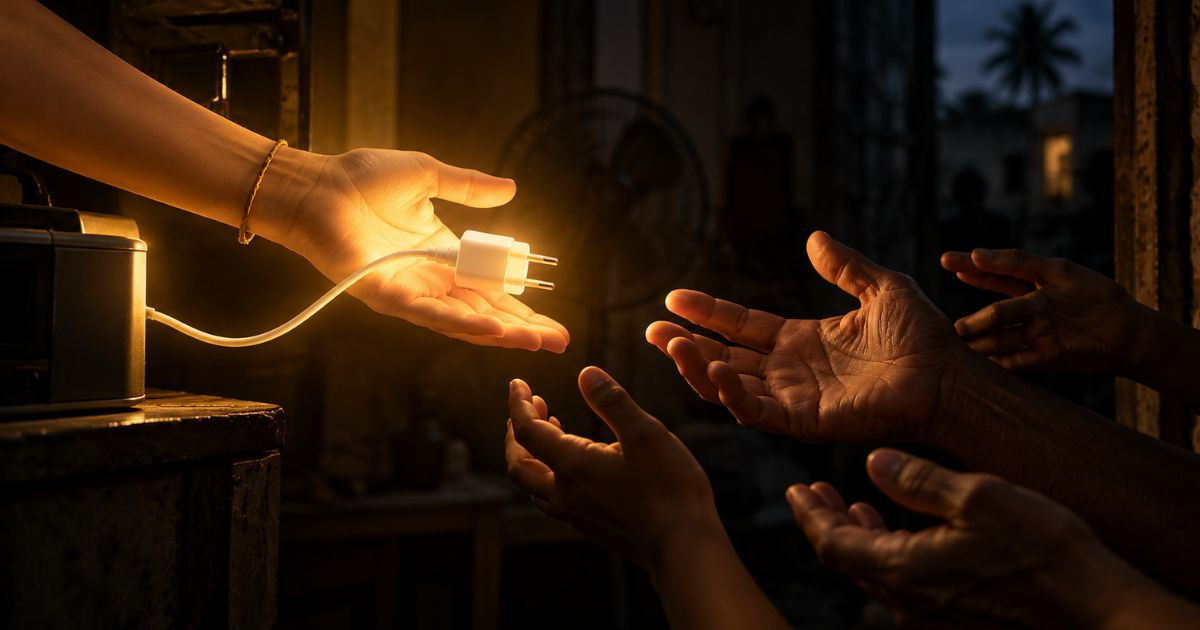
Amid the relentless power outages plaguing Matanzas province, a resident of Cárdenas has taken a heartfelt step to support her community. Yesenia Peña Godoy has opened her home to allow neighbors to charge essential electronic devices without any cost.
Sharing her generous offer on the Facebook group "Compra y Venta Cárdenas," Yesenia invited anyone in need to recharge items like rechargeable bulbs, fans, lamps, or portable power stations such as EcoFlow at her home, free of charge.
"Good morning, with the current power situation in Cárdenas, anyone needing to charge essential items such as bulbs, fans, EcoFlows, lamps, etc., is welcome to come to my house at no cost," she wrote, making a significant gesture during these extended blackouts.
Yesenia lives in the Brisas del Mar neighborhood, in an apartment marked by her shop's sign, "Tienda Yesenia." She provided directions for those interested in finding the location.
"It will be a pleasure to help you," she concluded in her message.
This initiative comes at a particularly challenging time for Matanzas residents, where many communities are enduring consecutive hours without electricity.
In such conditions, having a charged fan, lamp, or portable battery can provide significant relief for families.
Community Gratitude and Support
The post attracted numerous grateful reactions on Facebook. Many users praised Yesenia's generosity, emphasizing the importance of neighborly support when blackouts disrupt daily life.
"Thank you very much. I think I will have to take you up on your offer. God bless you," commented one user, hinting at their potential need to visit Yesenia’s home to charge devices.
Another user celebrated the initiative with a note of admiration: "It's wonderful that there are still people with such big hearts."
"Blessings to you for such a beautiful gesture for those in need, with no interest whatsoever," expressed another commenter.
Inspiring Further Acts of Kindness
Yesenia’s action inspired another neighbor to offer their apartment for charging devices as well. "You can also come to my apartment," the neighbor wrote, providing instructions to locate her home.
This personal offer from a Cárdenas resident quickly led to a second wave of assistance in a city where power cuts have severely disrupted daily life.
While most responses were positive, a few skeptics questioned the motivations of those offering help. However, the majority praised the neighbors and expressed gratitude, congratulations, and blessings.
The Broader Context of Matanzas' Power Crisis
The solidarity shown by residents like Yesenia is particularly crucial given Matanzas' severe electrical crisis. A recent report documented outages exceeding 60 hours in various circuits, with towns like Manuelito and Bolondrón approaching 70 hours without power.
According to official journalist Pedro Rizo Martínez from TV Yumurí, several circuits in Jagüey Grande and Bolondrón’s aqueduct had been without power for nearly 60 hours.
Other areas, including Pedro Betancourt, Güira, Los Arabos, Colón Este, Mexico, and San José, experienced interruptions lasting over 45 hours, while Versalles, Perico, Santa Marta, and Boca de Camarioca also faced long outages.
The provincial Electric Company director, Alejandro Rodríguez Aspeitía, acknowledged that the power shortfall in Matanzas exceeded 130 megawatts, the maximum load that could be removed from service at the time.
He noted efforts to prioritize circuits that had been without power the longest, though he cautioned that additional issues could arise while attempting to restore service.
This situation is not an isolated event. In late June, Matanzas had already experienced outages surpassing 70 consecutive hours, with eight substations offline, four of which were affected by the theft of dielectric oil from transformers.
In July, the crisis worsened, with reports of outages lasting up to 96 hours in some circuits, as residents questioned why government facilities maintained air conditioning during power cuts.
Acts of Solidarity Across Cuba
Yesenia's initiative echoes other gestures of solidarity by Cubans who chose to share the electricity available in their homes during emergencies.
In November 2025, Humberto Milán, a resident of Río Cauto in Granma, offered free electricity to his community following the devastation caused by Hurricane Melissa. His niece shared a message inviting residents to charge their devices at the family home between four and six in the afternoon, free of charge.
In the same province, a young man from Guisa provided a generator for neighbors to charge phones, tablets, flashlights, lamps, and fans for young children. The fuel required was donated by a friend who wished to remain anonymous.
A year earlier, in October 2024, Daniel Nieto Vega made a similar offer in Santiago de Cuba during the collapse of the National Electric System, which left many communities without power.
Linked to Baire in the Contramaestre municipality, Daniel announced he would start his generator to allow others to charge phones and lamps, setting two daily schedules to facilitate access for those in need.
During that emergency, images emerged of Santiago residents visiting radio stations, state facilities, and private homes with generators to recharge devices.
These experiences in Santiago de Cuba, Granma, and now Matanzas highlight how neighborly support has become a crucial resource in coping with prolonged blackouts.
FAQs on Community Support and Power Outages in Matanzas
What inspired Yesenia Peña Godoy to offer free electricity?
Yesenia was motivated by the ongoing power outages in Matanzas and the need to support her neighbors by allowing them to charge essential electronics at no cost.
How have residents responded to the power outages in Matanzas?
Residents have shown gratitude and praised community-driven initiatives like Yesenia's, which provide critical support during lengthy blackouts.
What other acts of solidarity have occurred in Cuba during power outages?
Cubans in various provinces have shared electricity from their homes, using generators or offering free charging for devices, as seen in Granma and Santiago de Cuba.