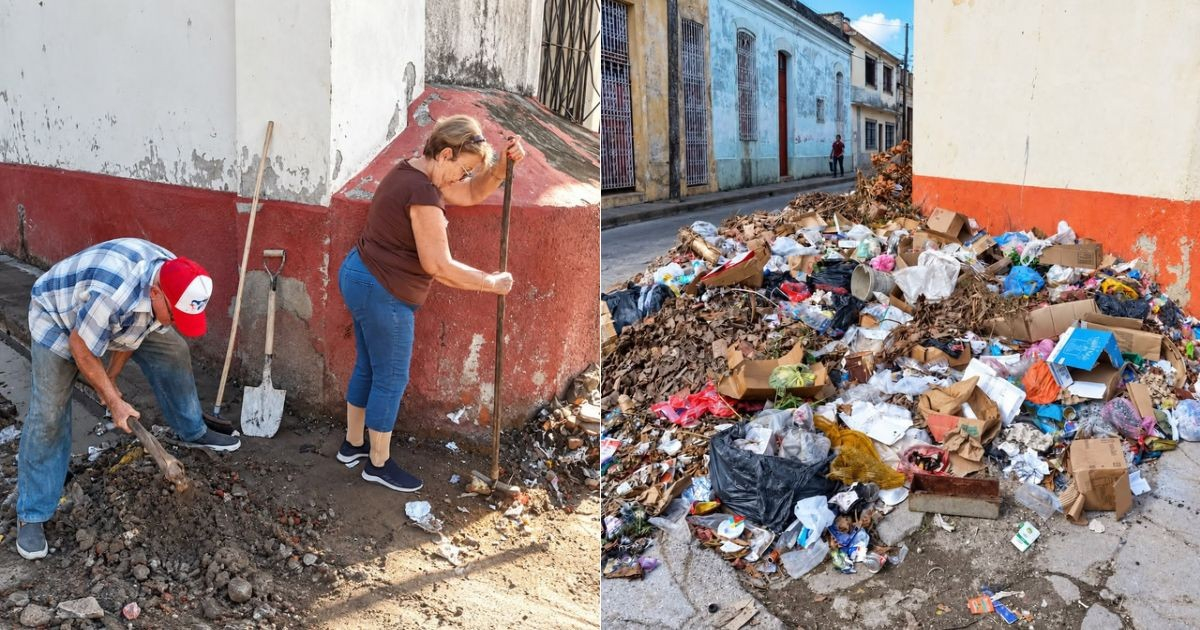
A Cuban journalist known on social media as María Teresa, who currently resides outside of Cuba, shared images on Facebook this past Friday showing her grandparents, approaching 80 years of age, cleaning up the garbage piled up outside the church of Santa Ana in the historic center of Camagüey. This task fell to them because the island's regime fails to provide waste collection services.
“Here are my grandparents, nearly 80, cleaning the trash heap by the church of Santa Ana in Camagüey because the government won’t do it,” the journalist wrote. Many commenters identified the elderly couple as Gilda and Enriquito.
María Teresa turned her anguish into a direct accusation: “Their children and grandchildren have left. Their friends are gone. They carry all the trash of this system, both literally and metaphorically.” She then demanded what she views as a fundamental responsibility of the state: “Trash collection is an essential public service the government must ensure. THAT'S WHY THEY ARE THERE. In any free and democratic country, they wouldn’t last another day in power.”
She also warned that her grandparents' efforts would be futile: “Soon enough, the trash will return. People will dump dead animals, rubble, and all kinds of waste. They’ll collect it whenever they feel like it, if they ever do.” She concluded with a stark image that encapsulates the plight of countless Cuban families: “Cuba is a failed state where El Cangrejo [Raúl Guillermo Rodríguez Castro, grandson of Raúl Castro] wears Hermès accessories and trades away the country his grandfather gifted him, while mine have to wipe the sweat off after cleaning the street corner trash, clasp hands, and return to an ever more empty house, to endure another hour of blackout and solitude.”
This incident is not isolated. Camagüey has long suffered from a chronic waste management crisis: municipal estimates indicate only 35% to 40% of generated waste is collected, leaving between 77 and 143 tons of garbage daily uncollected out of approximately 220 tons.
Back in July, a trash pile on Las Palmas street caught fire at dawn, causing explosions. In August, a resident on Camujiro street reported two months without trash collection. By September, the collapse of state services continued to flood the historic center, a UNESCO World Heritage site, with waste.
Comments on the social media post expressed outrage and concern for the elderly couple’s health. “It’s unbelievable what those left in this country have to endure, especially the elderly,” one user remarked. Another noted the health risks: “Having it around is bad, but picking it up is worse; they’re exposed to many diseases and shouldn’t do it.” A third voice captured the general sentiment: “It’s terrible what people live through.”
The plight of these grandparents highlights the institutional neglect faced by the elderly in Cuba. By the end of 2025, 2,519,823 Cubans—26.7% of the population—were aged 60 or older, according to official figures from the National Office of Statistics and Information (ONEI). In 2022, 17.4% of elderly individuals lived alone, a figure that experts believe may have risen due to mass emigration. In 2025 alone, Cuba saw a negative migration balance of 245,264 people, further weakening family support networks for the elderly.
A survey conducted between September and October 2025 by the Independent Trade Union Association of Cuba (ASIC) and the Cuban Association of Self-Employed Workers and Entrepreneurs (ACTAE), involving 506 retirees across five provinces, revealed that 99% of respondents found their pensions insufficient to meet basic needs, and 90.7% continued to work post-retirement.
Understanding Cuba's Waste Management Crisis
Why are the elderly in Cuba forced to manage waste themselves?
Many elderly residents are left to handle waste because the Cuban regime fails to provide adequate waste collection services, leaving communities to manage on their own.
What are the health risks associated with waste collection for the elderly?
Elderly individuals are at risk of exposure to various diseases when handling waste, which can be especially dangerous given their age and potential pre-existing health conditions.
How significant is the waste management problem in Camagüey?
Camagüey struggles with severe waste management issues, with only 35% to 40% of waste being collected, leaving significant amounts unaddressed daily.