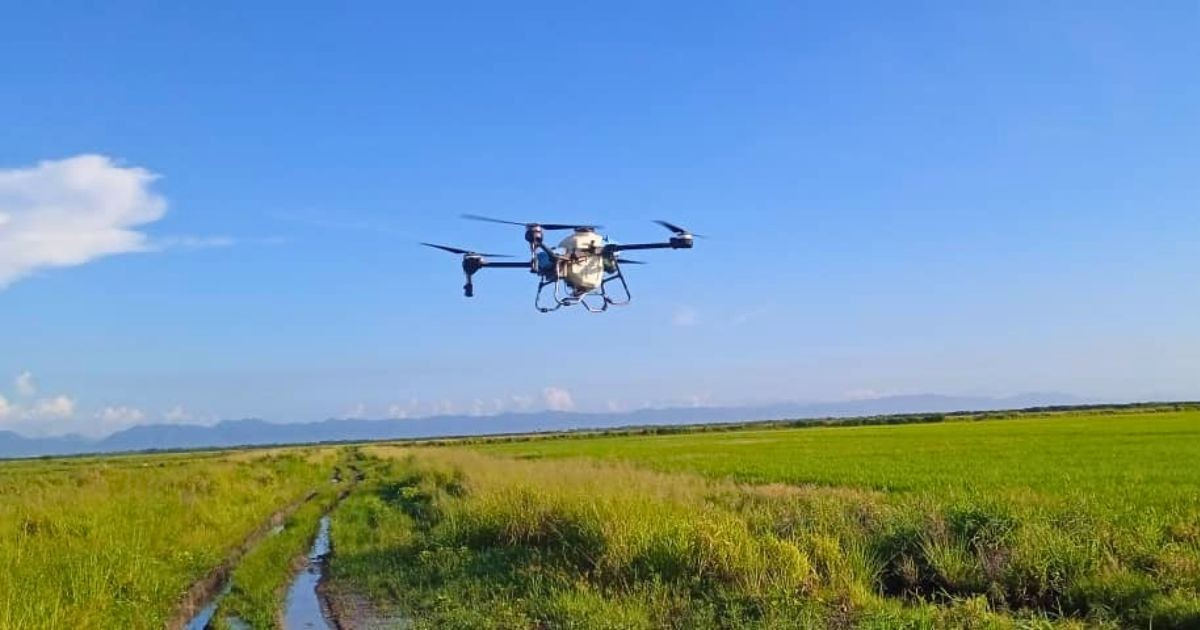
This week, the state-run Radio Guamá hailed the use of a drone to spray rice fields in the municipality of Los Palacios, Pinar del Río, as a landmark in agricultural modernization. However, the reaction from Cubans on social media was swift, filled with irony and outrage at the official report’s glaring omission: "but where's the rice?"
According to the state media report, a drone from the High Technology Company Geo-Cuba—manufactured in China, with a capacity of 55 liters and autonomous operation—has been used to spray over 250 hectares of rice fields with agrochemicals. These fields belong to the Cubanacán Base Seed Business Unit.
The user Dagoberto Remigio Echevarría expressed his enthusiasm about the experience: "We initially applied herbicides on 200 hectares and are now moving to another stage with fungicides and pesticides. The benefits are numerous. This is precision agriculture, and it speeds up the work significantly. Doing it manually would have taken us many days."
He further noted that the drone sprayed 62 hectares in a single day and compensated for the scarcity of nozzles, backpacks, and other equipment in the Cuban countryside. A critical point, briefly mentioned in the official report, is that the harvest from this campaign will not reach local stores or markets but will instead be used industrially to produce seeds for future planting.
The announcement was shared on Facebook by the newspaper Guerrillero, sparking a flood of comments that the officials did not foresee. "Soon, it might be easier to buy a drone than a sack of rice," remarked one user. Another was more blunt: "And we keep eating imported rice. You guys never stop making a fool of yourselves."
The criticisms also targeted a familiar pattern for Cubans. "This reminds me of the machines they introduced to cut Marabú; no one ever heard of them again... Or the state-of-the-art truck for fixing potholes, which also vanished. You are sellers of smoke," summarized one commentator.
From Pinar del Río, a resident was more direct: "Still nothing in the stores, and the last rice we got... they said it was from Los Palacios, but it was of terrible quality, sorting it was horrifying." Another citizen reported that two rice dryers in the area are inoperative—"one halfway, the other 95% done"—and demanded they be addressed before celebrating drones. "Aren't you ashamed to publish this when rice is 370 pesos?" a forum participant noted.
The stark contrast between the official announcement and the harsh reality is undeniable. National rice production plummeted from 304,000 tons in 2018 to a mere 79,000 in 2025, according to official figures cited by the press. Cuba requires around 700,000 tons of rice annually, meaning domestic production covers only about 11.3% of the estimated demand. Meanwhile, rice prices have soared to 400 pesos per pound, occasionally higher, against an average monthly salary of 7,354 Cuban pesos in August 2026, according to the National Office of Statistics and Information (ONEI).
Vice President Salvador Valdés Mesa pledged in November 2025 that Pinar del Río would achieve rice self-sufficiency in 2026. That promise remains unfulfilled. "Very nice, lots of technology, yet no rice for the people... The only visible and tangible things are the sky-high prices and the hunger sweeping through the streets," a netizen wrote, a reality no state-of-the-art drone can refute.
Frequently Asked Questions about Rice Production in Cuba
Why is the use of drones for spraying rice fields being criticized?
The criticism stems from the fact that despite the technological advancement, there is little to no improvement in the availability of rice for the population. The focus on technology contrasts sharply with the scarcity of rice in the market.
What is the current state of rice production in Cuba?
Cuba's rice production has declined significantly, from 304,000 tons in 2018 to just 79,000 in 2025. This is far below the annual requirement of approximately 700,000 tons, leaving a substantial deficit.
What are the implications of the rice production deficit for Cubans?
The deficit means that a significant portion of rice must be imported, leading to high prices that are unaffordable for many Cubans, contributing to increased hunger and economic hardship across the country.