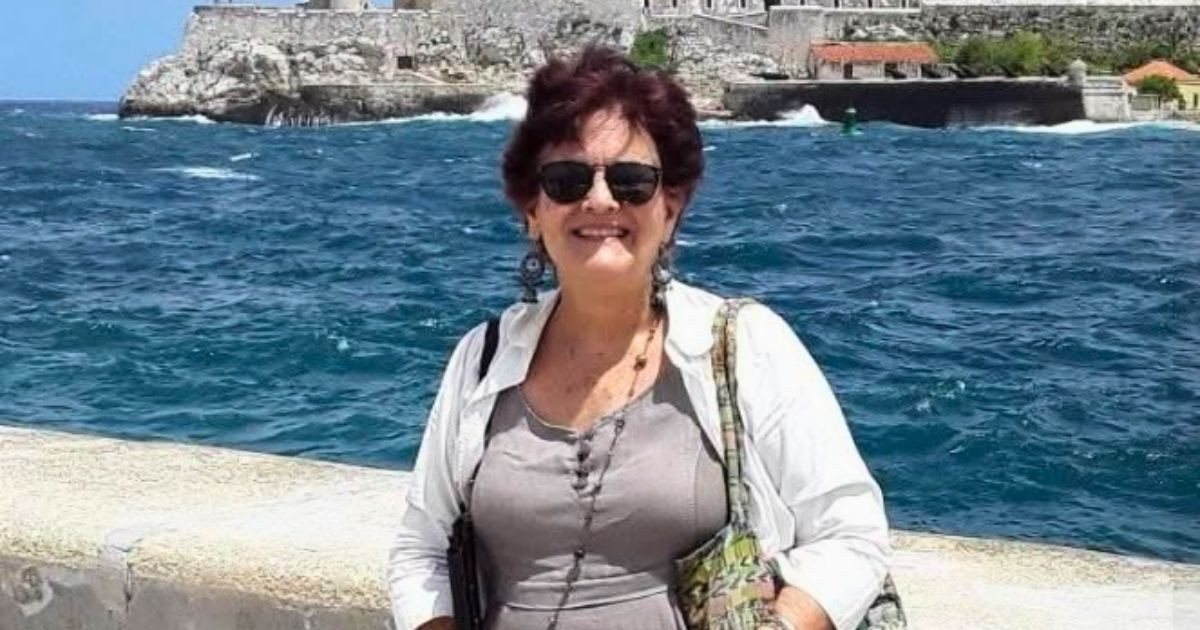
The Cuban psychologist and academic Carolina Luz de la Torre Molina passed away in Miami on Friday at the age of 79, reportedly due to a heart attack early in the morning. Her death, confirmed by the Cuban Society of Psychology, sparked an outpouring of grief among intellectuals, artists, former students, and friends across generations, both within and outside of Cuba.
Born in Matanzas in 1947, De la Torre graduated with a degree in Psychology from the University of Havana in 1971 and earned her doctorate in Psychological Sciences from Lomonosov Moscow State University in 1982. From 1983 onwards, she served as a full professor at the University of Havana's Faculty of Psychology, teaching courses such as History of Psychology, Social Psychology, and Political Psychology for over 40 years. She was also the president of the Cuban Society of Psychology and held the title of Honorary Member at the time of her passing.
Among her most notable works are "Latin American Psychology: Between Dependency and Identity" (1996)—which won the Cuban Academy of Sciences Award and was reprinted in Puerto Rico and Argentina—and "Identities: A Look from Psychology" (2002), awarded the National Scientific Critique Prize and the Fernando Ortiz Foundation's Catauro Cubano Prize. She also directed the documentary "The Accident" (2009), which was recognized at the National Video Festival in 2011.
One of her most personal works was "Benjamín. When Dying Makes More Sense than Waiting," published in Spain in 2018. In this book, she recounted the story of her brother, a young homosexual artist interned in the UMAP—forced labor camps created by Fidel Castro's regime between 1965 and 1968—who took his own life in 1968 after facing discrimination and stigma. Carolina was never able to publish this book in Cuba.
A Voice of Dissent
Apart from her academic career, De la Torre was a vocal critic of the Cuban regime. In August of this year, she wrote on Facebook expressing that "no power, to maintain itself, has the right to let those it serves die," seemingly referring to the island's government. In the same post, she hinted at the U.S. government by saying, "no power, to overthrow another, has the right to suffocate those it claims to want to save."
In March, she supported her son Abel Tablada, an architect and professor at CUJAE, after his teaching contract was not renewed due to his critical publications about the government.
Tributes and Condolences
Expressions of sorrow following her death flooded social media. Journalist Wilfredo Cancio Isla, who worked alongside her at the University of Havana between 1983 and 1994, described her as a "lucid intellectual, a sharp thinker on her country's reality, and admired by students and friends for her profound kindness and humanity."
Academic and historian Alina Bárbara López Hernández wrote, "Carolina de la Torre, Carola, was, above all, a good person. Just, ethical, with a civic attitude that caused her many challenges in a polarized environment," emphasizing that "she always raised her voice for just causes, against the grain of convenience and what was 'politically correct.'"
From Havana, audiovisual creator Yasmani Castro Caballero remarked that with her death, "a large part of the pedagogical legacy of Cuban psychology dies... The most important thing was her status as a Cuban citizen who always advocated for an idea of a nation for everyone."
Actor Luis Alberto García Novoa offered words that capture many people's sentiments: "How and how much it hurts... not to hear your advice and compliments anymore! Your classes on ethics and Cubanness! Farewell, teacher of many, Carolina de la Torre. Mother. Alma Mater."
Economist Mauricio de Miranda Parrondo noted that "Carola was a brilliant woman and also of her time. She contributed to the education of multiple generations of psychologists in Cuba and leaves an important professional and human legacy."
Actor Héctor Noas stated that with her passing, "a woman and a friend like few others" is lost. Addressing her directly, Noas said, "You sowed love, loyalty, and wisdom in every one of your actions."
The Cuban Society of Psychology highlighted in their obituary that "alongside the public figure lived a woman of deep feelings and a devoted mother who dedicated the best of her life to education and the well-being of her children." De la Torre leaves behind four children—Abel, Johana, José, and Claudia—and several grandchildren.
In a polarized society, fractured by years of dictatorship, where divisions run from social to familial, the image of Professor Carolina de la Torre stands as a hard-working mother, a fair intellectual without extremism, capable of both scientific inquiry and societal reflection while nurturing and educating her large family—mirroring Cuba's own diverse political tendencies and life orientations. She may become a symbol to which we must often turn.
In November 2025, from Miami, she had told OnCuba, referring to the legacy for her children after she was gone: "If they ever feel they are drifting apart, may they remember their mother and, in memory of me, never cease to love each other as they do now, despite their differences. Never forget that family is not just the new one they build, but also the one that formed them, leaving them proud to belong."
Remembering Carolina de la Torre's Impact
Who was Carolina de la Torre?
Carolina de la Torre was a Cuban psychologist and academic known for her influential work in psychology and her critical stance against the Cuban regime. She was a respected professor and author, leaving a significant legacy in education and advocacy for just causes.
What were some of Carolina de la Torre's notable works?
Her notable works include "Latin American Psychology: Between Dependency and Identity" and "Identities: A Look from Psychology." She also directed the documentary "The Accident" and wrote "Benjamín. When Dying Makes More Sense than Waiting," a personal work about her brother.
How did Carolina de la Torre contribute to Cuban society?
De la Torre contributed through her academic work as a professor at the University of Havana, her leadership in the Cuban Society of Psychology, and her vocal criticism of the Cuban government. She championed the cause of freedom and justice, influencing generations of psychologists.