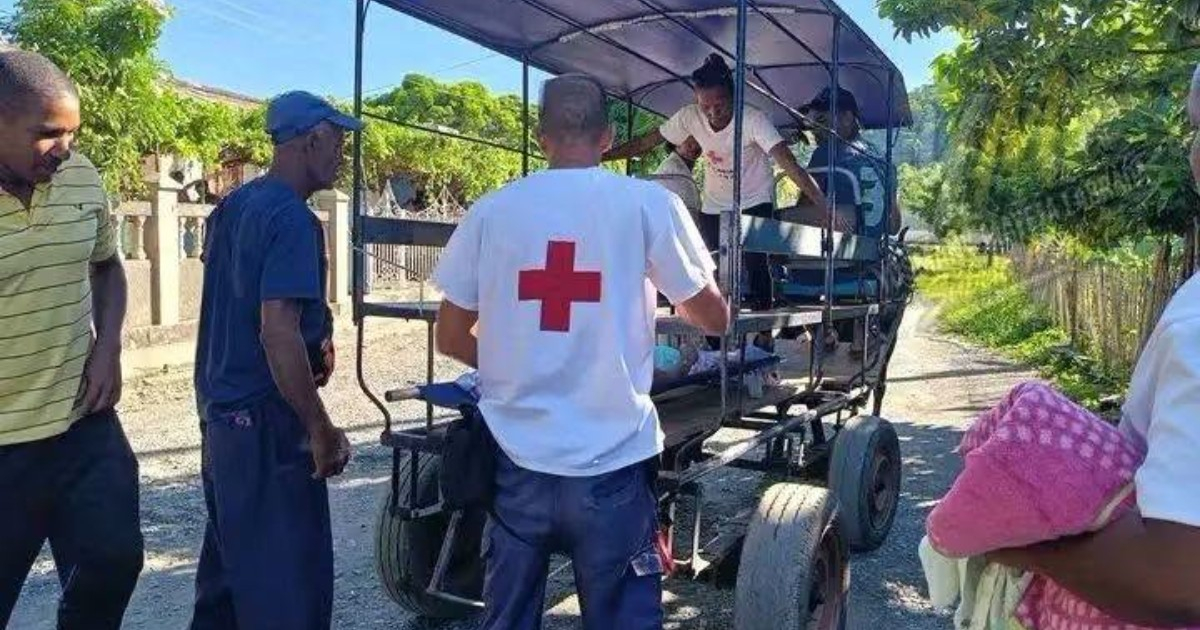
An 83-year-old woman, suffering from a hip fracture, was transported on Friday using a horse-drawn cart to reach the Giraldo Aponte Fonseca Polyclinic in Guamá, Santiago de Cuba for medical evaluation. This incident was documented by journalist Yosmany Mayeta Labrada.
The operation involved members of GMOS Guamá and volunteers from the Cuban Red Cross, who accompanied the elderly woman as she lay on an improvised board amidst a backdrop of deteriorating walls.
Images shared by Mayeta Labrada reveal the elderly woman being attended to by at least two individuals as the horse-drawn cart served as a makeshift ambulance, highlighting the lack of adequate medical transport in the area.
"How can it be that an 83-year-old with a hip fracture has to be transported this way for medical care?" questioned the journalist upon releasing the images.
This case is not isolated but rather the latest example of a systemic crisis affecting medical transport throughout Cuba.
Back in June 2026, a patient was taken via horse-drawn cart to the Camilo Cienfuegos Provincial Hospital in Sancti Spíritus, where local reports mentioned even deceased individuals arriving in such vehicles.
In August, a woman who fell into an uncovered well in Bayamo was initially transported by cart and then by electric scooter due to the absence of an ambulance.
Earlier in October, according to an Infobae report, a machete-injured farmer in Camagüey couldn't be moved by ambulance as the unit was out of service.
The statistics illustrate the severity of the issue: as per the Ministry of Public Health's 2022 data, only 39.6% of the required ambulances were technically available across the nation.
By 2026, the situation had worsened: Granma acknowledged operating 17 active ambulances against a need for 54; Pinar del Río managed with a mere 12 units; and in Matanzas, only 14 out of 20 ambulances were functional.
The regime's response has been mostly centered on Havana: 25 electric ambulances were introduced in February, and 200 electric cars for dialysis patients were deployed in May, yet these measures have not extended to rural areas like Guamá.
Santiago de Cuba also faces specific complaints: in September, provincial hospitals reported sewage under beds, cockroaches in delivery rooms, and rats in perinatology wards.
The Minister of Public Health, José Ángel Portal Miranda, acknowledged in July 2025 at the National Assembly that only 30% of the essential medicine inventory was available in the country.
"The solidarity of those who assist is commendable, but there is a dire need for ambulances and proper medical transport," concluded Mayeta Labrada, denouncing the transport conditions faced by the elderly woman in Guamá.
The Medical Transport Crisis in Cuba
What was the condition of the elderly woman transported in Guamá?
The woman, aged 83, was suffering from a hip fracture and required medical evaluation at a local polyclinic.
How prevalent is the use of non-traditional transport for medical emergencies in Cuba?
The use of horse-drawn carts and other non-traditional means for medical transport is not uncommon in Cuba due to a critical shortage of ambulances.
What measures has the Cuban government taken to address the ambulance shortage?
The government has introduced electric ambulances and cars for specific patient groups in Havana, but these measures have not reached rural areas effectively.
What are some reported conditions in hospitals in Santiago de Cuba?
Hospitals in Santiago de Cuba have reported unsanitary conditions such as sewage under beds, presence of cockroaches in delivery rooms, and rats in perinatology areas.