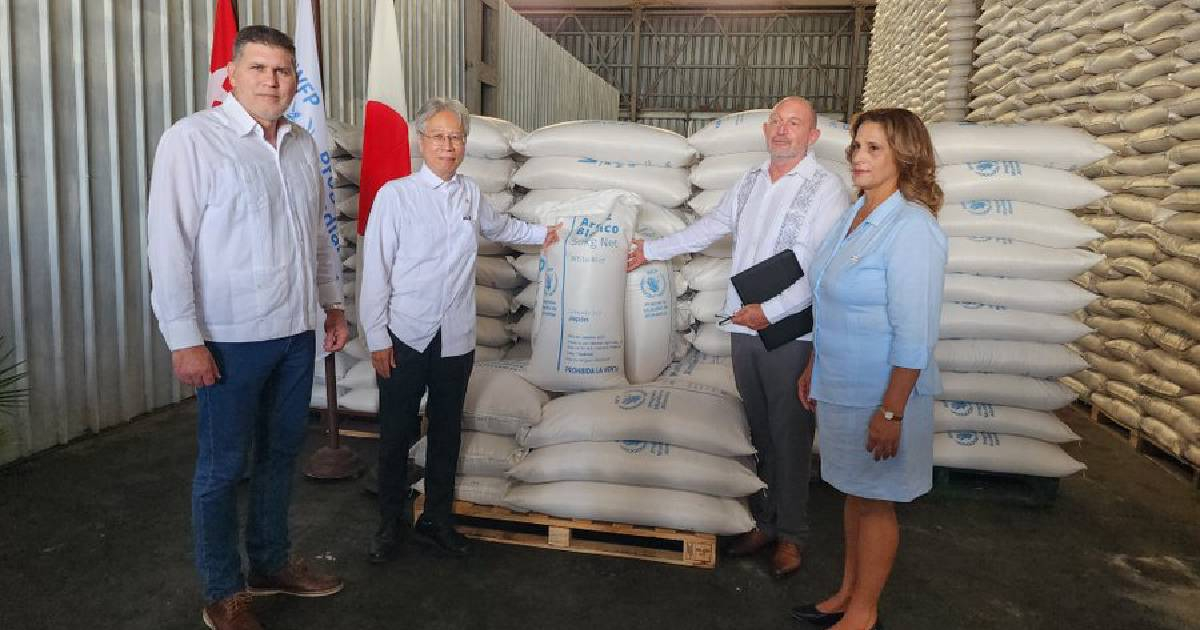
On World Food Day, the Japanese government made a significant contribution to Cuba by donating food valued at $1 million. This generous aid, facilitated through the World Food Program (WFP), aims to support victims of Hurricane Melissa in Cuba's eastern regions.
The funds from Japan were allocated to purchase 425 tons of rice, alongside grains and oil, which were delivered to the warehouses of the Provincial Food Company of Havana. These supplies are intended for distribution in the eastern communities that suffered the most from the hurricane, as reported by the Ministry of Foreign Trade and Foreign Investment via the social media platform X.
The ceremony was attended by key figures including the Vice President of the Council of Ministers and Minister of Foreign Trade, Óscar Pérez-Oliva Fraga, the Japanese ambassador Nakamura Kazuhito, and the WFP representative in Cuba, Etienne Labande. Also present was the Minister of Domestic Trade, Betsy Díaz Velázquez.
Ambassador Kazuhito emphasized that the devastation caused by Hurricane Melissa in Cuba's eastern provinces prompted this act of solidarity, which aims to improve the nutrition of those affected, according to a report from the Cuban News Agency.
However, the Cuban government used the occasion to shift blame for the distribution delays onto the United States. Pérez-Oliva pointed out that the food containers were held up at the port of Kingston, Jamaica, due to U.S. pressure on international shipping companies. He stated that the "imperialist blockade, aimed at suffocating Cuba, prevented the timely arrival of food to the affected areas."
In September, Foreign Minister Bruno Rodríguez highlighted at international forums that over 7,000 containers with food, medicine, and supplies were stuck in Caribbean ports due to expanded secondary sanctions imposed by the Trump administration in May.
Hurricane Melissa made landfall near Santiago de Cuba on October 29, 2025, as a Category Three hurricane, marking one of the most severe natural disasters in eastern Cuba in recent years.
The Red Cross estimated that over 60,000 homes were either destroyed or damaged, impacting 2.7 million people, with 2.2 million requiring urgent assistance.
The WFP described Japan's contribution as the largest financial support it has received from Japan for its Cuba office, sufficient to provide emergency rations—1.5 kilograms of rice, 0.9 kg of grains, and one liter of oil—to approximately 190,000 people for a month.
On the same day, Russia supplied 750 metric tons of vegetable oil for the WFP's emergency reserves in Cuba, part of a biannual Russian contribution of $4 million for 2025-2026, as shared in a WFP tweet.
Japan's donation is part of a growing trend of reliance on foreign aid. In 2026, China donated 90,000 tons of rice to the island, while the Trump administration directed $100 million through Caritas Cuba and Catholic Relief Services, bypassing the Cuban government as an intermediary.
The United Nations classifies Cuba as one of the world's 12 most underfunded humanitarian crises, with a shortfall exceeding $52 million in its $94.1 million response plan.
Impacts and Responses to Cuba's Humanitarian Crisis
What prompted Japan to donate food to Cuba?
Japan donated food to Cuba in response to the severe damage caused by Hurricane Melissa in the eastern part of the country. This act of solidarity was intended to help improve the nutrition of those affected by the disaster.
How did the U.S. embargo affect the distribution of the food aid?
The Cuban government claimed that the U.S. embargo led to delays in food distribution, as containers were held up at the port of Kingston, Jamaica, due to U.S. pressure on international shipping companies.
What other countries have contributed aid to Cuba recently?
Besides Japan, China donated 90,000 tons of rice in 2026, and Russia provided 750 metric tons of vegetable oil as part of a $4 million biannual contribution. The Trump administration also directed $100 million through Caritas Cuba and Catholic Relief Services.