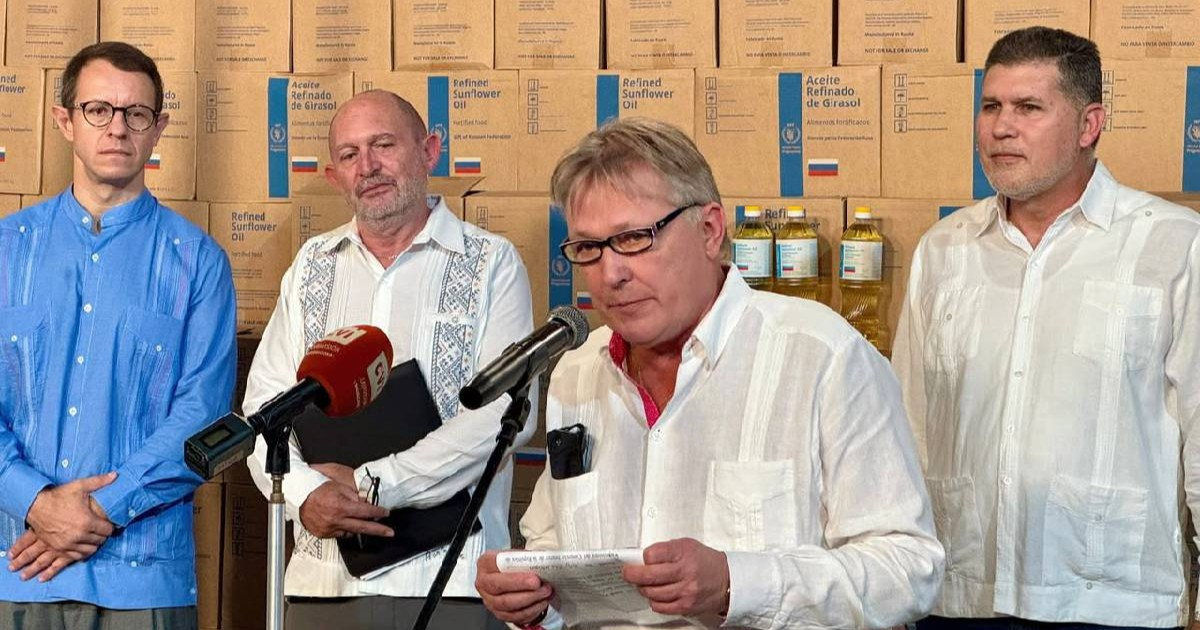
In a symbolic ceremony held in a Havana warehouse, Russia delivered more than 750 tons of refined sunflower oil fortified with vitamins A and D to Cuba this past Friday. The event was attended by officials from both nations and representatives from the United Nations' World Food Program (WFP).
The Russian Embassy in Cuba announced via social media that the donation was facilitated through Russia's Ministry of Emergencies as part of Moscow's contribution to the WFP. This aid is specifically aimed at supporting the country's most vulnerable groups, including children, the elderly, and pregnant women.
Among those present at the event were Cuba's Vice Prime Minister and Minister of Foreign Trade, Óscar Pérez-Oliva Fraga; Minister of Domestic Trade, Betsy Díaz Velázquez; and the WFP representative in Cuba, Etienne Labande.
Russian Ambassador Victor Koronelli led the Moscow delegation, seizing the opportunity to make political statements. He described the donation as "another testament to the enduring bonds of friendship and solidarity between the brotherly peoples of Russia and Cuba," attributing the island's current challenges to what he termed as the "unprecedented tightening of the economic, commercial, and financial blockade, now coupled with an energy siege, imposed by the U.S. government."
The donated oil, packaged in one-liter bottles with 15 per box, prominently features labels reading "Donation of the Russian Federation" and "NOT FOR SALE OR EXCHANGE," alongside the WFP logo.
Food Crisis Intensifies Amidst Aid Deliveries
This delivery comes as Cuba grapples with a severe food crisis, worsened by power outages, scarcity, and declining production. An independent survey released in May 2026 indicated that 33.9% of Cuban households reported at least one member going to bed hungry, while 94.9% experienced reduced access to food purchases over the past year.
Between January and March of this year, the WFP assisted approximately 500,000 Cubans, with over 800,000 receiving aid due to Hurricane Melissa and the ongoing energy crisis up until June, according to the organization's data.
This is not Russia's first humanitarian effort of this nature. In 2025, Russia delivered more than 800 tons of sunflower oil, followed by an additional 650 tons in April 2026, valued at nearly three million dollars.
Controversies Surrounding Aid Usage
Russian contributions to the WFP for Cuba have totaled over 15 million dollars since 2018, accounting for 32% of the 57.9 million dollars executed by the organization on the island from 2021 to 2025.
Despite these efforts, controversies have emerged. In 2021, some of Russia's donated oil surfaced for sale in Cuban state stores. Authorities explained that the WFP and the embassy had temporarily authorized 150 tons to be used as a loan due to a packaging line breakdown.
Koronelli reiterated on social media platform X that Moscow's support for Havana would persist: "We will continue to support the sister Republic of Cuba through both bilateral avenues and international organizations."
Understanding Russia's Aid to Cuba
What is the purpose of Russia's oil donation to Cuba?
The oil donation from Russia to Cuba is intended to support the nation's most vulnerable populations, including children, the elderly, and pregnant women, as part of a humanitarian aid effort facilitated through the World Food Program.
How has the food crisis affected Cuban households?
The food crisis in Cuba has severely impacted households, with a survey indicating that 33.9% of families reported someone going to bed hungry and 94.9% experiencing reduced access to food over the past year.
What controversies have arisen from Russia's aid to Cuba?
Controversies have arisen when some donated oil was found for sale in Cuban state stores. This was explained as a temporary measure authorized by the World Food Program and the Russian embassy due to a packaging line malfunction.