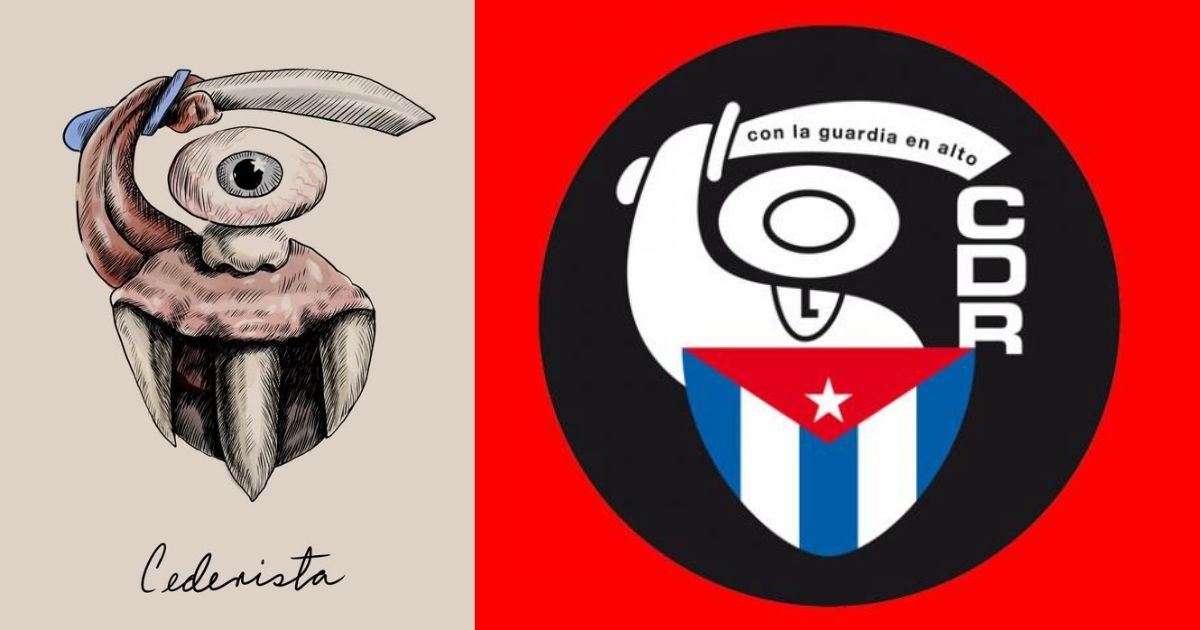
The Cuban artist, Camila Lobón, has transformed the image of the CDR member into a monstrous illustration. Although, to be fair, Fidel Castro laid the groundwork for this creative depiction back in 1960. This is part of the 32nd installment of her satirical series "Bestiario Miserable," which was published in the online publication Rialta on October 13th and later shared on her social media platforms.
The artwork, titled "Cederista," portrays an anthropomorphic claw with an all-seeing eye and a machete held by a tongue-arm. This surrealist-gothic style image derives its design from the original logo of El Cederista, created by Cándido Justiz Pileta, the organization's first national head of Surveillance. The emblem bore the motto "With the guard up."
Lobón, who admits to feeling an "ominous satisfaction" while crafting this piece, pairs the illustration with a text that serves as political analysis, personal recollection, and indictment all in one.
A Historic Betrayal Institutionalized
"In 1960, one of the most lethal institutions to freedom emerged in Cuba," writes Lobón, referencing the foundational words of the late dictator. The intent was for a "system of revolutionary collective surveillance" so that everyone knew who lived in their neighborhood, "what they did, who they associated with, and what activities they were involved in."
This so-called patriotic initiative institutionalized betrayal as a civic duty, turning neighbor against neighbor and fostering a widespread sense of suspicion.
The Legacy of Fear and Control
Camila Lobón, born in Camagüey in 1995 and educated at the Instituto Superior de Arte in Havana, left Cuba for the United States in October 2021 after enduring years of harassment by the State Security. She writes with the vivid memory of someone raised under constant surveillance: "The elders would warn us about the Cederista, as if it were the Boogeyman, whenever we voiced any political curiosity."
The artwork was released just two weeks after the 66th anniversary of the Committees for the Defense of the Revolution (CDR), celebrated on September 28th. Even the regime acknowledges the organization's decline. Díaz-Canel admitted to CDR members that many people see it as outdated and irrelevant, yet he still urged for an expansion of its neighborhood watch role, showcasing the regime's typical incoherence.
Public Reactions and Current Reality
Activist Alina Bárbara López described the CDR, currently led by former Cuban spy Gerardo Hernández Nordelo, as a "gigantic and ineffective bureaucratic structure without social foundation" in September. Ironically, the regime awarded 134 distinguished CDR members that same month.
Online comments on Lobón's work echoed these sentiments. One user remarked that the CDRs "turned a vice into a revolutionary virtue," while another criticized the revolution as an "immense work of corruption." A third highlighted that the CDRs continue to denounce protesters today, leading to numerous arrests.
Statistics support this observation: as of October 1, 2026, Cuba had a record 1,372 political prisoners, according to Prisoners Defenders. The nation is also plagued by power outages lasting 18 to over 20 hours daily and a chronic electrical generation shortfall exceeding 2,000 MW.
A Universal Reflection on Human Nature
In conclusion, Lobón reflects on the universality of this phenomenon: "This creature, sadly, is not exclusive to Cuba or any specific ideology or political system. A combination of two detrimental human weaknesses — cowardice and selfishness — it can be found dining with Christ or denouncing a Jew to the Nazis. It only needs power to place it in the dilemma of either pushing others or getting hit."
Insight into Cuba's CDR and Its Impacts
What is the significance of Camila Lobón's artwork on the CDR?
Camila Lobón's illustration critiques the CDR by symbolizing it as a monstrous entity, highlighting the betrayal and surveillance culture institutionalized by the regime under Fidel Castro.
How has the role of the CDR changed over time?
Initially a tool for revolutionary surveillance, the CDR has become increasingly seen as outdated and irrelevant, though the regime tries to maintain its role in neighborhood vigilance.
What current challenges does Cuba face regarding political prisoners?
Cuba has a record number of political prisoners, with 1,372 individuals detained as of October 2026, reflecting the ongoing suppression of dissent and protest.