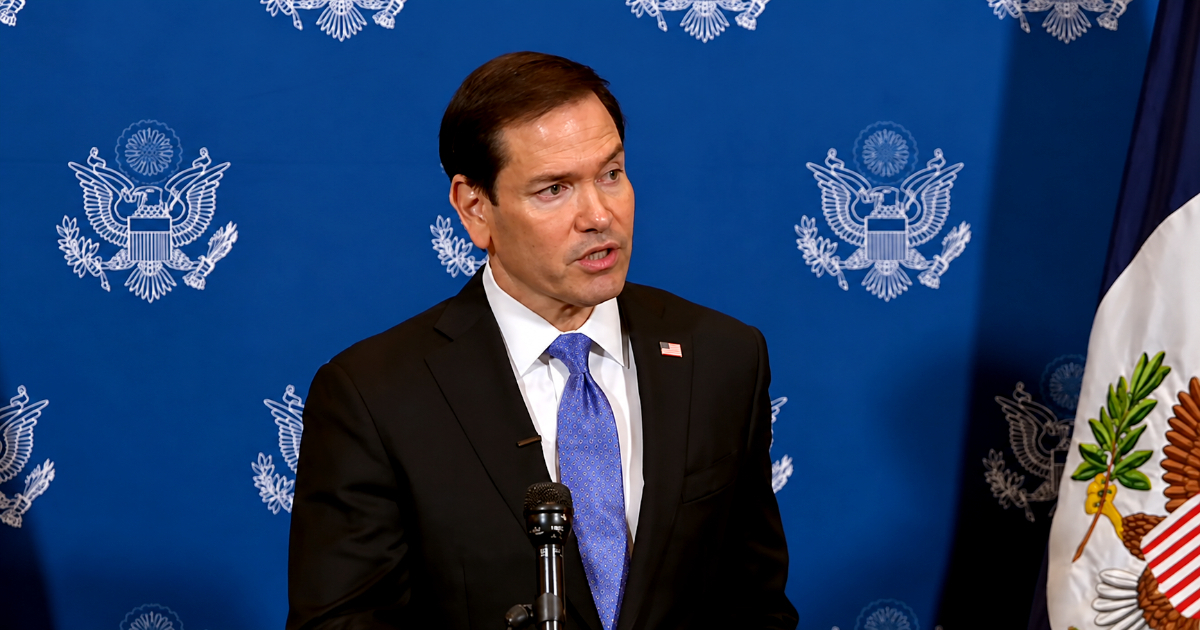
Marco Rubio, the Secretary of State, has leveled serious allegations against the Cuban regime, accusing it of serving as a launchpad for hostile actors and terrorist groups, including Iran, that aim to attack the United States from a mere 90 miles away.
"For far too long, communist Cuba has operated as a staging ground for hostile actors and terrorist groups—most notably the Islamic Republic of Iran, the world's leading state sponsor of terrorism—seeking to strike the United States," Rubio declared in an official statement from the State Department.
The statement, released on Thursday, also announced sanctions against the Banco Internacional de Comercio S.A. (BICSA), a Cuban state-owned financial institution. It was highlighted that BICSA had been providing financial services to Iran's Karafarin Bank since at least 2022. The U.S. Treasury Department had previously sanctioned Karafarin Bank in 2020 under Executive Order 13902 for its connections to the Tehran regime.
This designation was enforced under section 2(a)(i)(A) of Executive Order 14404, signed by President Trump on May 1, 2026, which authorizes comprehensive sanctions against those operating within the Cuban financial sector.
The move was part of a broader operation led by the Treasury Department targeting Iranian financial networks. The action also included designations against Iraq's International Development Bank for Investment and Finance and two Iranian entities: Jazireh International Bank Company and Chabahar International Bank Overseas Company.
Rubio was unequivocal in his warning about the Trump administration's intentions: "We will not tolerate a rogue state hosting hostile military, intelligence, and terrorist operations less than a hundred miles from our shores."
He further emphasized that Washington will continue "aggressively identifying and dismantling the Cuban regime's financial and security links with Iran and other dangerous and hostile states and actors."
Escalating Sanctions Against Cuba's Banking System
The sanctions against BICSA mark the third strike against the Cuban banking sector in under four months. The Banco Financiero Internacional was sanctioned on June 23, along with other entities connected to GAESA, and the Banco Exterior de Cuba was targeted on September 3 in a round focusing on the financial, energy, and mining sectors.
Cuban Foreign Minister Bruno Rodríguez Parrilla decried the measure, describing BICSA as a "completely legitimate bank" whose transactions are also "legitimate." Rodríguez accused Rubio of intensifying the "collective punishment" against the Cuban people and attempting to "shut off every valve" to the island's economy.
Cuba's Controversial Place on the Terrorism Sponsor List
Cuba was re-added to the list of state sponsors of terrorism on January 20, 2025, when Trump reversed his predecessor's decision. It remains on the list alongside Iran and North Korea. The Trump administration claims to have imposed over 240 sanctions on Cuba since January 2025.
This latest sanction comes just ahead of the scheduled October 28, 2026, vote in the UN General Assembly on the U.S. embargo against Cuba, adding a clear diplomatic pressure dimension to Washington's financial offensive.
Understanding the Implications of U.S. Sanctions on Cuba
What is the significance of the sanctions against BICSA?
The sanctions against BICSA, a state-owned Cuban bank, are part of a broader strategy to cut off financial links between Cuba and countries like Iran, which are considered threats to U.S. security.
How has the Cuban government responded to these sanctions?
Cuban Foreign Minister Bruno Rodríguez Parrilla has rejected the sanctions, asserting that BICSA operates legitimately and accusing the U.S. of punitive economic measures against the Cuban people.
Why was Cuba added back to the list of state sponsors of terrorism?
Cuba was reinstated on the list of state sponsors of terrorism due to its alleged support for international terrorist activities and its alliances with countries considered hostile by the U.S., such as Iran.