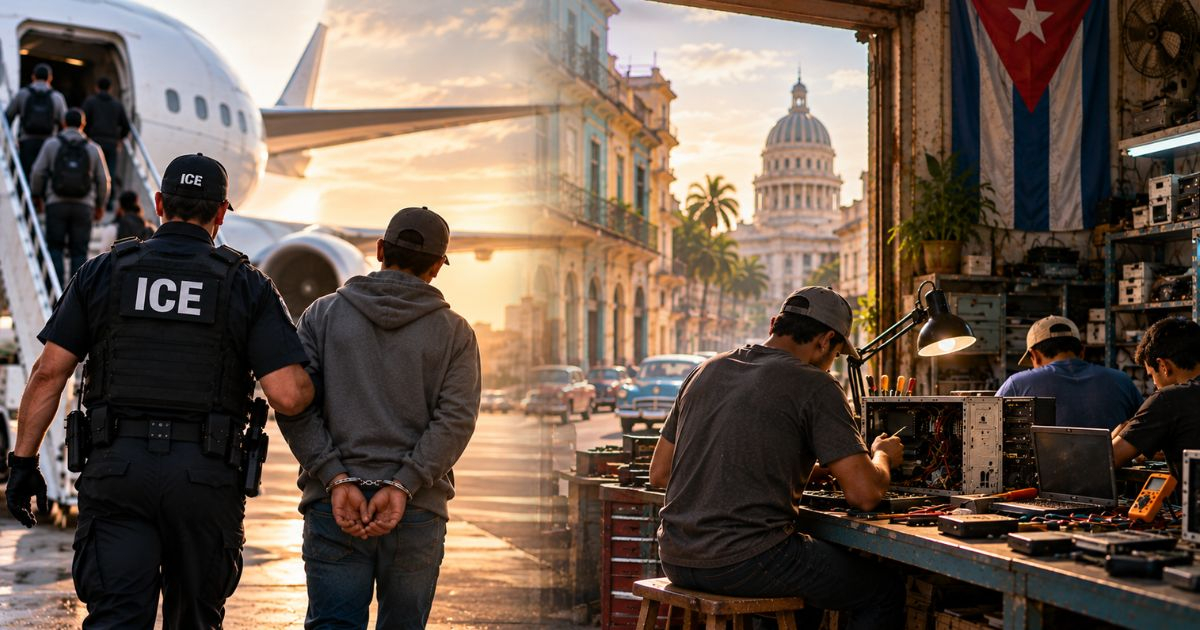
Marcos Javier Ramos Estrada, a 29-year-old Cuban who was deported from the United States after spending several months in an immigration detention center, is striving to rebuild his life in Havana. He has established a computer repair and support workshop where he currently employs two other young men who also returned to the island.
Located in the Cerro district, the business provides technical services to small businesses. Behind this venture lies a story of migration that began with selling his family home and ended with returning to Cuba without a house, without savings, and with the need to start from scratch.
His journey was documented in an interview published by CubaNet, where he detailed the hardships of his journey to the United States, his detention, and the path to economic recovery following his deportation.
Starting Over in Havana
Before emigrating, Marcos lived in the Diez de Octubre district. In 2024, he decided to sell the apartment he had inherited from his grandparents to finance his journey. He also parted with his motorcycle, work tools, music equipment, and other belongings.
In his account, he managed to gather around $12,000 to embark on a migration route that took him through several Central American countries and Mexico. Along the way, he faced precarious living conditions, unexpected expenses, and extortion situations.
He spent nearly two months in Tapachula, Mexico, waiting for a document to continue his journey. When he finally reached the United States, his goal was to settle there permanently.
Rebuilding a Life and Business
However, after seeking immigration protection, he spent several months detained in Texas. According to his testimony, a judge ordered his deportation, and he was sent back to Cuba.
Upon his return, he found himself in a very different situation from when he left Havana: his home was sold, his savings depleted, and he no longer had the tools he once used for his livelihood.
During his first weeks back, he stayed with a relative. The need for income led him to resume his work as an IT technician, initially with borrowed tools and by offering home repair services.
From Home Repairs to a Thriving Workshop
Marcos began by addressing IT issues for cafes and small private businesses, particularly with network failures, inventory systems, and sales equipment.
His strategy, as he explained, was to offer quick and affordable solutions to business owners who needed their equipment operational. To cut costs, he walked long distances and reused components salvaged from broken devices.
With the earnings and recommendations from his early clients, he managed to rent a space in Cerro and establish his technical support workshop there.
The venture also enabled him to hire two young men who had been deported from the United States and, like him, were facing the challenge of finding a source of income after returning to the island.
In the interview, Marcos shared that he decided to offer them jobs because he saw in their situations the difficulties he had once faced.
Inspiration for Other Returnees
For Marcos, the workshop represents both a means of regaining stability and an opportunity to assist others who returned without resources.
Other Cubans have also tried to rebuild their lives after returning. A recent example is Liexer De La Cruz, a Cuban who returned to Havana from the United States and resumed his work as a taxi driver using a solar-powered tricycle.
De La Cruz had worked as an electrician in the United States but ended up returning to Cuba with his wife after facing challenges related to his immigration status. Once back on the island, he returned to a familiar occupation from before his emigration.
His experience also highlighted the economic hurdles of returning: power outages, water shortages, and the high cost of food complicated his daily life and sometimes prevented him from working.
Another story is of a Cuban woman who shared how she had to start over after being deported, recounting her efforts to move forward through work and the financial hardships she faced upon returning.
Each deportation story is unique, marked by personal circumstances, losses, and challenges. However, experiences like these demonstrate that, even after returning to Cuba without the resources they left with, some Cubans manage to rebuild their lives, regain their economic independence, and find new opportunities.
Challenges and Opportunities for Deported Cubans
What prompted Marcos Javier Ramos Estrada to open a workshop in Havana?
After being deported from the United States and returning to Cuba with no home or savings, Marcos sought to rebuild his life and income by starting a computer repair and support workshop.
How did Marcos Javier Ramos Estrada finance his initial journey to the United States?
He sold his inherited apartment, motorcycle, work tools, music equipment, and other possessions to raise approximately $12,000 for his migration journey.
What challenges did Marcos face after returning to Cuba?
Upon his return, Marcos faced the challenge of starting over with no home, depleted savings, and lacking the tools he previously used for his work, prompting him to initially rely on the generosity of family and borrowed tools.