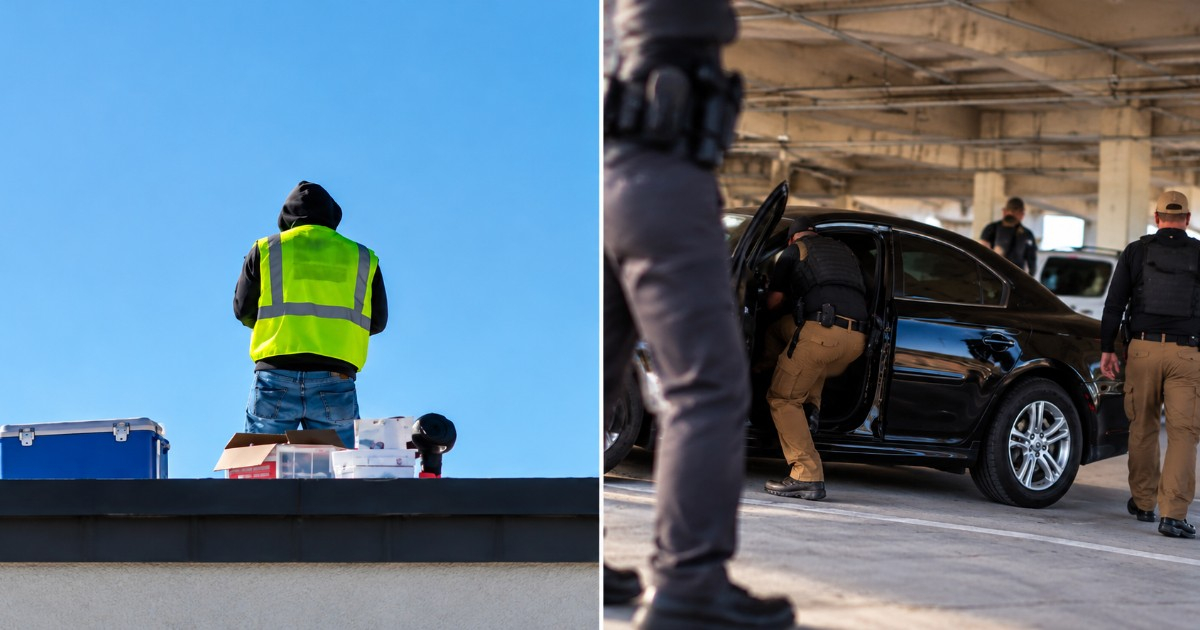
A group of armed and uniformed agents from the U.S. Immigration and Customs Enforcement (ICE) spent over two hours at a building in Pensacola Beach, Florida, demanding that four Hispanic workers come down from a roof they were repairing after damage caused by Hurricane Isaías.
The incident took place on Tuesday, October 13, at The Grand Marlin, a well-known establishment in Pensacola Beach, as reported by local station WEAR-TV (ABC 3).
The presence of the agents was captured in a video filmed by a witness who had arrived to assist the workers.
According to accounts gathered by the media, the agents arrived in uniform, identifying themselves as police officers, and insisted that the workers descend from the roof.
Some workers remained on top until the agents eventually left. The confrontation ended without any arrests being reported.
Eric McKnight, a friend of the workers and a witness to the event, explained that the men were frightened and reluctant to come down.
"They were scared. They said they weren't going to come down," McKnight told the station.
The witness noted that the workers had called him for translation help. He also brought them water and their documentation.
People close to the workers affirmed that their papers were in order.
McKnight recorded part of the encounter on his cell phone and stated that the agents withdrew after he and others present explicitly mentioned it was an immigration issue.
"As soon as we said that word, it was like flipping a switch," the witness described, noting the agents' hasty departure.
The operation occurred amid ongoing construction efforts to restore Pensacola Beach following Hurricane Isaías's impact, which had caused damage in northwest Florida.
The Grand Marlin confirmed to WEAR-TV its awareness of the incident and that it had hired a local roofing company with which it had a longstanding business relationship to repair the damage to its facilities.
The establishment explicitly acknowledged involvement with the Department of Homeland Security (DHS) and ICE but refrained from providing further details.
It also indicated that it remained open and operating normally, while focusing on its employees, customers, and the community affected by the hurricane.
According to McKnight, his friends planned to return to work, though they might not work at The Grand Marlin again after the incident.
The event raised concerns among representatives of the Hispanic community in northwest Florida, especially as it occurred during post-disaster reconstruction efforts.
Grace Resendez McCaffrey, owner and editor of the newspaper La Costa Latina, mentioned receiving calls from workers' family members worried about their loved ones returning home.
"We're in a disaster situation, trying to recover from a terrible catastrophe. We need everyone's help to rebuild," she stated.
Resendez McCaffrey also urged the community to express their concerns to state legislators, advocating against such interventions during recovery work.
"We don't want people harassed from rooftops just trying to help rebuild," she emphasized.
The station also asked Republican Congressman Jimmy Patronis if he was aware of immigration operations during recovery efforts after the hurricane.
Patronis responded that he hadn't personally witnessed such interventions and was focused on restoring services and infrastructure.
ICE's presence at a repair site following a hurricane raises questions about the impact of immigration controls on sectors reliant on immigrant workers, particularly construction, maintenance, and property restoration after weather events.
Florida has seen a rise in immigration operations and cooperation between federal, state, and local authorities.
Between March 2025 and April 2026, the Miami Sector of the Border Patrol reported 12,599 immigrant arrests, accounting for 10% of the 125,199 apprehensions nationwide during that period.
In the same timeframe, ICE's Miami office recorded 41,310 detentions between January 2025 and April 2026, averaging about 120 daily arrests, according to figures released then.
The intensification of these operations has also raised concerns over potential economic consequences, especially in industries with significant foreign labor presence.
An August report by America's Voice linked the reduction of immigrant workers to higher costs and job losses in various U.S. sectors.
The study cited, among other indicators, a 5% decrease in construction employment in the Rio Grande Valley, Texas, and warned about the effects immigration operations may have on construction, agriculture, landscaping, and hospitality activities.
The impact is also felt among small businesses in Florida. Representatives from the Hispanic Chamber of Commerce reported that sales at certain establishments in Doral, Miami, and Homestead had dropped by up to 45%, attributing this to fear caused by immigration raids.
For the thousands of immigrants, including Cubans, working in construction and property maintenance in Florida, the Pensacola Beach incident highlights the tensions between immigration law enforcement and the labor needs for rebuilding communities after natural disasters.
ICE operations in workplaces have become increasingly common in various states. Stay updated on arrests, raids, and immigration rights in our U.S. Immigration section.
Key Questions About ICE Operations in Florida
What prompted the ICE operation in Pensacola Beach?
The ICE operation at Pensacola Beach was initiated when agents demanded that four Hispanic workers repairing a roof after Hurricane Isaías come down. The reasons behind ICE's presence at the site are not clearly detailed by authorities.
How did the community react to the ICE presence?
The incident raised concerns among the Hispanic community, with calls for legislative intervention to prevent such operations during post-disaster recovery. Community leaders emphasized the need for cooperation in rebuilding efforts without the fear of immigration enforcement.
What are the potential economic impacts of ICE operations?
ICE operations can lead to higher costs and job losses in sectors heavily reliant on immigrant labor, such as construction and hospitality. Reports indicate a significant drop in sales for small businesses due to fear of immigration raids.