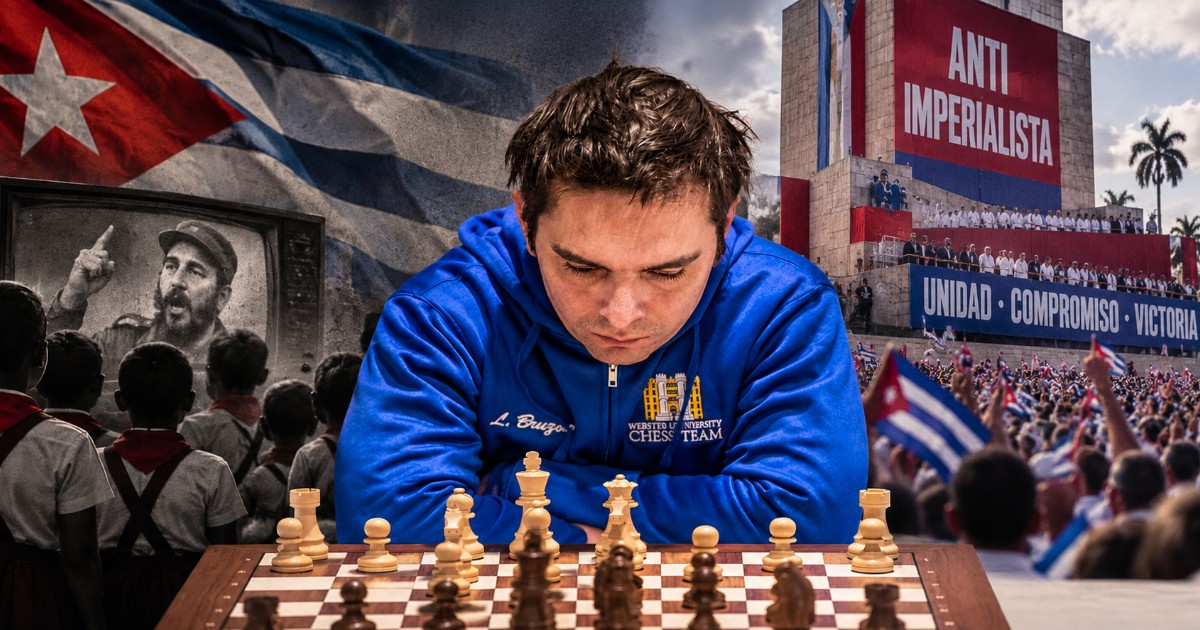
The renowned Cuban chess Grandmaster, Lázaro Bruzón, has emerged as a vocal critic of the Cuban regime from within the sports community. Recently, he challenged those who continue to defend the political repression in Cuba, emphasizing that the widespread access to information has dismantled any excuses for supporting the oppressive system.
Bruzón shared an in-depth reflection on his Facebook page, where he delved into the indoctrination that has influenced generations of Cubans, the role of the internet in political awakening, and the responsibility of those who, in his view, persist in backing repression.
"This evil won't last forever. Change and justice will come. Today, we all have access to data, history, and evidence. Everyone can choose their side, but no one should complain when it's time to be held accountable. The 'confusion' excuse no longer holds," he asserted.
The Power of Information and Internet Access
Having maintained a public stance against the Cuban government over recent years, Bruzón began his analysis by addressing a common debate among Cubans: when should they have grasped the true nature of the political system established in 1959?
According to Bruzón, it is unfair to critique the past without considering the conditions under which entire generations were raised, subjected from childhood to an education presenting the Revolution and its leaders in an exclusively positive light.
He recalled that for decades, only a minority of Cubans had the necessary tools and family environment to question the official narrative. In his own home, politics and discussions about the system were absent.
"That was the design: to mold you from childhood so you wouldn't see any other truth," he stated, referring to the propaganda's influence in schools, media, and daily life.
The Moral and Civic Damage of the System
Bruzón also highlighted a crucial distinction for understanding Cuba's deterioration: the harm caused by the system cannot be measured solely through economic indicators.
"The primary damage was never economic. It was moral, civic, and human. The damage was the total cancellation of freedom," he expressed.
He identifies the 1959 political system as Cuba's fundamental problem, which, in his opinion, eradicated individual freedoms and divided citizens into revolutionaries and traitors.
The Grandmaster pointed to internet access as a pivotal factor that has significantly altered how Cubans perceive their history and reality.
He argues that the ability to consult diverse sources, compare versions, and learn about events previously out of reach has weakened the government's ability to impose a singular interpretation of facts.
"The advent of the internet and the ability to verify and learn directly from history have unmasked the regime," Bruzón stated.
Public Criticism and Double Standards
Bruzón's reflection took on a particularly critical tone when he addressed public discussions about Anna Bensi, a young Cuban whose case has sparked solidarity and denunciations of repression.
He recounted listening to Luis Dener analyze a program from La Joven Cuba, where, in Bruzón's view, three participants attempted to justify the repression against Bensi and portray her as responsible for what happened.
He also questioned the indignation shown over criticism directed at Gabriela, associated with the pro-government program Con Filo, for traveling to Mexico for a master's degree in human rights.
"It's grotesque," Bruzón declared, using particularly harsh words to reject what he sees as a double standard in handling both cases.
He argues that those participating in spaces aimed at discrediting government critics are part of a communication structure that upholds Cuba's political system.
The chess master insists that, unlike in previous decades, it is now much harder to justify certain positions by claiming ignorance of the facts.
"That's the difference in this era: information has liberated Cubans while exposing those still willing to whitewash the dictatorship," he concluded.
Continuing the Fight for Freedom
Bruzón has frequently addressed the defense of free expression and the denunciation of abuses in Cuba in his public interventions.
In early October, he disregarded advice to remain silent about the Cuban situation, asserting that speaking out transcends ideological differences.
He explained that he receives messages suggesting he avoid political matters, as his statements might not change reality. However, he remains committed to voicing his opinions.
On Tuesday, he also condemned the neglect of former Cuban athletes, describing them as individuals used by the system during their sporting success and later discarded when they were no longer useful for official propaganda.
He acknowledged that he spent years within Cuba's sports structures without fully understanding, as he put it, the political role that athletes' achievements played.
Bruzón's personal journey sheds light on the origins of his current positions. After a distinguished career representing Cuba, he left the island in 2018, having been the 2000 World Junior Chess Champion and one of the sport's most prominent figures in Cuba.
In an April 2026 interview, he described how leaving Cuba and subsequent conflicts with sports authorities led him to reassess his former beliefs and study the political system more deeply.
Bruzón's transformation wasn't instantaneous; it emerged from experiences that made him question long-held ideas.
His recent publication highlights the challenges faced by those raised under official indoctrination, yet he believes the current availability of information demands a different level of accountability from those who continue to defend repression.
Frequently Asked Questions about Cuban Repression and Lázaro Bruzón
What role does Lázaro Bruzón play in criticizing the Cuban government?
Lázaro Bruzón is a vocal critic of the Cuban government, using his platform as a prominent chess Grandmaster to challenge the political repression and advocate for change and accountability.
How has internet access affected political awareness in Cuba?
Internet access has significantly increased political awareness in Cuba by allowing citizens to access diverse sources of information, enabling them to verify and learn directly from history, which challenges the government's narrative.
Why does Bruzón emphasize moral and civic damage over economic indicators?
Bruzón emphasizes moral and civic damage because he believes the primary harm caused by the Cuban system is the suppression of freedom and individual rights, rather than merely economic issues.