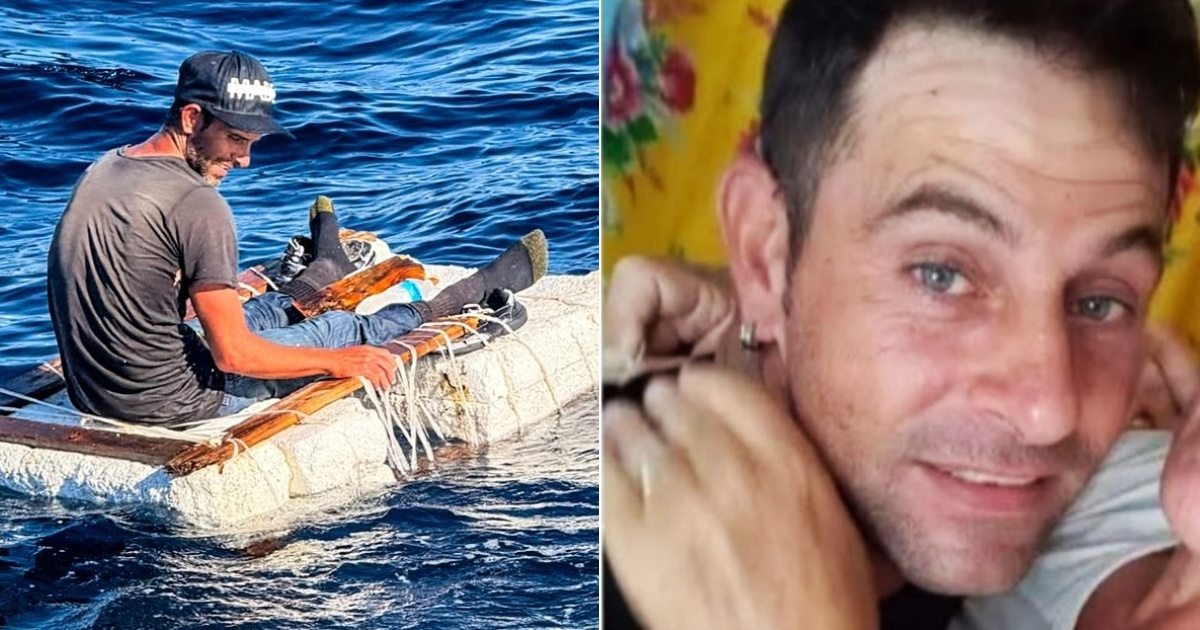
Enrique René Reyes Martínez, a Cuban national rescued on Monday from a makeshift raft roughly 16 miles east of Key Biscayne, has become the center of contrasting accounts from his family regarding how he ended up adrift in the Florida Straits. These differing stories were reported by journalist Javier Díaz for Univision.
Enrique's aunt, Yelsa Reyes Fabelo, insisted that while her nephew was eager to leave Cuba, he did not set out to sea with the intention of emigrating.
However, other family members acknowledged Enrique's long-standing desire to leave Cuba. A cousin suggested that the journey was indeed intentional and that Enrique had concealed his plans to avoid worrying his relatives.
Did Enrique Intend to Leave Cuba?
Yelsa Reyes Fabelo stated over the phone that although Enrique was desperate to leave Cuba, the journey was not deliberate. "He was crazy about leaving Cuba, but it wasn't intentional," she said after U.S. authorities found her nephew.
According to several relatives interviewed by Díaz, Enrique went fishing from Cojímar beach in Havana on Thursday, October 8, and was considered missing until he was found four days later on October 12, drifting near Florida's coast.
One relative explained that unfavorable weather conditions might have caused Enrique to drift away from the shore. "There was bad weather, a strong breeze, which started carrying him away. Other fishermen returned, but he was very distressed because he has many problems here," she recounted, choosing not to disclose her identity.
While another family member admitted Enrique frequently expressed a wish to leave Cuba, she denied that he had taken a deliberate migration journey. "I believe he wanted to go; he was fed up and often said, 'I wish I could leave,'" she said, adding that he didn't set out with the intention of leaving.
Conversely, a cousin provided a different account, telling Univision that Enrique had intended to emigrate but chose to hide his plans from his family to prevent them from worrying.
A Couple's Discovery at Sea
Enrique was discovered by a couple traveling from the Bahamas, who noticed a figure on a raft while heading to Miami. "A couple leaving the Bahamas on a tourist trip spotted a figure in the distance and decided to approach it, realizing it was a person on a raft," a family source explained to Univision.
The Cuban was found aboard a rudimentary raft constructed with polystyrene blocks, wooden planks, and ropes, approximately 16 miles east of Key Biscayne. A navigator alerted authorities via the VHF 16 marine emergency channel, initiating a rescue operation.
Miami-Dade Fire Rescue paramedics evaluated Enrique, determining he did not require emergency care, and he was later transferred to the USCGC Melvin Bell for immigration processing.
Who is Enrique René Reyes Martínez?
Although U.S. authorities have not publicly confirmed his identity, Enrique's relatives identified him as Enrique René Reyes Martínez, a 38-year-old from the Los Cangrejitos neighborhood in Santiago de Cuba. Now residing in Havana, he is the father of a young daughter who remains in Cuba. As of the latest reports, Enrique is recovering in a hospital.
Legal Challenges and Immigration Uncertainty
Regarding Enrique's legal future, immigration attorney José Guerrero, consulted by Univision, indicated that Enrique might face deportation from the United States. "He will be transferred to a detention center and placed in expedited removal proceedings as a foreign national arriving in the U.S. by sea," Guerrero noted.
However, the attorney clarified that not all migrants intercepted under these circumstances are necessarily deported. "The 'wet foot, dry foot' policy ended in January 2017, but depending on the case, not everyone is deported. Even without parole, there remains the possibility to enter the U.S. and seek asylum," he explained.
A Broader Crisis Reflected in One Man's Journey
Enrique's case unfolds against a backdrop of increasingly restrictive legal migration avenues for Cubans. The Cuban Family Reunification Program closed to new applications in December 2025, and in late September, the U.S. announced additional visa category restrictions for Cubans.
Just days before Enrique's rescue, the U.S. Embassy in Havana issued a warning with the slogan "Don't risk your life, it's not worth it," which prompted a wave of criticism from Cubans who highlighted the lack of legal migration options.
In the same week, the Coast Guard repatriated six Cubans following two separate operations in the Florida Straits. Between 2021 and 2026, more than 1.79 million Cubans left the island in what has become the largest exodus in its history.
CBP Air and Marine Operations summarized the peril of these voyages in an official statement: "The open sea is unforgiving, and these journeys can quickly become fatal."
Understanding the Legal and Personal Implications of Cuban Migration
What are the potential legal consequences for Enrique René Reyes Martínez?
Enrique may face expedited removal proceedings, as he arrived in the U.S. by sea. However, this does not guarantee deportation, as there is potential for seeking asylum.
How did Enrique get rescued?
A couple traveling from the Bahamas to Miami spotted Enrique on a makeshift raft and alerted authorities, leading to his rescue.
Why is Enrique's case significant?
Enrique's story highlights the ongoing crisis of limited legal migration options for Cubans, revealing both personal desperation and systemic challenges.