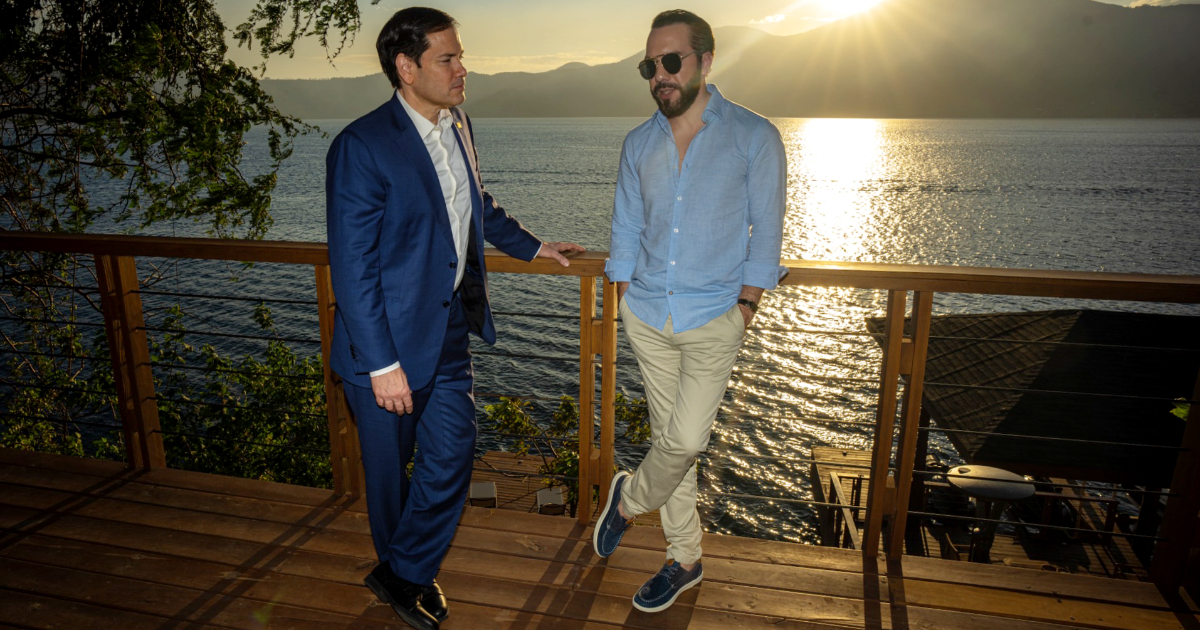
El Salvador's President, Nayib Bukele, revealed on Tuesday the establishment of a governmental commission tasked with evaluating the potential conditional release of nearly half of the over 92,000 individuals incarcerated under the emergency regime.
This announcement came shortly after a phone call between Bukele and U.S. Secretary of State Marco Rubio, during which they discussed strategies to counter "malignant foreign influence" in the region, the security of ports and critical infrastructure, and coordination within the United Nations, as confirmed by the State Department.
An investigation by El País highlights that the Salvadoran president's decision marks a significant departure from his administration's four-year-long anti-gang policy rhetoric.
U.S.-El Salvador Relations and Security Models
The relationship between Washington and San Salvador remains close-knit: Rubio visited El Salvador in February 2025, praising Bukele's security model. In March of the same year, the U.S. transferred 238 suspected members of the Tren de Aragua and leaders of the MS-13 to the Center for the Confinement of Terrorism (CECOT).
Bukele described the commission as a "third form" of justice operating outside the conventional judiciary and the Attorney General’s Office, seemingly contradicting the Salvadoran Constitution.
Details of the Conditional Release Plan
The president clarified that the mechanism is intended to assist those who had "minimal collaboration" with gangs, a group potentially representing "around 50%" of the detainees, equating to approximately 46,000 individuals.
"We are reviewing cases to offer early release to a significant number of inmates who are indeed guilty and deserve imprisonment, but under the conditions our country faces, an exception might be feasible for many," Bukele stated.
The commission's existence was first disclosed in April 2026 by Ibrahim Bukele, the president's brother, who, despite holding no official position, wields significant influence. He shared on social media that the commission reviews cases "one by one" and includes judges, prosecutors, executive staff, and First Lady Gabriela de Bukele.
Contradictions with Past Policies
This announcement starkly contrasts with Bukele's previous stance over the past four years, during which he claimed his repressive policy had a "margin of error" of merely 1% and even asserted that those detained would "never be released."
The emergency regime was declared on March 27, 2022, following a surge of violence that resulted in 87 deaths within 72 hours, attributed to MS-13 and Barrio 18. It has been continuously extended since then. Human rights organizations have documented over 500 deaths in state custody and thousands of arbitrary arrests during this period.
International Concerns and Human Rights Violations
In March 2026, an international team of experts submitted a report to the UN indicating that there are reasonable grounds to believe crimes against humanity, including torture, forced disappearances, and sexual violence, are being committed in El Salvador.
Since January, Salvadoran courts have initiated mass trials lacking defense guarantees, processing thousands of detainees simultaneously. "They are convicting everyone," remarked one attorney consulted by El País.
Bukele did not specify timelines for case evaluations, while thousands of detainees have already spent more than four years in prison.
"We had a patient with metastatic cancer, affecting 85% of the body. We applied chemotherapy. It worked. Now the cancer is in remission. There are no homicides, assaults, or robberies. The cancer isn't affecting the body. But cancerous cells still exist. Every day, we catch gang members," the president defended his security policy, which reduced El Salvador’s homicide rate from 103 per 100,000 inhabitants in 2015 to just 1.3 in 2025, the lowest in the Americas.
Key Details on Bukele's Inmate Release Proposal
What prompted Nayib Bukele's announcement?
The announcement followed a conversation between President Nayib Bukele and U.S. Secretary of State Marco Rubio, during which they discussed regional security and foreign influence.
How does the proposed commission operate?
The commission is described as a "third form" of justice, working outside the traditional judiciary and Attorney General’s Office, and aims to evaluate cases for potential early release.
What has been the impact of the emergency regime in El Salvador?
The emergency regime has been characterized by ongoing extensions, with human rights groups documenting over 500 deaths in custody and widespread arbitrary arrests.
What are the international concerns regarding El Salvador's policies?
An international report presented to the UN suggests that crimes against humanity, including torture and forced disappearances, may be occurring in El Salvador under the current policies.