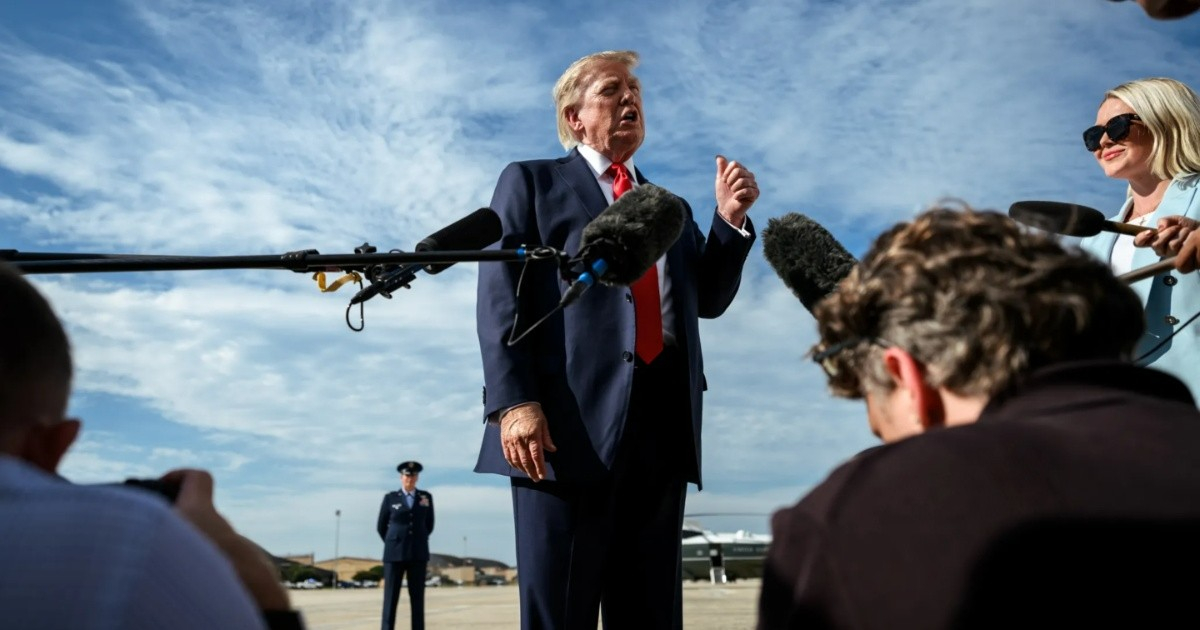
On Wednesday, former United States President Donald Trump revealed plans for a significant exploration of oil, gas, and minerals in Greenland. This announcement, shared on his Truth Social platform, was sparse on details regarding the companies involved, specific locations, or a precise start date for the initiative.
Trump stated, "Massive exploration of oil, gas, and minerals is set to commence in our new and beautiful Greenland," adding that "experts" claim the island holds more "easily accessible" oil than "almost any other territory in the world," though he did not cite any studies or reliable sources to support this claim.
Strategic Importance of Greenland
Trump also framed the announcement within the context of national security, describing Greenland as an unmatched strategic position for intercepting threats. He noted, "Any future attack against the United States would have to pass through Greenland, where our defense will routinely intercept drones, missiles, or any other form of weapon yet to be conceived. It provides time, location, and line of sight like no other place in the world."
This announcement follows just three weeks after the United States, Denmark, and Greenland signed a trilateral Arctic security agreement on September 22, 2026, which Trump heralded as a historic achievement.
Implications of the Arctic Security Agreement
The agreement expands the U.S. military presence on the island—modernizing the Pituffik space base and authorizing new facilities in Narsarsuaq and Mestersvig—while prohibiting bases from non-NATO countries and facilitating the deployment of the "Golden Dome" missile defense system. Nevertheless, the agreement explicitly reaffirms Danish sovereignty and the right of the Greenlandic people to self-determination.
Analysts from the Peterson Institute for International Economics, Foreign Policy, and Independent suggest the agreement largely updates the 1951 defense treaty between Washington and Copenhagen, which already granted the U.S. extensive military rights on the island. Essentially, Trump presented it as a diplomatic win while it mostly maintained the status quo.
Historical Context and Domestic Impact
Trump's interest in Greenland is not new. In 2019, during his first term, he attempted to purchase the island, a proposal Denmark deemed "absurd." Upon returning to the White House, Trump escalated pressure by declaring control over Greenland an "absolute necessity" for national security, not ruling out military force and threatening tariffs on Denmark and other European nations opposed to the idea.
Domestically, this announcement aligns with the upcoming midterm elections on November 3. Trump faces mounting pressure over fuel prices: diesel hit a record $6.53 per gallon on September 22, and gasoline averaged over $4.56 in June, far above the levels promised by his "drill, baby, drill" policy.
Challenges of Greenland's Oil Potential
The reality of Greenland's oil potential is more complex than Trump's portrayal. The autonomous Greenlandic government halted new oil and gas exploration licenses in 2021 due to climate concerns. Commercial exploitation faces significant hurdles: extreme weather, Arctic ice, lack of infrastructure, complex geology, and prohibitive costs. No scientific evidence exists to verify reserves on the scale Trump suggests.
The message on Truth Social, posted at 4:17 a.m., concluded with Trump's signature sign-off: "Thank you for your attention to this matter. President DONALD J. TRUMP."
Key Questions About Greenland's Oil Exploration
What details are lacking in Trump's announcement about Greenland exploration?
Trump's announcement did not provide specifics on the companies involved, exact locations for exploration, or a definitive start date.
How does the recent Arctic security agreement affect U.S. military presence in Greenland?
The agreement allows for the modernization of existing bases and the establishment of new facilities, while banning non-NATO bases. It also enables the deployment of the "Golden Dome" missile defense system.
What are the challenges facing oil exploration in Greenland?
Oil exploration in Greenland is hindered by extreme weather, Arctic ice, lack of infrastructure, complex geology, and high costs, alongside a suspension of new exploration licenses by the Greenlandic government.