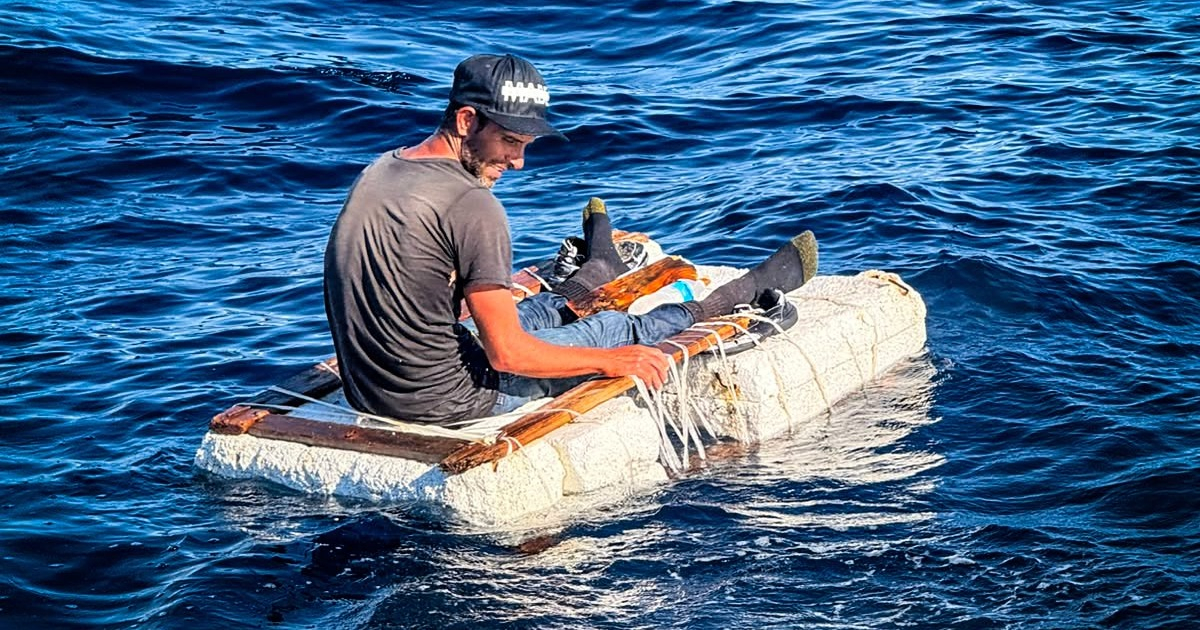
On Monday, a Cuban man was rescued alive after being discovered adrift and alone on a makeshift raft approximately 16 miles east of Key Biscayne, Florida. This was reported by the official CBP Air and Marine Operations account on social media platform X.
A Stranger's Alert Saves a Life
The alarm was raised thanks to an anonymous bystander who spotted the man drifting and reported the sighting via VHF channel 16, the international maritime distress frequency. This crucial notification allowed authorities to initiate a rescue operation.
Upon receiving the alert, maritime units from CBP AMO based in Miami and Fort Lauderdale, along with the U.S. Coast Guard, responded promptly. They located the individual and provided him with emergency assistance at the scene.
This rescue sheds light on the ever-evolving migration landscape. For continuous updates on Cuban arrivals in the U.S. and related operations, visit our U.S. Immigration section.
Emergency Medical Evaluation and Transfer
The man underwent a medical evaluation by emergency services and was subsequently cleared by the Miami-Dade Fire Rescue Department. He was then transferred to the USCGC Melvin Bell for immigration processing.
An Improvised Raft in Open Waters
A photograph released by CBP AMO alongside their statement highlights the extreme precariousness of the raft: constructed from blocks of white polystyrene foam reinforced with wooden planks bound by ropes, it was barely sufficient to keep one person afloat.
In the image, an adult man with a beard, wearing a gray t-shirt and a black cap, is seen hunched over the raft in the open ocean, with some belongings or supplies attached to the structure.
CBP AMO emphasized in their post that the "Cuban citizen is fortunate to be alive," warning that "the open sea is unforgiving, and these journeys can quickly turn fatal."
Increased Maritime Migration Due to Legal Pathway Closures
This rescue occurs amid a backdrop of continued maritime migration despite the stricter immigration policies of the Trump administration. Family reunification categories F1, F2A, F2B, F3, and F4 were blocked, and the Cuban Family Reunification Program closed to new applications in December 2025. By late September 2026, Washington announced additional restrictions affecting more visa categories for Cubans.
Just ten days before this rescue, the U.S. Embassy in Havana released a deterrent graphic warning, "Don’t risk your life, it’s not worth it," sparking a flood of responses from Cubans who noted the impossibility of legal migration routes. One commenter remarked, "You can’t enter legally either." Another user bluntly stated, "Living in Cuba, now that’s risking your life; the sea seems small compared to such danger."
The lethal risks of these journeys were tragically highlighted in August 2026, when two young Cuban rafters drowned in the waters off Sandino, Pinar del Río: 17-year-old Leodannis Sánchez and his 19-year-old partner Osmaikel, during an attempted irregular departure to Mexico.
In September, the Coast Guard returned 14 out of 15 intercepted rafters near Elbow Cay, Bahamas, to Cuba; one was evacuated for medical reasons. In June, 27 Cubans were repatriated after being rescued in the Yucatán Channel when their vessel risked sinking.
Between 2021 and 2026, over 1.79 million Cubans left the island in what is described as the largest exodus in its history, driven by economic hardship, blackouts, shortages, and political repression under the dictatorship.
"This country is so tough that risking your life adrift at sea is worth it, even knowing that reaching the shore is difficult and you might be sent back. Yet, Cubans try because freedom is priceless," wrote a Cuban commenter in response to the U.S. Embassy’s deterrence campaign.
Understanding Cuban Migration Challenges
What prompted the Cuban man to undertake such a dangerous journey?
The man, like many others, was likely driven by the oppressive economic conditions, political repression, and lack of legal migration pathways in Cuba.
How did the authorities respond to the emergency alert?
The CBP AMO and U.S. Coast Guard quickly coordinated a rescue operation, locating the individual and providing necessary emergency assistance.