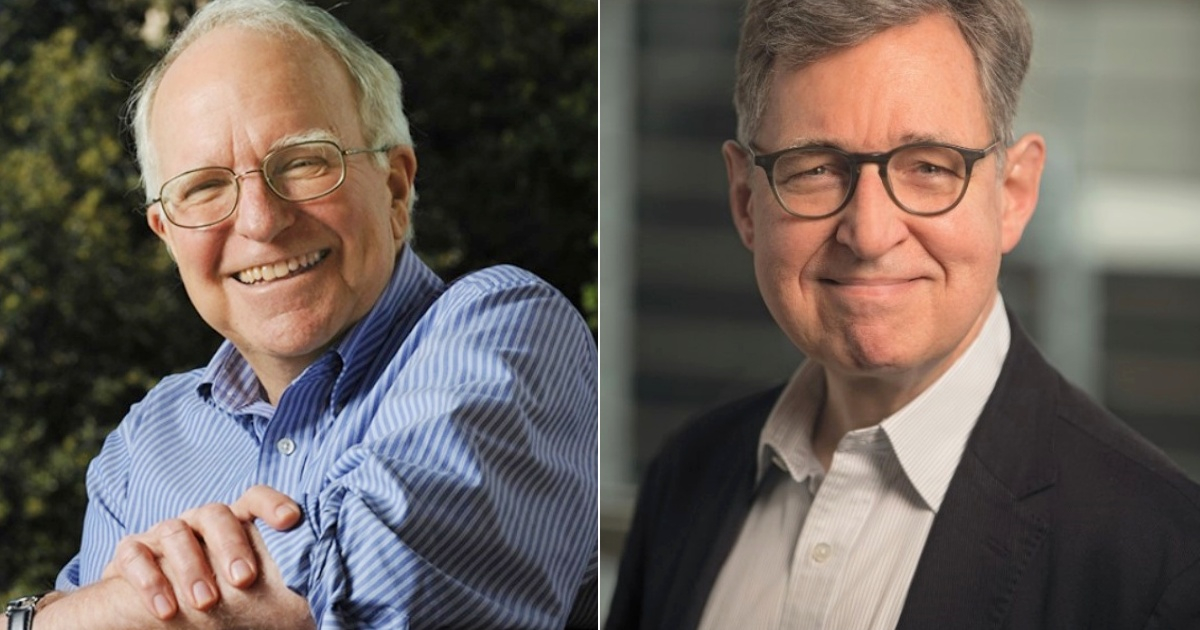
This Monday, the Royal Swedish Academy of Sciences announced that the 2026 Sveriges Riksbank Prize in Economic Sciences in Memory of Alfred Nobel has been awarded to American economists Robert E. Hall and Michael Woodford. They have been recognized for establishing the microeconomic foundations of macroeconomic stabilization.
The two scholars will share a prize of 12 million Swedish kronor—equivalent to approximately $1.2 million—divided equally between them.
Meet the Laureates
Born in 1943 in Palo Alto, California, Robert E. Hall earned his Ph.D. from the Massachusetts Institute of Technology (MIT) in 1967. He serves as a professor at Stanford University and is an associate researcher at the Hoover Institution. Hall also led the American Economic Association as its president in 2010 and has long directed the National Bureau of Economic Research’s program on economic fluctuations.
Michael Woodford, born in 1955 in Chicopee, Massachusetts, also obtained his Ph.D. from MIT in 1983. Since 2004, he has held the John Bates Clark Chair of Political Economy at Columbia University in New York. His acclaimed book, "Interest and Prices: Foundations of a Theory of Monetary Policy" (2003), has been cited over 14,000 times and is a central reference for central banks worldwide.
Upon learning of the award, Woodford expressed his feelings modestly, saying, "It's a surprise, but I feel very good about it," during the press conference announcing the award, as reported by the BBC.
The Significance of Their Work
The importance of their research becomes clearer when considering the historical context in which it was developed. The oil crises of the 1970s led to stagflation—a period of high inflation coupled with low growth and rising unemployment—conditions that classical Keynesian models failed to address or rectify.
The Academy pointedly described this shortcoming, stating that earlier approaches "did not reduce unemployment but instead led to runaway inflation." Hall and Woodford reconstructed macroeconomic analysis from its microeconomic roots. Rather than linking aggregate variables through statistical equations, their models focus on household decisions regarding consumption and savings, as well as how firms set prices in markets with imperfect competition.
A key aspect of their approach is the role of expectations. "When governments and central banks communicate their economic policy plans, they can influence this view of the future and steer the economy in the right direction," the Academy noted when highlighting the laureates' contributions. This tool proved critical during the 2008 financial crisis and the COVID-19 pandemic when interest rates hit zero, and communication became the primary tool of monetary policy.
The Jury's Verdict
John Hassler, chair of the Economic Sciences Prize Committee, emphasized the practical utility of the models developed by Hall and Woodford. "The work of the laureates has provided us with a solid theoretical foundation for the models now used by central banks and governments worldwide," he stated.
"Thanks to them, we are better equipped to tackle economic crises, such as energy crises or sudden changes in household consumption," Hassler added.
The prize, established in 1968 by Sweden's central bank, has been awarded in 57 editions to 99 laureates. Americans account for about 70% of all recipients since its inception in 1969.
The complete schedule of the 2026 Nobel Prizes is available for those interested in following the rest of the announcements.
The formal award ceremony will take place on December 10, 2026, in Stockholm, coinciding with the anniversary of Alfred Nobel's death in 1896.
Understanding the 2026 Nobel Economics Prize
What contribution did Robert E. Hall and Michael Woodford make to earn the Nobel Prize?
Hall and Woodford were honored for laying the microeconomic foundations for macroeconomic stabilization, which has significantly influenced how economic policies are crafted and implemented globally.
Why is their work considered crucial in modern economics?
Their work is vital because it addresses the shortcomings of previous economic models during periods of stagflation and provides a framework that considers the role of expectations in economic planning, which has been pivotal during crises like the 2008 financial downturn and the COVID-19 pandemic.