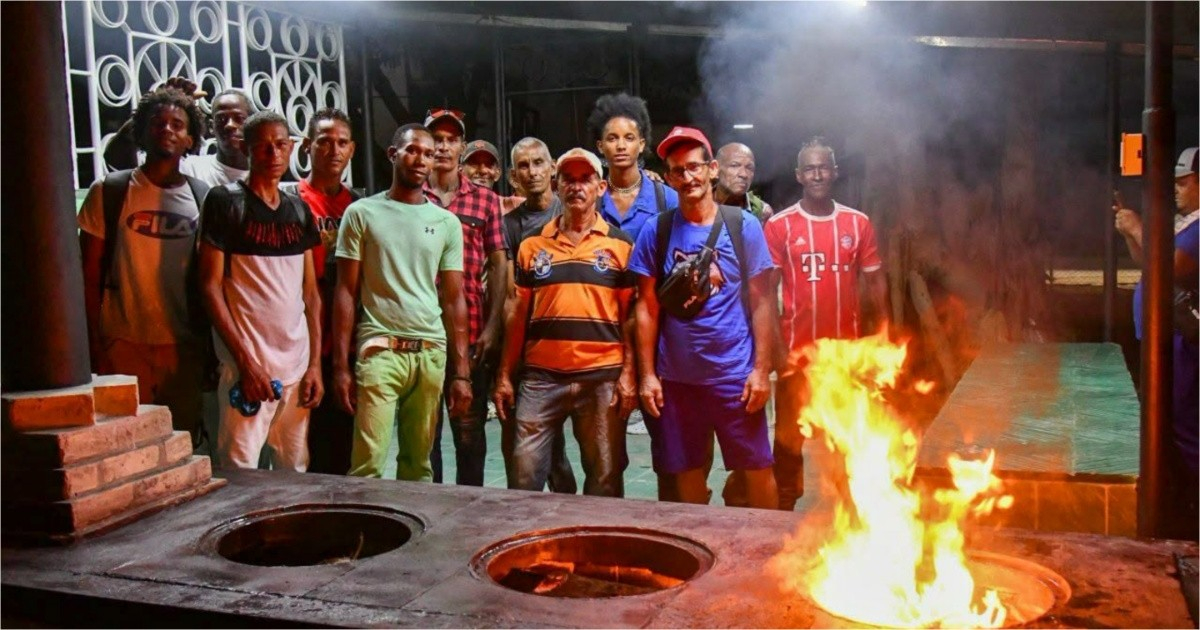
This past weekend, the University of Oriente in Santiago de Cuba marked its 79th anniversary by unveiling a new wood-fired kitchen on campus. The ceremonial event included a ribbon-cutting, speeches, and the presence of local authorities.
In its official Facebook post, the university hailed the wood-fired kitchen as a testament to "creativity, ingenuity, and commitment" in the face of the ongoing embargo, labeling it an "innovative solution." According to the post, "This alternative is a call to be creative, to work together, and to prove that intelligence and collective effort are our greatest assets."
Photos from the event depicted students wearing T-shirts commemorating Fidel Castro's centenary, emblazoned with "CON FIDEL / 100," alongside a makeshift stove structure featuring three circular openings. The event took place as an outdoor evening gathering.
Social Media Outcry
The reaction on social media was overwhelmingly negative. Santiago Pedreira Bazan encapsulated the sentiment of many with his blunt comment: "A celebration of regression."
Day Castellanos sarcastically questioned, "Is cooking with wood now considered ingenuity and innovation?" Meanwhile, Roger Rivero wondered if the university's page was a satire: "Is this for real? Or is this the parody page of UO?"
Criticism of Academic Credibility
Pedro Rodriguez offered the most detailed critique, stating, "This borders on the absurd: staging a ceremony to celebrate the creation of an 'alternative gas kitchen' is merely setting up three stones and lighting a fire, without all the fanfare. From an academic institution, one would expect reason and science, not the glorification of scarcity and backwardness as an 'achievement' worthy of coverage."
Marino Paumier expressed succinct dismay: "How sad to see this being celebrated."
Background of Resource Shortages
Since January 10, 2026, the state-run company CUPET indefinitely halted the distribution of liquefied gas in Santiago de Cuba and the eastern provinces due to supply shortages, leaving hundreds of thousands of families without fuel.
By April 2026, more than 834,000 of the 1.7 million registered customers in Cuba were unable to access state-provided gas. On the black market, a gas cylinder soared to a staggering 50,000 pesos in eastern cities.
The national electricity deficit exceeded 2,000 megawatts, with demand close to 3,000 MW, resulting in blackouts lasting 22 to 36 hours daily in several provinces throughout 2026.
In March 2026, President Miguel Díaz-Canel normalized these setbacks by urging the provision of cooking materials "from charcoal to wood" during National Defense Day. This appeal coincided with the appearance of wood stoves on the balconies of buildings in Santiago de Cuba and bakeries in Holguín baking bread with wood due to a lack of electricity and fuel.
What sets the University of Oriente apart is its choice to transform this setback into a public celebration, complete with a ribbon-cutting ceremony, while its over 13,000 students face a crisis that, by May 2026, necessitated changes in the assessment of nearly 177,000 students across Cuba's university system.
"From an academic institution, one would expect reason and science," reiterated Pedro Rodriguez. "Please, a little respect for common sense."
Implications of the University of Oriente's Wood-Fired Kitchen
Why is the inauguration of a wood-fired kitchen at the University of Oriente controversial?
The controversy stems from the perception that the event celebrates a regression in infrastructure, highlighting a lack of progress and modern resources amid ongoing shortages in Cuba.
How have resource shortages affected daily life in Cuba?
Resource shortages have led to significant challenges, including the suspension of gas distribution and extensive power outages, forcing many to resort to alternative cooking methods such as wood stoves.
What measures did President Díaz-Canel propose in response to the shortages?
President Miguel Díaz-Canel suggested ensuring the availability of materials for cooking, including charcoal and wood, as a response to the ongoing shortages during National Defense Day in March 2026.