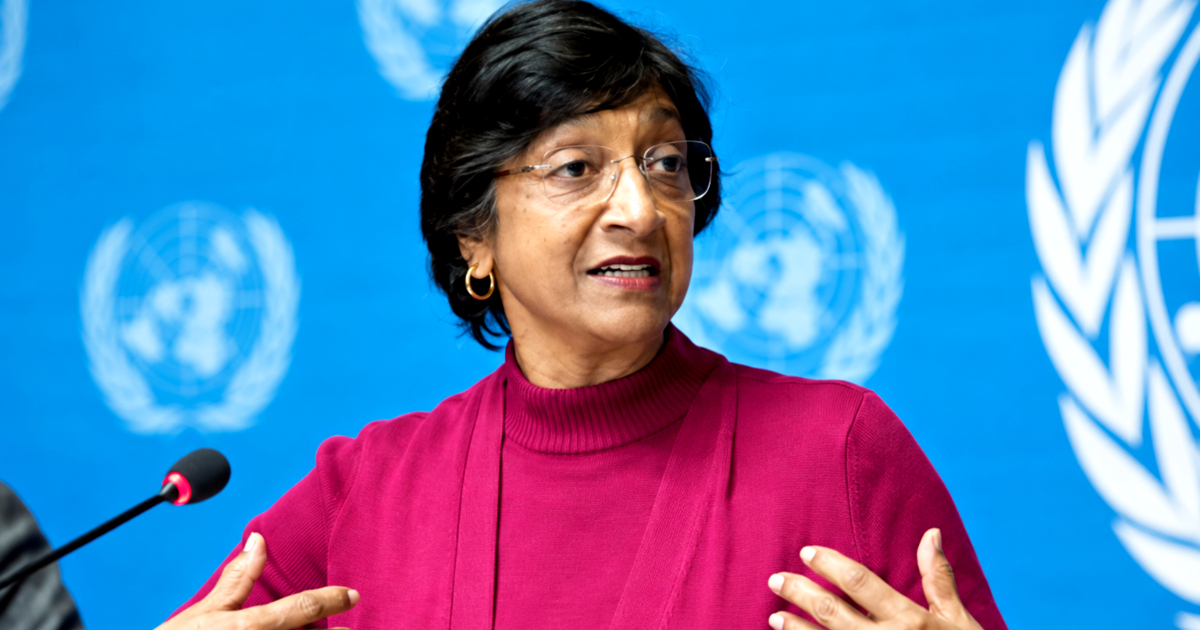
The awarding of the 2026 Nobel Peace Prize to South African jurist Navanethem "Navi" Pillay has sparked a wave of criticism beyond the reactions from Donald Trump and the Israeli government.
The organization UN Watch, along with a former United Nations official, has accused the laureate of remaining silent on human rights abuses in Cuba and being "complicit in the Uyghur genocide" during her tenure as the UN High Commissioner for Human Rights.
Allegations of Complicity
Emma Reilly, a former official at the UN High Commissioner's Office, has leveled serious allegations against Pillay. She claims that between 2008 and 2014, the office disclosed to Chinese authorities the names of over 50 dissidents—mostly Uyghurs—scheduled to participate in Human Rights Council sessions, putting them at risk of reprisals.
"The winner is an absolute disgrace," declared Reilly in a statement released following the prize announcement.
Impacts on Activists' Families
Reilly asserts that family members of these activists faced intimidation, arbitrary detentions, torture, and disappearances as a result of their identities being leaked to the Chinese regime.
In April 2024, Reilly presented documentation of these practices to the Foreign Affairs Committee of the British Parliament.
UN's Response
The UN has acknowledged a practice of verifying names with certain states but denies it endangered human rights defenders, adding that the practice ceased in 2015—a claim Reilly disputes.
Another incident highlighted by Hillel Neuer, executive director of UN Watch, was Pillay's absence from the 2010 Nobel Peace Prize ceremony for Chinese dissident Liu Xiaobo, then imprisoned by communist authorities—a move seen by human rights organizations as yielding to Beijing's pressure.
"In 2010, the Nobel Committee honored Liu Xiaobo for standing up to the Chinese dictatorship. Pillay refused to attend his ceremony. Now the Committee has given her the same award," Neuer remarked, demanding an explanation for the recognition.
Connections with Cuba
Pillay's ties to Havana have also come under scrutiny. In July 2008, Cuba supported her appointment as High Commissioner on behalf of the Non-Aligned Movement.
In March 2010, while the death of political prisoner Orlando Zapata Tamayo—who died after a hunger strike of about 85 days in prison—drew international condemnation, Pillay was photographed smiling in Geneva with Cuban Foreign Minister Bruno Rodríguez Parrilla.
During a visit to Havana in April 2019 as president of the International Commission against the Death Penalty, she thanked the Cuban regime for its hospitality and willingness to consider recommendations to abolish the death penalty. However, Cuba's 2022 Penal Code not only maintained capital punishment but expanded the number of offenses punishable by death from 20 to 24.
A 2011 study by UN Watch documented that during her first two years as High Commissioner, Pillay remained silent on violations in 34 countries deemed "not free" by Freedom House, including Cuba, North Korea, Saudi Arabia, Sudan, and Eritrea, while issuing 21 statements on the Middle East, nine of which concerned Israel.
Political Reactions
The prize also highlighted a striking political contrast: Spanish President Pedro Sánchez congratulated Pillay warmly just two hours after the announcement, praising her for dedicating her life to "pursuing impunity and defending the weak against the powerful."
This promptness contrasts with his stance on the 2025 Nobel Peace Prize awarded to Venezuelan opposition figure María Corina Machado, when Sánchez refused to publicly congratulate her, stating, "I don't comment on Nobel prizes, I don't get into evaluating them," as reported by Cadena SER.
The award ceremony for Pillay is scheduled for December 10, 2026, in Oslo.
Frequently Asked Questions about Navi Pillay's Nobel Peace Prize Controversy
What are the main criticisms against Navi Pillay regarding her Nobel Peace Prize?
The main criticisms involve her alleged silence on human rights abuses in Cuba and complicity in the Uyghur genocide during her time as UN High Commissioner for Human Rights.
Why did Emma Reilly criticize Navi Pillay?
Emma Reilly criticized Pillay for allegedly allowing the leaking of dissidents’ names to Chinese authorities, putting them at risk of reprisals.
How did UN Watch view Navi Pillay's absence from Liu Xiaobo's Nobel ceremony?
UN Watch saw her absence as a concession to pressure from Beijing, contrasting with the Nobel Committee's recognition of Xiaobo's stand against the Chinese dictatorship.