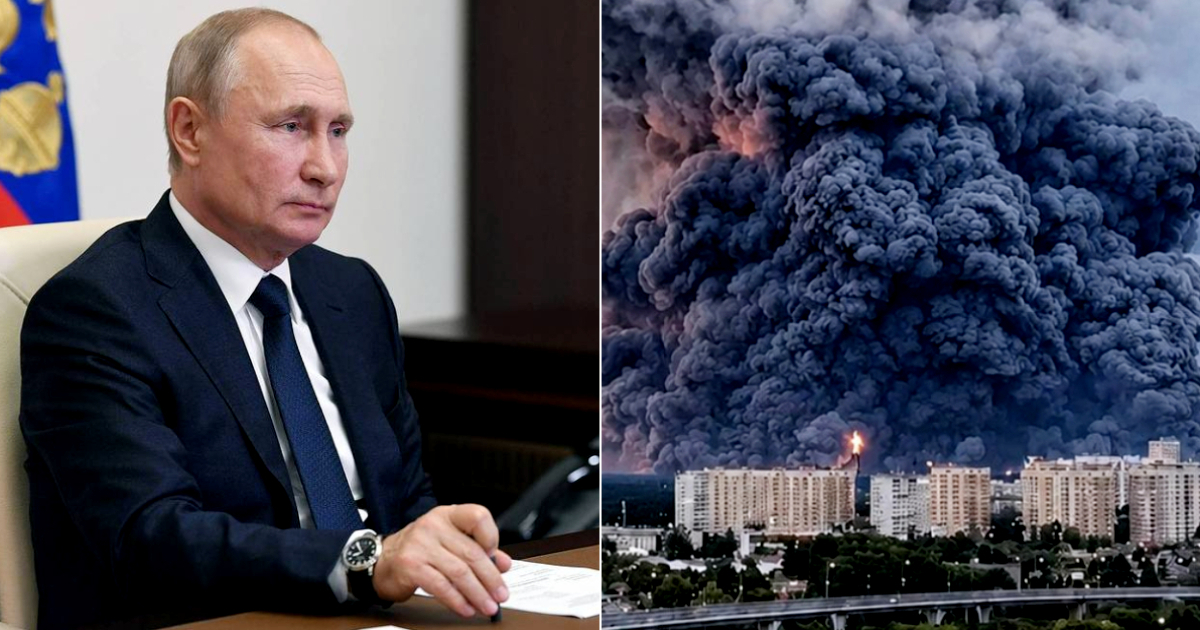
This week, Ukrainian drones targeted two data centers belonging to Yandex, Russia's largest technology provider, in a move Kyiv describes as a calculated effort to dismantle Russian artificial intelligence infrastructure and increase the economic burden of the conflict.
The strikes, which occurred on Wednesday and Thursday and were confirmed by Yandex itself, rendered two out of three of its supercomputers non-operational, causing widespread disruptions across Russia's digital economy, according to The Kyiv Independent.
The initial attack hit the Sásovo data center in the Ryazan region, leaving it completely out of operation. The following day, another facility in Kaluga suffered severe damage, with multiple modules disabled; nine people were injured, and 26 drones were shot down, according to the regional governor.
These facilities housed the "Chervonenkis" and "Lyapunov" supercomputers, where the YandexGPT artificial intelligence model was trained using approximately 2,700 Nvidia A100 accelerators.
Impact on Russian Digital Economy
As servers went down, systems at Wildberries, Ozon, T-Bank, Russian Railways, and the real estate portal Cian—relying heavily on Yandex's cloud services—were among the first to report malfunctions.
These attacks are part of a broader Ukrainian campaign targeting the Russian economy, which began in mid-July with systematic strikes on Wildberries warehouses, the e-commerce giant dubbed the "Russian Amazon." Reports from The Guardian and Reuters indicate that about 20% of the company's storage capabilities were damaged or destroyed, with losses potentially reaching $1.18 billion.
Strategic Justification for the Attacks
The Ukrainian Ministry of Defense defends the Yandex strikes, arguing that its services extend beyond civilian use. Expert Konstantin Tarasov, in an analysis published by OBOZ.UA, points out that "Yandex Cloud services and its mapping systems process high-precision geospatial data, and the company's AI algorithms analyze satellite images, adjust military logistics routes, and assist in target recognition."
Moreover, the Sásovo data center shared a site with the "Sasta" factory, which manufactures components for the Iskander tactical ballistic missile system.
Propaganda and Political Dimensions
The propagandistic role of Yandex also factors into Ukraine's decision. An EU-financed audit, dubbed Weaponised Algorithms and conducted by researcher Ihor Samokhodskyi, found that the assistant Alice supported Kremlin narratives in 86% of its Russian responses. The report concluded that "the finding is not merely a limitation of training but a deliberate suppression of real-time information," with Alice claiming the Bucha massacre was "staged."
The Yandex attacks are also seen as a direct counter to Russia's late-September campaign, where Moscow bombed at least eight data centers in Kyiv, leaving 100,000 homes without internet and causing four deaths in an attack on the provider Datagroup.
Political Tensions and U.S. Involvement
Political tensions further heighten the scenario. On Saturday, Trump publicly criticized Zelensky, claiming "it's time" for Ukraine to have a different president and accusing him of "causing problems for the world" by continuing strikes against Russian refineries.
U.S. negotiators reportedly cautioned Kyiv that Washington might suspend intelligence sharing if Ukraine didn't halt this energy strategy. Zelensky dismissed Trump's Moscow-backed diesel agreement as "absolutely terrible," warning that it would enable Russia to continue funding the war. Far from halting the offensive, Kyiv expanded it into the tech sector, adding data centers to a list that already included refineries, logistics warehouses, and e-commerce platforms.
The cumulative impact of this strategy is evident in Russian financial reports: the federal budget recorded a deficit of approximately $67 billion in the first half of 2026, with a Kremlin insider warning Reuters of "a wave of bankruptcies" in the commercial sector that no one has the resources to contain.
Key Insights on Ukraine's Strategy Against Russia
What was the target of the Ukrainian drone strikes?
The Ukrainian drone strikes targeted two data centers operated by Yandex, Russia's leading technology provider, aiming to disrupt its artificial intelligence infrastructure.
Why does Ukraine justify its attacks on Yandex?
Ukraine justifies the attacks on Yandex by highlighting that its services are not solely civilian, as they process high-precision geospatial data and aid in military logistics and target recognition.
What are the broader implications of these strikes on Russia?
The strikes have led to significant disruptions in Russia's digital economy and are part of a larger Ukrainian campaign causing economic strain, with reports of a potential wave of bankruptcies in the Russian commercial sector.