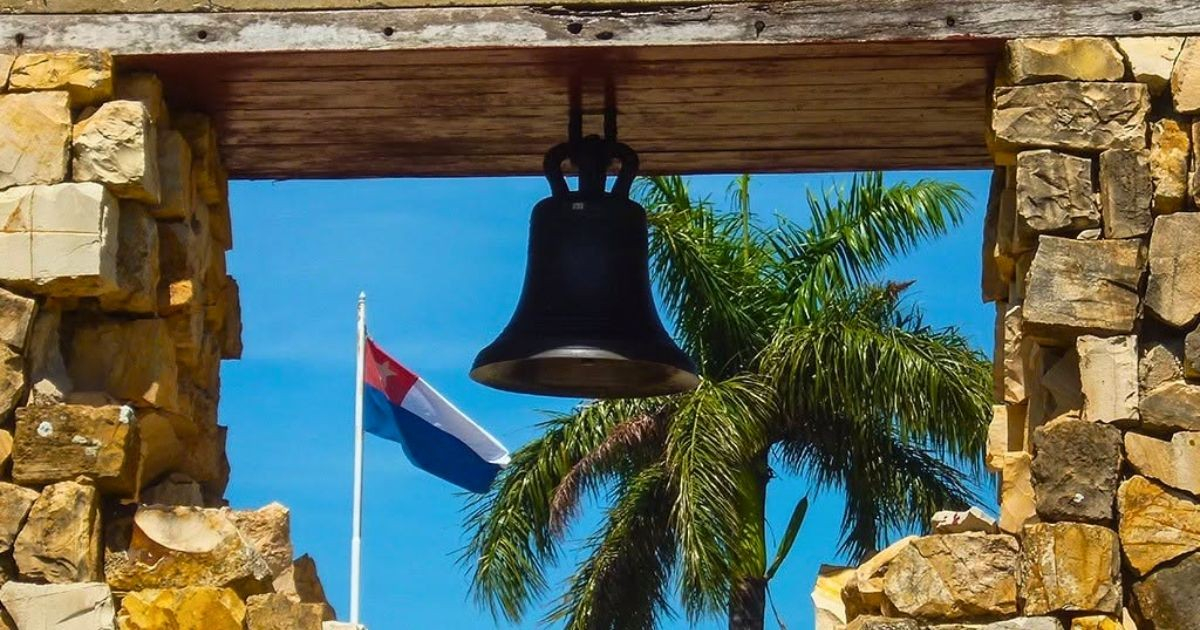
On the 158th anniversary of the La Demajagua Uprising, Cuban historian Ivette García González shared a poignant reflection on her Facebook profile, highlighting segments of the Manifesto of the Revolutionary Junta of the Island of Cuba. She argues that the manifesto remains profoundly relevant in today's Cuba.
García González, who holds a doctorate in Historical Sciences and previously taught at the University of Havana, encourages readers to engage in a simple yet revealing exercise: mentally replace the word "Spain" with "Regime" as they read the foundational 1868 document. Her conclusion is straightforward: "The method may change, but the underlying issues remain the same."
The document she revisits was first presented by Carlos Manuel de Céspedes on October 10, 1868, at the La Demajagua sugar mill near Manzanillo. On that day, he declared his slaves free and led the uprising that sparked the Ten Years' War against Spanish colonial rule.
This initial insurrection, later known as the Grito de Yara following the first battle in Yara the next day, initiated a conflict that endured until 1878, ending with the Pact of Zanjón without achieving independence. Cuba would not become a republic until 1902, following numerous struggles and an American military occupation.
The Echoes of a Historic Manifesto
The Manifesto condemned the oppressive conditions under which Cubans lived, deprived of "all political, civil, and religious freedoms," with their sons "exiled to distant lands or executed without trial," and denied even the right to assemble. One of its most striking assertions captures the intellectual suffocation of colonialism: "In short, the Island of Cuba cannot prosper […] Cubans cannot speak, cannot write, cannot even think […]"
In response to these realities, the document declared: "We are not driven by ambition; we only wish to be free and equal, as the Creator made all men."
García González emphasizes that this demand from 158 years ago resonates powerfully in contemporary Cuba. "We come from there too," she writes, "we are a people who have risen time and again against oppression." The statistics of 2026 support this view: the Cuban Observatory of Human Rights recorded over 3,000 repressive actions in the first nine months of the year, while Prisoners Defenders notes more than 1,300 individuals imprisoned or restricted for political reasons on the island.
A Call for Political Reform and Civic Action
The 1868 Manifesto not only denounced but also proposed a political agenda that included universal suffrage, national representation to enact laws and taxes, free trade with friendly nations, and "the religious observance of the inalienable rights of man." These demands remain unmet in the 21st-century Cuba under Communist Party rule.
The October 10 publication is part of a series of analyses García González has released throughout 2026. In September, she argued that protests must evolve into a strategic fight to break the cycle of "crisis-protests-retreat," and in May, she asserted that "neither is Cuba an exception, nor are dictatorships invincible." That same month, she introduced a strategy to form a National Civic Movement against the dictatorship.
The Cuban Conflict Observatory reported 1,415 protests and critical expressions in July 2026 alone, the highest monthly figure ever recorded, in a nation whose economy has contracted by more than 15% since 2020.
By drawing a line from the 1868 Manifesto to today's reality, García González concludes her reflection with the powerful words from the document itself: "No, Cuba can no longer belong to a power that, like Cain, kills its brethren, and, like Saturn, devours its children. Cuba aspires to be a great and civilized nation, to extend a friendly arm and a fraternal heart to all other peoples."
Understanding the Historical Relevance of Cuba's October 10 Manifesto
Why is the October 10 Manifesto still relevant in Cuba today?
The October 10 Manifesto remains relevant as it addresses issues of freedom and equality that continue to resonate with Cubans under the current regime, echoing the ongoing struggle against oppression.
What were the main demands of the 1868 Manifesto?
The 1868 Manifesto called for universal suffrage, national representation for creating laws and taxes, free trade, and the observance of human rights, demands still unmet in today's Cuba.
How has Ivette García González contributed to the discourse on Cuban history?
Ivette García González has enriched the discourse by drawing parallels between historical documents like the October 10 Manifesto and the current socio-political climate in Cuba, advocating for strategic civic actions against the regime.