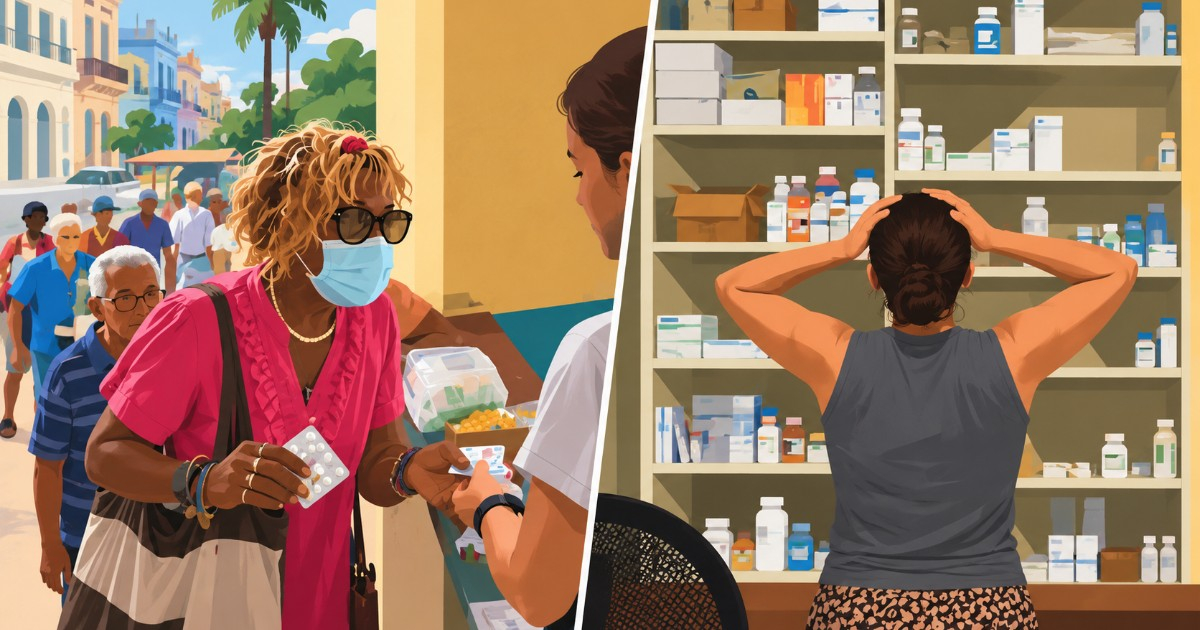
In Havana's Vedado neighborhood, residents struggling to find medications in state-run pharmacies are turning to a compassionate community network offering free distribution. Known as "Medicine Is Not for Sale," this initiative organizes requests through WhatsApp and operates on donations and volunteer work, amidst a persistent scarcity affecting Cuban patients.
Coordinated by Laura Mendoza, the project was featured in a report by journalist Andrea Rodríguez for the Associated Press (AP) on Sunday, October 11. The agency highlighted how every Thursday and Sunday at noon, Mendoza hands out medicines that beneficiaries have previously requested. The available products include antihistamines, diuretics, eye drops, and antibiotics.
WhatsApp Groups and Donations Support the Initiative
Mendoza explained to AP that the project manages five WhatsApp groups in Havana and recently added another in Guanabo. She estimated that approximately a hundred similar community initiatives exist in the capital, although this figure is based on her personal assessment and not on official records.
The network collaborates with Cáritas and receives medications from humanitarian organizations in Canada and the United States, travelers, and neighbors who contribute what they can. According to Mendoza, the donations received exceed 13 kilograms weekly, representing the weight of the products, not the number of patients served or complete treatments available.
The collaboration extends to delivering medicines to individuals unable to travel on their own. However, the solidarity has its limits: medications requiring refrigeration, certain cancer treatments, and supplies like syringes, gauze, or anesthetics are among the hardest to provide, according to testimonies collected by AP.
The Impact of Pharmaceutical Shortages
The emergence of these networks highlights the dwindling ability of state pharmacies to ensure standard treatments. Even the regime's leader, Miguel Díaz-Canel, acknowledged the severe medication shortages in statements broadcast on October 7. In August, he had admitted that only about 30% of the essential drugs were available.
The scarcity extends to domestic production. AP recalled that the president of BioCubaFarma, Mayda Mauri Pérez, announced in June that nearly 300 of the 395 medications supposed to be supplied by the company hadn't been produced due to issues with imported raw materials. In Ciego de Ávila, health authorities also reported a mere 10% availability of essential medicines in state pharmacies, hampered by both shortages and distribution problems.
Finding the product is not the only hurdle; affording it when available outside state channels is another. A retired woman interviewed by AP mentioned that informal sellers had demanded up to 1,000 pesos for a supply of medicine she previously bought at a much lower subsidized price. According to her account, this cost exceeds 30% of her monthly pension. Her experience is specific to her and not a universal price for all patients.
Private Pharmacies Fail to Meet Immediate Needs
Amidst the crisis, the Cuban regime authorized private pharmacy operations under Decree 160/2026, which took effect in August. However, allowing the activity does not mean there are authorized, stocked establishments accessible to the public. According to Ministry of Public Health data released in September, 36 proposals were under review, and 14 had been approved for further processing, but no pharmacy had opened under the new model by then. The AP report from October 11 also noted that their opening was still pending.
The new system maintains state control over imports, which must go through Medicuba or Farmacuba, and requires health authorizations to sell medications. Even when these establishments begin to operate, pricing will remain a concern for those with very low incomes.
Meanwhile, community-driven deliveries help alleviate immediate needs but depend on irregular donations and cannot replace a continuously stocked pharmacy network offering affordable medications. The efforts of volunteers expose a stark reality affecting thousands of families: securing basic treatment has become an uncertain quest.
FAQs about Medicine Shortages in Havana
What is the "Medicine Is Not for Sale" initiative?
"Medicine Is Not for Sale" is a community project in Havana that distributes free medications to residents who cannot find them in state pharmacies. It organizes requests through WhatsApp and relies on donations and volunteer efforts.
How are medications distributed to those in need?
Medications are distributed by Laura Mendoza every Thursday and Sunday at noon. Beneficiaries must request the medicines in advance through the project’s organized WhatsApp groups.
Why is there a shortage of medications in Havana?
The shortage is due to the state's inability to ensure a consistent supply of essential drugs, compounded by issues with domestic production and imported raw materials.