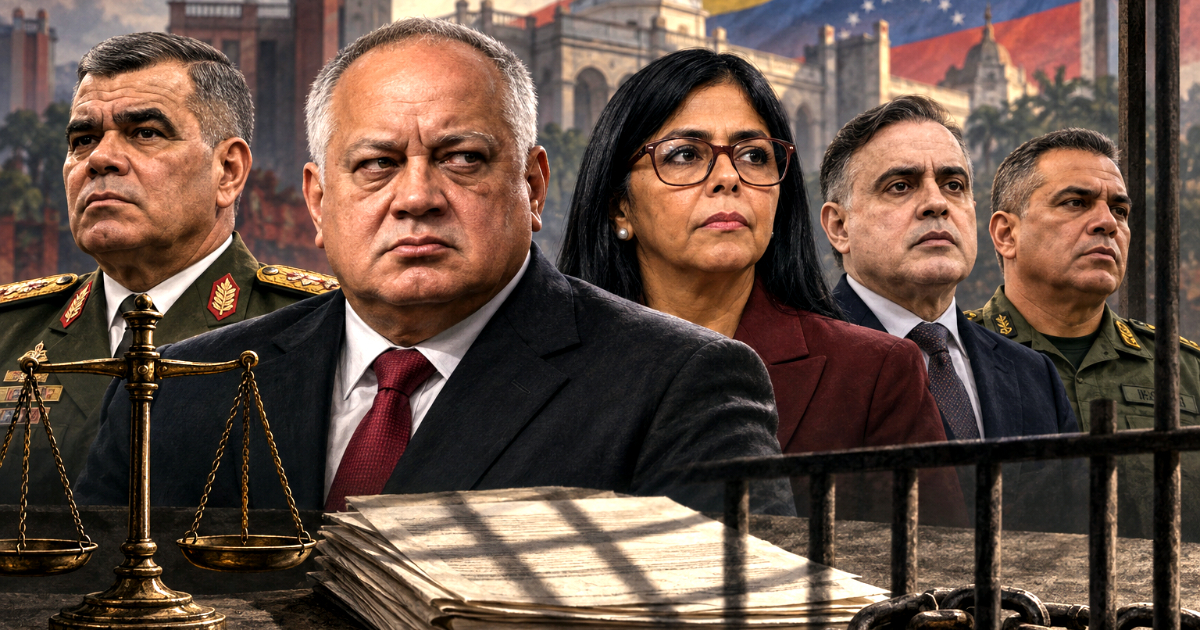
On October 8, federal prosecutors in New York leveled fresh accusations against Nicolás Maduro and Cilia Flores, alleging their involvement in a conspiracy to commit torture. This criminal charge complements a civil judgment issued earlier this year in Florida, which implicates several high-ranking officials who continue to hold positions under the interim leadership of Delcy Rodríguez.
In the civil proceedings, Judge Jacqueline Becerra ruled on May 12 that a payment of $300,425,616 must be made to Americans Matthew John Heath and Osman Imran Khan and their families for the kidnapping and torture they endured in Venezuela. This ruling places shared liability on twelve individuals and four organizations.
The list of those named in the judgment (case no. 1:25-cv-20040-JB, document 67) includes Nicolás Maduro Moros, Cilia Adela Flores de Maduro, Diosdado Cabello Rondón, Vladimir Padrino López, Alex Nain Saab Morán, Tarek William Saab Halabi, Néstor Luis Reverol Torres, Iván Rafael Hernández Dala, José Miguel Domínguez Ramírez, Reynaldo Hernández, Marlon Salas Rivas, and Alexander Enrique Granko Arteaga.
Additionally, four organizations have been held accountable by Judge Becerra: Compañía General de Minería de Venezuela (Minerven), Segunda Marquetalia, Revolutionary Armed Forces of Colombia–People's Army (FARC-EP), and the Cartel of the Suns.
The Unyielding Grip of Chavista Power
Despite the hefty compensation order, figures like Cabello Rondón, Padrino López, Hernández Dala, and Tarek William Saab continue to wield power within the Venezuelan state apparatus. Cabello's case is particularly controversial, as he retains leadership over the Ministry of Interior, Justice, and Peace, despite numerous allegations linking him to oppressive measures.
Cabello Rondón is one of the officials identified by the United Nations Independent International Fact-Finding Mission as being responsible for orchestrating or facilitating human rights violations or crimes against humanity. His ongoing role in the Ministry ensures he maintains a significant influence over the internal security landscape of Venezuela.
In 2018, the U.S. Department of the Treasury sanctioned him, citing his involvement in a sprawling corruption network marked by drug trafficking, money laundering, extortion, and embezzlement. Further, in March 2020, the Department of Justice filed criminal charges against Cabello for alleged narcoterrorism conspiracy, cocaine importation, and weapons offenses, separate from the civil ruling in the Heath case.
Shuffling Roles, Maintaining Influence
Alexander Granko Arteaga, another official condemned in the Florida case and cited by the UN mission, remains entrenched in the upper echelons of the Directorate General of Military Counterintelligence (DGCIM). Meanwhile, Padrino López, who served as Defense Minister for over a decade, was reassigned to lead the Ministry of Agriculture and Lands by Delcy Rodríguez in April. This shift did not remove him from the interim government.
Iván Rafael Hernández Dala, formerly heading the General Directorate of Military Counterintelligence, transitioned to overseeing CANTV in November 2024, still under Maduro's administration. As of September 2026, he continued to be identified as the director of the primary state communications company.
Tarek William Saab, who was the Attorney General during the captivity of Heath and Khan, was appointed in March to lead the Grand Mission "Viva Venezuela, Mi Patria Querida," affiliated with the Presidential Office.
The UN mission has identified twelve individuals as responsible for human rights violations or crimes against humanity, and another six who held key positions in entities involved in repression. Delcy Rodríguez is part of this latter group due to her past role as vice president and her oversight of SEBIN activities until 2021. Although she is not named in the Heath case, she leads an administration that keeps several implicated officials in power.
Pending Justice for Torture Survivors
Heath, a former Marine, was held for 752 days, while Khan spent 259 days detained. Their legal team claims they were tortured and used as leverage to extract concessions from Washington, including the release of Cilia Flores's two nephews imprisoned on drug trafficking charges. Both Americans were freed in October 2022.
The judgment was rendered by default, awarding $221.3 million in compensatory damages—tripled under the Anti-Terrorism Act—and $79.1 million in punitive damages. The total amount is a collective responsibility, not individual liabilities.
However, the judgment's enforcement remains pending. The court records document ongoing efforts involving asset seizures and disputes with financial entities and third parties, indicating that the execution process is still active.
Key Questions on the Venezuelan Political Crisis
What is the significance of the civil judgment against Venezuelan officials?
The civil judgment highlights the international condemnation of human rights abuses in Venezuela and seeks to hold top officials accountable financially for their actions, even if they remain in power.
Why do Chavista leaders remain in power despite these accusations?
Chavista leaders maintain power due to a tightly controlled political apparatus and the lack of effective enforcement mechanisms to remove or penalize them, coupled with support from the current interim government.