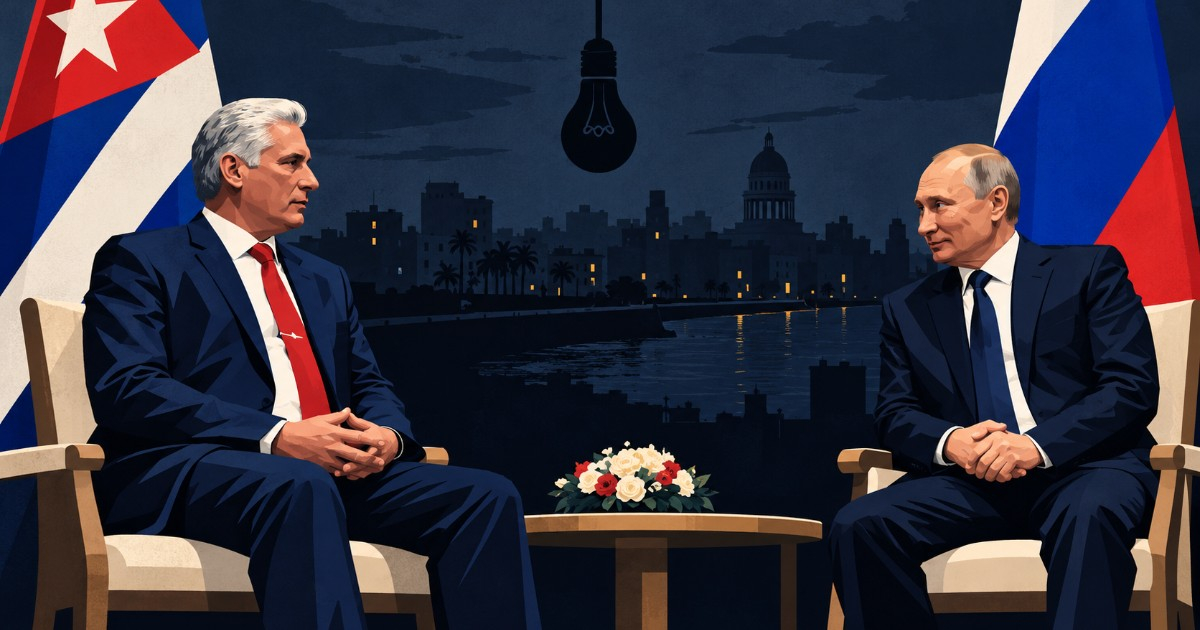
Even Russia's state-run media, traditionally a staunch supporter of Cuba's communist regime, acknowledges the severe challenges of daily life in Havana. An article published on October 6 by Rossiyskaya Gazeta outlines the grim reality: daily power outages lasting over 20 hours, trash accumulation, water shortages, and gasoline sold on the black market for nearly three dollars per liter.
The contradiction is stark: Vladimir Putin's official newspaper, a political and energy ally of Havana, paints a picture of a deteriorating capital that Cuban leader Miguel Díaz-Canel has repeatedly vowed to revitalize. Journalist Dmitri Kulemiakin aims to highlight the resilience of the Cuban people, yet concludes that the crisis is far from over.
Living in Darkness: Havana's Struggles with Electricity and Fuel
According to the Russian report, prolonged blackouts have become a routine, sometimes lasting over 20 hours. The fuel scarcity disrupts not only transportation but also garbage collection and other municipal services. Water supply issues and the health risks from uncollected garbage add to the woes.
While more cars are seen on the roads compared to spring, this does not signify a return to normal fuel availability. Informal markets sell gasoline for $2.5 to $2.8 per liter, a price point highlighted in the report, though not officially sanctioned or representative of the entire nation.
One entrepreneur interviewed shared concerns that U.S. sanctions might further limit this informal supply. This reflects the worries of those who rely on vehicles for work or transporting goods, as obtaining fuel through these channels means incurring high costs in an economy already burdened with low incomes and shortages.
The Impact on Small Businesses
Small enterprises are not immune to these challenges. The article describes cafes and restaurants that must rely on diesel generators or solar panels to remain operational. A business owner in Old Havana notes that power outages are less frequent in his area, highlighting disparities within the capital that affect the ability to weather the crisis.
Moscow's portrayal is corroborated by Cuban electrical reports. On October 8, Havana's Electric Company reported 91 circuits out of service and a 235-megawatt deficit due to insufficient generation, as documented by CiberCuba. Some circuits experienced over eight hours of interruptions, reflecting a snapshot of the ongoing struggle, not a constant daily figure.
Putin's Promises of Support Fall Short
Russia is deeply involved in this crisis, having strengthened its ties with Cuba through political, energy, and military cooperation while defending the regime in global forums. Yet, this strategic alliance has not prevented ongoing extreme power cuts and a lack of basic services.
On March 31, the Russian tanker Anatoly Kolodkin delivered approximately 100,000 tons of crude oil to Matanzas, equating to around 730,000 barrels. This shipment was processed into gasoline, diesel, and other derivatives; however, Díaz-Canel admitted in April it only covered about ten days of fuel needs. This relief was temporary and not a long-term solution.
Politically, the alignment remains strong. On October 7, a day after the Russian report, Díaz-Canel publicly congratulated Putin on his 74th birthday. Despite the show of friendship, Cubans continue to find ways to cook, transport water, preserve food, and keep their businesses running.
The Castro Legacy: A Systemic Failure
Blaming external "restrictions," a common narrative in Havana and Moscow, avoids addressing the core issue: the political and economic system established by Fidel Castro in 1959, maintained by Raúl Castro, and now managed by Miguel Díaz-Canel. While trade and financial constraints have impacts, they do not fully explain the deteriorated power plants, lack of sufficient investment and maintenance, government inefficiency, and failure to provide basic services.
For decades, the Castro family controlled political power and military structures that also played a pivotal role in the economy. GAESA, the military-linked conglomerate, expanded under Raúl Castro's leadership and was managed by his son-in-law, Luis Alberto Rodríguez López-Calleja. The concentration of strategic economic activities in military hands and the lack of transparency raise inevitable questions: how can these priorities be justified when the state fails to ensure electricity, water, or garbage collection?
The Rossiyskaya Gazeta article is not an opposition denunciation nor an exercise of independent journalism from Russian power. Precisely for this reason, it is revealing. Even an official media outlet from a nation that diplomatically shields the Cuban regime depicts Havana plagued by prolonged outages, black market gasoline, and overwhelmed municipal services.
While the regime might continue to receive congratulations, oil, and political backing from Moscow, it cannot demonstrate, after more than six decades of Castro rule and its successors, a system capable of reliably meeting its citizens' basic needs. That is the undeniable reality that even the official newspaper of its ally cannot conceal.
Understanding Cuba's Energy and Economic Crisis
What factors contribute to Cuba's prolonged power outages?
Cuba's power outages are primarily due to deteriorating infrastructure, insufficient investments in power plants, and an inefficient state-run system. External factors like U.S. sanctions also play a role but are not the sole cause.
How does the fuel scarcity affect daily life in Havana?
Fuel shortages disrupt transportation, garbage collection, and other municipal services. This scarcity forces residents and businesses to rely on expensive black market fuel, adding financial strain in an already struggling economy.
What is the role of GAESA in Cuba's economy?
GAESA is a conglomerate linked to the Cuban military, controlling significant sectors of the economy. Its expansion under Raúl Castro's leadership highlights the military's influence over strategic economic activities, often prioritizing military interests over public needs.