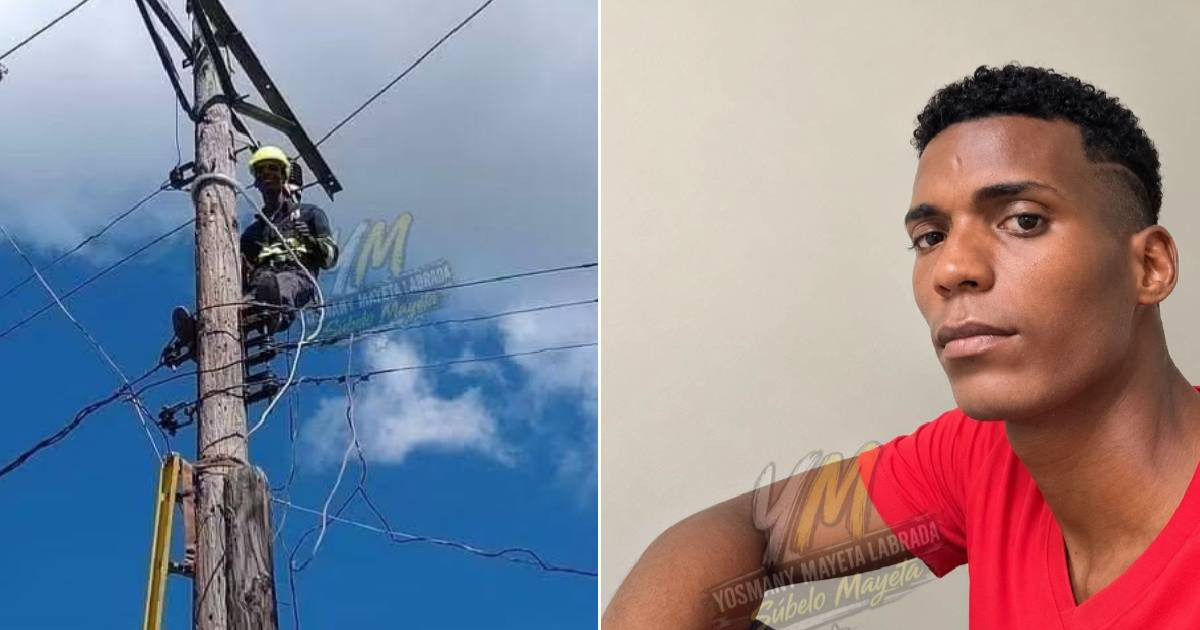
A relative of David Enrique Perdomo Álvarez, an employee of the Santiago de Cuba Electric Company who lost his right hand after a knife assault, has publicly exposed the bureaucratic obstacles he faces in obtaining the 113,458.96 Cuban pesos awarded as compensation by the court.
This revelation was made public on Friday by independent journalist Yosmany Mayeta Labrada via his Facebook profile. The relative, wishing to remain anonymous, provided the details of the situation.
The Violent Attack and Its Aftermath
The incident traces back to January 2024 when David Enrique was attacked by members of the notorious gang known as Banda 59 in the Abel Santamaría neighborhood, colloquially referred to as El Sala'o, in Santiago de Cuba.
Over five assailants attacked him around 5:40 in the morning, robbing him of his wallet and causing severe injuries, including the amputation of his right hand and wounds to his clavicle.
Legal Proceedings and Compensation Challenges
The judicial process culminated in Case No. 108 of 2025 at the Santiago Provincial People's Court, where five individuals were charged, facing sentences ranging from 11 to 22 years for various offenses related to the attack.
Now, over two years since the attack, the relative recounted how David Enrique approached the court, secured the necessary paperwork, and then presented himself at the Ministry of Justice's Compensation Office.
There, he was issued a new document and instructed to check back in three months to assess the likelihood of receiving payment.
The presentation document, dated September 28, 2026, officially acknowledged the 113,458.96 Cuban pesos as compensation, albeit subject to a 10% deduction as per Article 24.1 of Decree Law 86/24 of the Compensation Office.
Additionally, the document warned that if the payment is not claimed within 180 days, the right to it expires, and the amount reverts to the Compensation Office's funds, according to Article 27 of the same decree law.
The Bureaucratic Quagmire
The core issue lies in Article 6 of Decree Law 1258.51, which stipulates that "the amounts for civil liability can be collected by the victim when the convicted party pays the debt, either in full or in part."
In practice, this means David Enrique cannot access his compensation until his attackers meet their financial obligations, a scenario contingent entirely on the aggressors' willingness or financial capability.
Meanwhile, David Enrique continues to work at the Electric Company as a technician on the night shift for the UEB Redes Santiago, performing his duties despite the permanent physical limitation of having lost his right hand, according to the source.
Other Cases of Institutional Neglect
His case is not isolated; it highlights a broader issue of institutional neglect towards severely injured workers in the electrical sector. Osmani Hernández, a former lineman from Havana who lost both arms in September 2025, reported that the company failed to fulfill promises of support almost a year after the accident.
When asked about David Enrique's life post-aggression, his relative shared the affected individual's own words: "Terrible. Initially, everyone offers help and shows concern, but over time, I've been the only one who remembers I had a hand."
The looming question is how much longer must a worker who has lost a limb wait to receive court-recognized compensation, and will the aggressors ever settle the debt that this payment hinges on?
Bureaucratic Challenges in Compensation for Injured Workers
What are the bureaucratic challenges faced by injured workers in Cuba?
Injured workers in Cuba, like David Enrique, face significant bureaucratic obstacles in obtaining compensation. These challenges include delays, complex legal requirements, and dependency on the aggressors' financial capability to settle debts, as mandated by specific decrees.
Why can't David Enrique access his compensation?
David Enrique is unable to access his compensation because, according to Decree Law 1258.51, the payment can only be collected when the convicted attackers pay their debts. This dependency creates a significant delay and uncertainty in receiving the compensation.