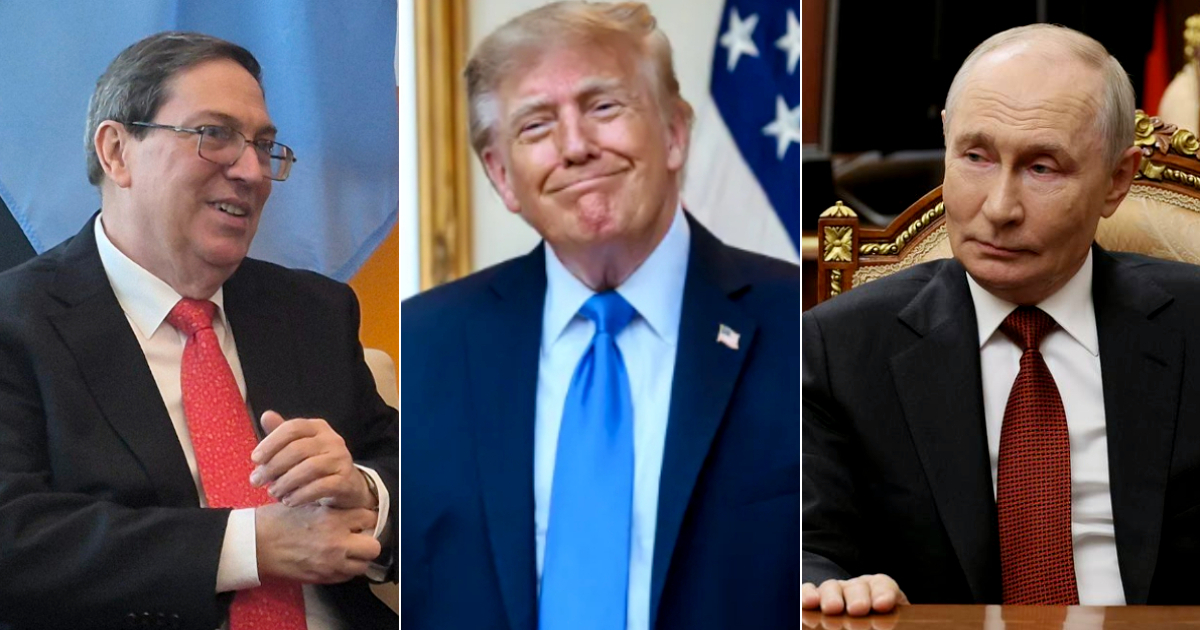
Cuban Foreign Minister Bruno Rodríguez Parrilla took a swipe at the Trump administration this past Saturday, lambasting their attempt to replace the term "artificial intelligence" with "superintelligence."
While his message was filled with accusations against Washington, he failed to mention the newly announced agreement between Donald Trump and Vladimir Putin to trade millions of tons of Russian diesel fuel.
This omission is stark against Rodríguez's frequent praise for Moscow: the ally that Havana showcases as a bulwark against U.S. pressure has just struck a deal with the American president whom Rodríguez accuses of aggression and coercion.
"For the U.S. government, military aggression, seizing foreign territories and resources, extrajudicial assassinations at sea, energy and naval blockades, punishing entire populations while threatening the rest of the world, and whimsically renaming geographic locations aren't enough. Now, they attempt to impose a new technical term on #ArtificialIntelligence through threats and blackmail, aiming for a legacy marked by barbarism, ignorance, and chaos," the Foreign Minister wrote on X.
Rodríguez criticized the executive order signed by Trump on September 29 to replace "artificial intelligence" with "superintelligence" in federal communications. The president had advocated for this terminology at the UN on September 22, warning on October 8 that the White House would consider anyone using the previous term an "enemy."
This threat provides a clear point of critique. What's revealing is that Rodríguez included a list of grievances against Washington without addressing the energy deal struck on Friday between Trump and the Cuban regime's key political ally.
Russia Negotiates with Havana's Adversary
The deal announced by Trump includes the immediate supply of over 300,000 tons of diesel, an additional 500,000 tons in November, and a million more shortly thereafter. An extra three million could follow, dependent on the condition of Russian refineries. The diesel is intended for both U.S. and international markets.
The Treasury Department issued General License 135 to temporarily authorize certain transactions involving the sale, delivery, unloading, and import of Russian diesel, including its entry into the United States, until April 7, 2027. This authorization does not broadly lift sanctions against Russia.
This agreement introduces an awkward element to the narrative maintained by Rodríguez: Moscow as a fraternal ally and Washington as an aggressive power. Though Russia can maintain its ties with Cuba and negotiate with the United States, this independence of interests is absent from Rodríguez's narrative.
The Brotherhood Bruno Celebrates
In February, Putin hosted Rodríguez at the Kremlin, promising that Russia would "always" support Cuba against U.S. sanctions. The Foreign Minister then described the bilateral ties as "historic, fraternal, special, and strategic."
In April, Rodríguez publicly thanked Moscow for a petroleum shipment during a meeting in Havana with Russian Deputy Foreign Minister Serguéi Riabkov. By September, Rodríguez and Foreign Minister Serguéi Lavrov met in New York, reaffirming the "excellent state" of strategic relations.
Miguel Díaz-Canel also extended birthday wishes to Putin on his 74th birthday, amid Cuba's severe energy crisis.
Rodríguez can criticize Trump's verbal excesses without questioning Moscow. The recent oil agreement demands a more nuanced response: explaining how the ally touted as Cuba's defender can supply fuel to the nation whose government is accused of imposing energy blockades.
His message avoids this tension, reserving criticism for Washington while leaving the Kremlin's decision untouched.
Key Questions about Cuba-Russia-U.S. Relations
Why did Bruno Rodríguez criticize Trump?
Bruno Rodríguez criticized Trump for attempting to replace the term "artificial intelligence" with "superintelligence," viewing it as another instance of U.S. aggression and political manipulation.
What was the agreement between Trump and Putin about?
The agreement involved the trade of millions of tons of Russian diesel fuel, intended for U.S. and international markets, as part of a broader energy deal.
How does the Russia-U.S. deal affect Cuba?
The deal complicates Cuba's narrative of Russia as a steadfast ally against U.S. aggression, highlighting Moscow's willingness to negotiate with both sides.